The Historical Identity and Contributions of India's Scheduled Caste Communities
The question of the communities known today as Scheduled Castes or so-called Dalits in India is not merely a question of social discrimination. It is also a serious question connected with history, civilization, identity, culture, land, and existence.
From anthropological, sociological, and ethnological perspectives, it is not enough to understand the current state of these communities solely as a result of poverty, backwardness, or social exclusion. It is also necessary to study their past, community oral traditions, oral history, cultural continuity, and civilizational contributions equally.
From a humanistic, sociological, and ethnographic viewpoint, it is insufficient to understand the current condition of these communities merely as a result of poverty, backwardness, or social exclusion. It is equally necessary to study their past, community oral traditions, oral history, cultural continuity, and civilizational contributions.
The process of victors writing history and the experiences of the defeated or marginalized communities being pushed to the margins of history is a universal problem. The history of the Shilpi communities of Nepal and India has also largely gone through a similar situation. The community has long been raising questions to the state about the possibilities of such occurrences.
According to the alternative historical perspective alive within the community, many indigenous communities known today as Scheduled Castes or so-called Dalits are the successors of the ancient indigenous groups of the Indian subcontinent. They understand themselves as belonging to non-Aryan Dravidian, Naga, and some Kirat mixed ethnic communities.
This perspective claims that these communities played a significant role in the construction of the Indus Valley Civilization, metallurgy, crafts, construction, and production systems. However, such claims are subjects for further research. But the strong presence of these in the collective memory of the community cannot be denied.
Various historical facts, records, geographical evidence, and the community's understanding indicate that with the arrival of external groups in the Indian subcontinent, the balance of power changed significantly. Initially, discrimination based on caste, color, or cultural differences gradually transformed into discrimination based on labor, laborers, and caste.
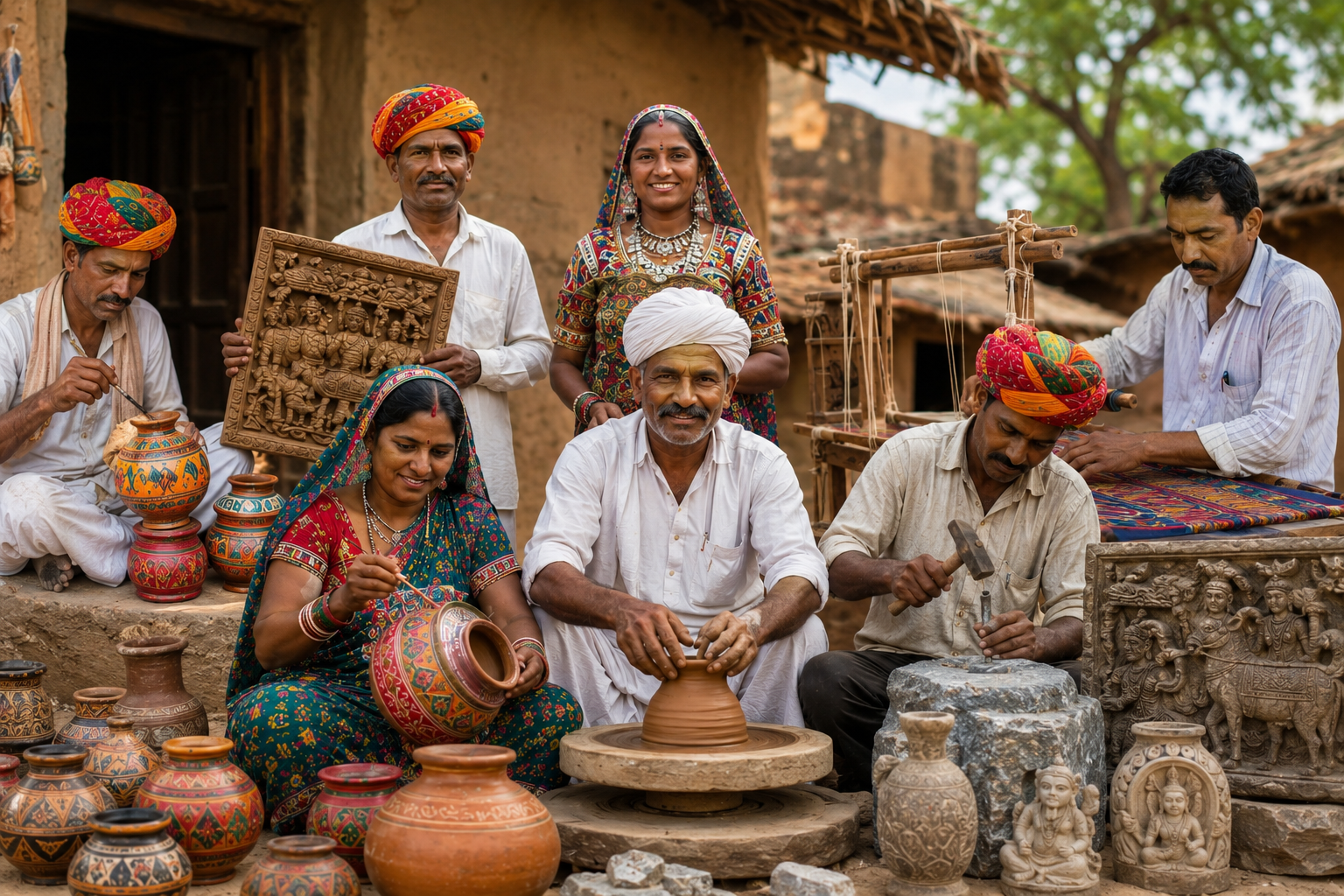
As a result, communities associated with production, construction, metallurgy, leatherwork, musical instrument making, and other life-sustaining skills were gradually marginalized socially. The community claims that it is through this process that the Shudra, Untouchable, and ultimately the so-called Dalit, who are insulted and despised, came to be known.
From this perspective, today's Dalit identity is not their ancient ancestral identity. Rather, it is the result of political, religious, and social power relations developed over a long period of history.
If history is viewed only as the history of power and royalty, the contributions of the historical working communities that built society become invisible. However, the role of crafts, labor, and production is central to the construction of civilization.
The construction of any civilization is impossible without the genetic knowledge system of communities involved in mining various minerals and metals, constructing buildings, making agricultural tools, smelting metals, making musical instruments, and producing textiles and leather goods. The irony is that the very hands that built civilizations have disappeared from the pages of history. But the names of the rulers have been preserved in history.
Historical oral traditions, folklore, and geographical facts prevalent within the community speak of the ancient presence and political role of communities like Mahar, Chanwar, Sambar, Chaumbar, Pasi, Dusadh, and Dom in India. Alternative interpretations within the community link Maharashtra to the ancestral land of the Mahar community, Saurashtra to the Chamar or Sarki community, Lucknow to Emperor Lakhan Pasi, and the tradition of minting metal coins to the Lohar (Luwar) dynasty.
Such narratives can be subjects of academic research. They are also an important part of the historical consciousness of the community. For the community, these are not just stories, but concrete bases, ancestral footprints, and clues for searching their lost history.
In the context of Nepal, such memories are also found in abundance. In the Terai region, King Sahalesh (Dusadh/Paswan) ruled with Maisothagadh (present-day Siraha) as his center between the 7th and 13th centuries. He is revered by both the people of the Terai and the land's indigenous people.
In the Terai, the Dom community's Chhath festival cannot be completed without weaving baskets from bamboo strips. Similarly, the Musahar community is considered to have specialized knowledge of traditional herbal medicine.
Likewise, the tales of the rule of the Dom and Chamar dynasties in Mithila are still alive in the community. Italian Capuchin priest Cassiano, who visited Nepal several times between 1739-1754 AD, mentioned the walls of Simraungadh in his report. According to him, the labyrinthine structure of Simraungadh (via Charmanagar, Chimanagar) was located in the Bhaktapur Durbar area, which he published in an Italian magazine (Bahubhashik Sayapatri, Year-4, 2055 BS: 149). According to Dr. Nawal Byogi, the Scheduled Castes of India and the indigenous Shilpi communities of Nepal are primarily descendants of the Dravidian and Nagpal dynasties. History shows that Sarki kings were the first to introduce currency in society by minting leather coins.
Especially the Shilpi communities of the Terai, Far-West, Karnali, and Bheri regions consider themselves the developers of the ancient craft (human) civilization of that geography. They also associate the naming of Karnali and Bheri, civilizational development, and land and cultural development with these communities. Their argument is that before the large-scale arrival of Khas and Bahun people, these indigenous Shilpi communities had a long reign, political, and cultural presence in the Terai, Far-West, Karnali, and Bheri regions.
This fact is proven by the various forts, palaces, and fortresses in the ancestral lands of the Terai, Far-West, and Karnali, Bheri regions.
The place names in those regions are considered significant geographical evidence. For example, places like Luharkot in Kalikot, Sunar Gaun in Jumla, Sunikot, Dumrakot, Sunigad, Khandachakra in Bajhang, etc., remain as historical symbols in the community's memory even today. The community questions: If these communities were always marginalized, why were so many forts, palaces, and geographical areas named after them? Why are there historical sites with 3 to 4 community names found in various districts?
According to locals, Shanti and Devraj Luhar, among others, ruled in Luharkot, Kalikot. Khandachakra is explained in connection with the tradition of Lohar kings rotating it in a circular motion during special occasions. Similarly, Purna Prakash Nepal Yatri mentions in his book 'Historical Outline of Jumla' that Suvarnanagar (Sunar) in Jumla is related to King Deshdev, and Sunikot in Bajhang is related to Kalu Sunel (Sunar), as mentioned by Dr. Suryamani Adhikari in the history of the Baisi states.
Bhyalkot and Sunarkot (Sarki and Sunar), Mugu, Bhulkot (Sarki/Bhul), Baglung/Bajhang, Dum or Domrajakot (Dom, Dum), Surkhet and Doti (Udumburipuri), Tiruwa Kot, Ruchal Kot and Samudrapal Gadhi (Kami and Sarki), Humla, Purkot (Sarki), located in Tanahun.
K.P. Sankhwar, in his book 'A Researched History of Shudras or the True History of India,' mentions that kings of the Chamar (Sarki) dynasty ruled for a long time. According to him, Chamar/Sarki King Sarangdev (Sarkidev) ruled from North India to Sarangkot and Kaski in Nepal around the eleventh century.
Similarly, Darnakot and Badikot (Damai and Badi), Achham, Pyuthan, Kumalikot and Gandharvakot (Badi and Gandharva), Doti and Baglung (Gal Kot). Especially in the Terai, Central Nepal, Far-West, Karnali, and Bheri regions, these communities appear to have been centers of political rule and governance.
This history of the importance of historical state power, royal evidence, centers of governance and administrative existence, dominance and mining, ancient settlements, defensive strategic forts, art and culture, and centers of artistic and musical conduits remains obscure. There is a saying in Bajhang, 'Of all the forts, Dumrakot is the eldest; of all the Mashts, Dhandhar Masht is the eldest.' This is considered an expression of the community's primality, ancient presence, and cultural memory.
Another important question for the community relates to the writing of history. They believe that the history of the craft (human) civilization of the Far-West, Karnali, Bheri, and Terai regions has not been adequately researched. Instead, a short period of royal heritage has been established as civilization.
Whereas the history of the long-standing indigenous communities has been overshadowed. Purna Prakash Nepal Yatri, in his book 'Historical Outline of Sinja,' mentions that 'Khas civilization' can be spoken of based on a reign of about three hundred years. However, questions arise within the community: If a community had a strong presence or rule for centuries, why was it not studied?
Historian Dr. Surendra KC discusses the entry of Khas groups through Kumaon, Garhwal, and Achham in the fifth and sixth centuries. The alternative perspective prevalent within the community argues that after this process, the indigenous Shilpi communities were gradually politically displaced. According to them, as a result of this displacement, the Shilpi communities migrated to Eastern Nepal, Darjeeling, Sikkim, Assam, and Bhutan, extending through Gandaki, Lumbini, Bagmati, and Koshi. Along with the question of existence, the question of cultural ownership is equally important.
Debates over ownership and identity are intensifying regarding dances like Dahama, Dholki, Hudke, Chhaliya, Panchai Baja, metallurgy, musical instrument making, and various craft traditions. Any caste or community's culture can be used and shared by everyone.
However, displacing the original creators and carriers of that culture, erasing their identity, and claiming credit is cultural appropriation and genocide. According to UNESCO, the concept 'Whose culture, their first right' provides this moral basis and spirit.
Today, another debate is related to the definition of indigeneity. The United Nations has proposed some international criteria for indigenous identity. However, some thinkers among the indigenous Shilpi communities argue that in the South Asian context, ancient craft-knowledge, historical connection with water, land, and forests, contribution to civilization building, continuity as indigenous people, and cultural memory should also be taken as important bases. According to them, the assumption that all indigenous communities were always only ruled might not align with the complex historical reality of South Asia.
In this context, the debate of caste and class is also important. Karl Marx primarily analyzed society based on class relations. However, in South Asian society, caste discrimination has profoundly affected the distribution of economic, social, and political opportunities. For this reason, the world-renowned Buddha and the epoch-making Dr. Bhimrao Ambedkar gave special importance to caste discrimination in the fundamental structure of social injustice.
From this perspective, the social reality of South Asia cannot be understood solely from a class angle. The fundamental structure of social injustice gave special importance to caste discrimination. Therefore, the social reality of caste, history, and identity in South Asia cannot be understood solely from a class perspective.
However, the community's biggest challenge does not come only from external oppression. Indifference towards their own history, failure to document oral traditions, lack of study of place names, neglect of archaeological potential, weakness in the conservation of cultural heritage, and a mentality of self-deprecation have caused great damage.
In addition, the lack of deep research, lack of unity, cooperation, collaboration, and collective spirit within the community, and the transfer of historical consciousness to the new generation have not yet been systematically organized. It is said, 'History is not only erased by others; sometimes, it is lost by being forgotten by successors.'
Therefore, the need today is not just an emotional repetition of a glorious past. The need is for research. History needs to be read in a new way by connecting today's facts, evidence, archaeology, oral history, geography, and cultural memory.
If Luharkot in Kalikot, Sunar Gaun in Jumla, Sunikot in Bajhang, Dumrakot, Sunigad, and countless historical sites in Karnali, Bheri, and Terai are systematically studied, there is still potential for tourism promotion and the uncovering of new facts.
Conclusion:
The question of the indigenous Shilpi communities is ultimately not just a question of the past; it is also a question of the present and the future. If a community's history, culture, craft-knowledge, land, and collective memory gradually disappear, its self-confidence, self-respect, and the foundation for building the future also weaken.
The need today is not to prove any community superior or inferior to others. The need is for the voices that have been pushed to the margins of history to be heard. Impartial research is necessary on the oral history, place names, cultural memory, craft-knowledge, and civilizational contributions of the indigenous Shilpi communities. If the community's claims have historical substance, they should be made public.
If there are misconceptions, scientific research should clarify them. However, denying history without research is not in favor of knowledge. At the same time, the concerned community also needs to introspect. The responsibility of preserving their cultural heritage, documenting oral histories, transferring historical consciousness to the new generation, and encouraging research lies with the community itself. The future cannot be built solely on the memory of suffering; only knowledge, organization, research, and cultural renaissance can build the future.
Hudke, Chhaliya dance, Panchai Baja, metallurgy, musical instrument making, leatherwork, and indigenous knowledge systems are not just cultural heritage. They are living expressions of the community's collective soul, memory, and identity. Without their proper conservation, protection, development, and intergenerational transfer, the long-term existence, history, and identity of the community cannot be secured.
Ultimately, the question remains the same today: when will the community, which has been alienated from its own history, return to find its own roots? When will it recognize the civilization, craft-knowledge, and cultural heritage built by its ancestors? Only by taking the path of re-reading history, cultural renaissance, self-respect, and educational awakening can the community regain its rightful place. After all, when will the collective consciousness, which has fallen into Kumbhakarna's sleep, awaken? The answer to this question also lies here.
Perhaps that day will come when the community begins to seek its own historical existence rather than the identity imposed by others. When it chooses self-respect over inferiority, when it connects emotion with research, memory with evidence, and pride with knowledge.
That day will mark the beginning of the true renaissance of the indigenous Shilpi communities. That day, the voices pushed to the margins of history will begin to be heard at the center of history. And, possibly, that day the communities entangled in the web of conspiracy until now will rediscover their true historical ground.
This specific news has been automatically translated by AI. As a result, there may be some inaccuracies or language errors.