Asymmetric Price Transmission: Nepal's Market Imbalance

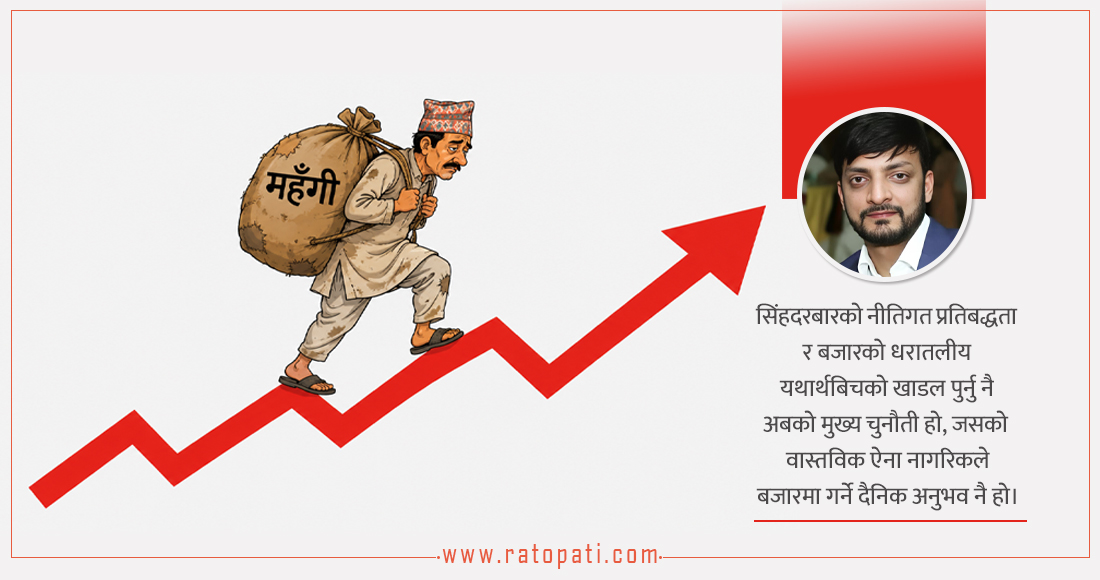
When the price of petroleum products increases in the international market, the speed and aggression with which prices are increased in the Nepali market is met with the exact opposite, a mysterious and irritating inertia, when the international market slows down and prices decrease. For example, on Asar 16, Nepal Oil Corporation reduced the price of petrol by Rs 20 per liter and diesel by Rs 30 per liter according to the automatic pricing system. A single drop of about 16 to 18 percent in diesel, considered the main lifeline of transportation and industrial production, means a sharp decrease in the cost of the country's overall supply chain.
Theoretically, such a significant drop in fuel prices should be reflected in direct relief in public transport fares, transportation services, retail prices of daily necessities (vegetables, food grains, milk, meat), and construction materials (cement, rebar) within 24 to 48 hours. However, the ugly reality of the Nepali market is that the market, which picks up rocket speed when prices rise, is not ready to descend even at a tortoise's pace when prices fall.
Consumers in Nepal often complain that businesses that cite the international market and future costs as reasons for price increases tend to evade responsibility when costs decrease by citing the constraint of old, expensive stock. While the initial difficulty of old inventory may seem natural for a short period, the market's failure to correct itself for a long time is considered a structural weakness. This not only imposes an additional financial burden on consumers but also weakens public trust in the state's regulatory presence.
- One-sided Price Increase and Crony Capitalism
In economics, this one-sided nature of pricing is also called asymmetric price transmission or, in common parlance, the 'rocket and feather effect'. This refers to the market's characteristic of prices rising rapidly like a rocket but descending slowly like a feather, or not descending at all. Although it is said that supply and demand determine prices in a free market economy, in an import-dependent country like Nepal, crony capitalism, which flourishes under political protection within a policy framework, is said to have completely displaced this principle with syndicates and cartels in public discourse.
This market trend is not limited to making kitchens expensive; it appears to be weakening the country's overall economy from within and creating a serious crisis in revenue as well.
Consumers generally feel that healthy competition is not possible in any sector, including transportation, production, or sales and distribution, due to the invisible syndicates of business organizations. A strong example of this is the price control practice seen in Nepal's EV (Electric Vehicle) market. Despite government tax concessions, it is heard that limited sellers have created multi-layered dealerships among themselves to artificially inflate prices. The general public understands that the large difference between the actual import cost of vehicles and their retail price hinders fair competition in the market.
EVs are just one representative example; there are many instances in the market where artificial price hikes are created under the guise of domestic assembly industries or through cartels in both production and sales. If the market were fully competitive, a decrease in fuel prices would reduce production costs, prompting a business to lower the price of goods to attract more customers, which others would have to follow. However, due to the strong practice of price-fixing through collusion, businesses appear unwilling to engage in healthy competition. As a result, even when fuel becomes cheaper or the state provides policy concessions, the benefits are not passed on to the general public but are allegedly converted into unnatural profits for a limited number of intermediaries and industrialists.
- Long-term Impact on the Economy
This market trend is not limited to making kitchens expensive; it appears to be weakening the country's overall economy from within and creating a serious crisis in revenue as well. Our financial system is currently going through a peculiar situation. While there is about 12 trillion rupees of idle investable funds in banks, and the weighted average interest rate on commercial bank loans has fallen to a historic low of 6.73 percent, there is no demand for credit in the market. The fact that the private sector is not borrowing and citizens are hoarding money in banks despite falling interest rates indicates that the economy is trapped in a liquidity trap, and this unnatural price increase in the market is one of its main links.
The first direct impact of this is reflected in the decline of citizens' real purchasing power. Artificial inflation keeps incomes stable but drastically increases expenses, leading to a situation where the public's earnings are exhausted in essential sectors like food, education, and health. Moreover, the information asymmetry between consumers and sellers is so deep that ordinary citizens are deprived of even knowing the extent to which they are being cheated.
As consumers' pockets become emptier, goods stop selling in the market, creating an environment of sharp contraction in overall demand. Due to the lack of demand, our manufacturing industries are forced to operate at only 30 to 40 percent of their full capacity, risking a decline in private sector morale and initiating a cycle of job cuts.
The market's current slowdown and unhealthy contraction in consumption could pose the biggest challenge to the government's ambitious revenue target of nearly 14.5 trillion for the upcoming fiscal year.
Since Nepal's economy relies mainly on a consumption-based revenue system, this slowdown poses a significant risk to national revenue. A large portion of our total revenue comes from import customs duties, value-added tax, and excise duties; therefore, as business transactions decrease, the state's income is likely to automatically reduce. The main reason why the government's collected revenue has barely been sufficient to cover even current expenditures in previous years is this contraction in consumption.
The market's current slowdown and unhealthy contraction in consumption could pose the biggest challenge to the government's ambitious revenue target of nearly 14.5 trillion for the upcoming fiscal year. Among the many factors affecting revenue collection, the 'weight' of this artificial inflation, which reduces consumer purchasing power and prevents the market from becoming dynamic, can be projected to be the highest. The unnatural profits in some trade levels affect the entire market cycle, potentially disrupting the balance of the state treasury. Therefore, while costs and supply-related crises at the international level are immediately passed through to the consumer level in our market structure, the benefit of cost reduction and concessions generated within the system does not easily reach the kitchen, indicating a one-sided tendency. This imbalance is the main reason why artificial inflation persists in the market and good governance is not concretely felt on the ground, despite policy changes.
- International Practices of Regulation and the Responsibility of the Two-Thirds Government
While Nepali consumers are continuously caught in the market's labyrinth, global practices show the necessity of a strong state presence to protect consumer interests. Developed and emerging economies worldwide never allow markets to become so unregulated; instead, they establish powerful and autonomous bodies to monitor monopolies and price-fixing collusion. In the United States and the European Union, the Federal Trade Commission and the Antitrust Division have the power to strictly monitor such malpractices and impose penalties on guilty companies equivalent to a certain percentage of their total turnover, and even imprison their directors.
Our neighboring country India's experience is also a strong example of the state's vigilance towards consumer interests. There, the Competition Commission of India imposed a historic fine of over 60 billion rupees on 11 major cement companies for colluding to increase prices in 2016. The Ministry of Consumer Affairs there transparently publishes the price index of 22 essential commodities daily through digital portals and media, preventing traders from arbitrarily setting prices.
While unstable governments in the past have cited a lack of sufficient political power to break syndicates, the current government has the legal and administrative capacity to fundamentally transform the market structure.
Compared to such strong international practices, Nepal has legal documents like the 'Consumer Protection Act, 2075 BS', but the implementation aspect appears disappointing. Although the act prohibits artificial price increases and grants the authority to impose immediate fines and file lawsuits, our regulatory bodies are heard to be limited to seasonal and media-oriented stunts like raiding a few retail stores during festivals.
The act grants the authority to prevent artificial price hikes and take immediate action, but our regulatory bodies are still not strong and organized enough. Due to a lack of technical capacity and independence to understand the entire market system and large traders, government monitoring is limited to small and retail shops.
This is where the role of the current stable and powerful two-thirds government in the country is put to the test. While unstable governments in the past have cited a lack of sufficient political power to break syndicates, the current government has the legal and administrative capacity to fundamentally transform the market structure. If this government also fails to break the unhealthy collusion in the market and ensure that the benefits of cost reduction are passed on to the public's kitchens through the price index, serious questions will inevitably arise about its governance legitimacy and political credibility. A strong government means not just making decisions in Singha Durbar's rooms, but also seeing its strong implementation in the market and the public feeling relief.
- Practical and Strategic Roadmap for Good Governance
To break the market's old inertia, traditional and superficial monitoring methods are no longer sufficient. It is imperative for the government, the private sector, and local levels to understand their respective responsibilities and immediately implement a practical and strategic roadmap.
This can start with immediate policy steps, such as establishing an automatic scientific system where transportation fares are automatically revised as soon as the prices of key cost-increasing components or raw materials decrease. The day Nepal Oil Corporation adjusts fuel prices, the technical mechanism of the Ministry of Physical Infrastructure and Transport should mandate the digital implementation of new transportation fares.
Along with this, by exercising the authority granted by the Local Government Operation Act, 2074 BS, the market monitoring committee chaired by the deputy mayor or deputy chairperson of each municipality can be activated daily. Legal provisions limiting the layers of middlemen from producer to consumer to a maximum of two layers in the supply chain will create an environment where farmers receive fair prices and consumers also get relief. Along with this reform, it is necessary to have strict administrative determination to revive provisions of the 'Black Market Act, 2032 BS' and the 'Consumer Protection Act, 2075 BS' and revoke the business licenses of large traders and organizations that create artificial inflation or do not reduce prices through collusion even when costs decrease.
This trend of prices not falling even when the main reasons for increasing costs are removed is not just a minor anomaly; it is depleting consumer purchasing power and seriously impacting overall demand and national revenue.
For a medium-term solution to this problem, the use of technology and institutional transparency is the second important link. The government can immediately build a central 'National Price and Cost Monitoring Dashboard' and integrate digital billing and VAT databases. By using artificial intelligence to automatically identify abnormal price fluctuations in the domestic market, the price chain from producer to consumer can be transparently tracked.
With the maximum retail prices of essential goods updated daily on a digital portal for districts and local levels, information asymmetry in the market will be automatically eliminated. Within this, a legal provision mandating cost and price audits for large manufacturing industries (cement, iron, packaged food) can be another strong link. Auditing the actual production costs of industries and the impact of falling fuel or raw material prices with the help of expert chartered accountants will help prevent unnatural profiteering.
To eradicate market cartels and non-competitive behavior structurally, the formation of a powerful, autonomous, and quasi-judicial competition and price regulation authority, rather than traditional bodies, has become relevant in Nepal. A strong structure like India's Competition Commission, capable, well-resourced, and above party politics, can alone ensure fair competition in the market. Such an institutional arrangement can permanently discourage the tendency of artificial price increases on the one hand and permanently guarantee consumer protection and macroeconomic stability on the other.
Therefore, this trend of prices not falling even when the main reasons for increasing costs are removed is not just a minor anomaly; it is depleting consumer purchasing power and seriously impacting overall demand and national revenue. Hence, developing a culture where prices fall in accordance with costs has become indispensable for fair competition and a sustainable economy.
For the current strong government, which has made good governance its main agenda, this is also a historic opportunity to uproot this unhealthy syndicate. Bridging the gap between policy commitments in Singha Durbar and the ground reality of the market is the main challenge ahead, the true mirror of which is the daily experience of citizens in the market. Ensuring that the real benefits of cost reduction reach the people's kitchens and pockets and proving the state's strong regulatory presence in the market will be the most practical test of good governance today.
This specific news has been automatically translated by AI. As a result, there may be some inaccuracies or language errors.

_Haqbgxersl.jpg)