Nepal's Judiciary Lags in Federalization, Local Courts Urgently Needed

_uwZqw7sHpf.jpg)
Nearly a decade after the promulgation of Nepal's constitution, the full federalization of state organs remains incomplete. While the executive and legislative branches operate at the center, provincial, and local levels, the structure of the judiciary has yet to fully transition to a federal model.
Article 127 and Schedule 8, Clause 12 of the constitution envision the establishment of 'local courts,' 'mediation centers,' and 'arbitration' at the local level. Currently, 'judicial committees' led by deputy mayors or vice-chairpersons are active in local units.
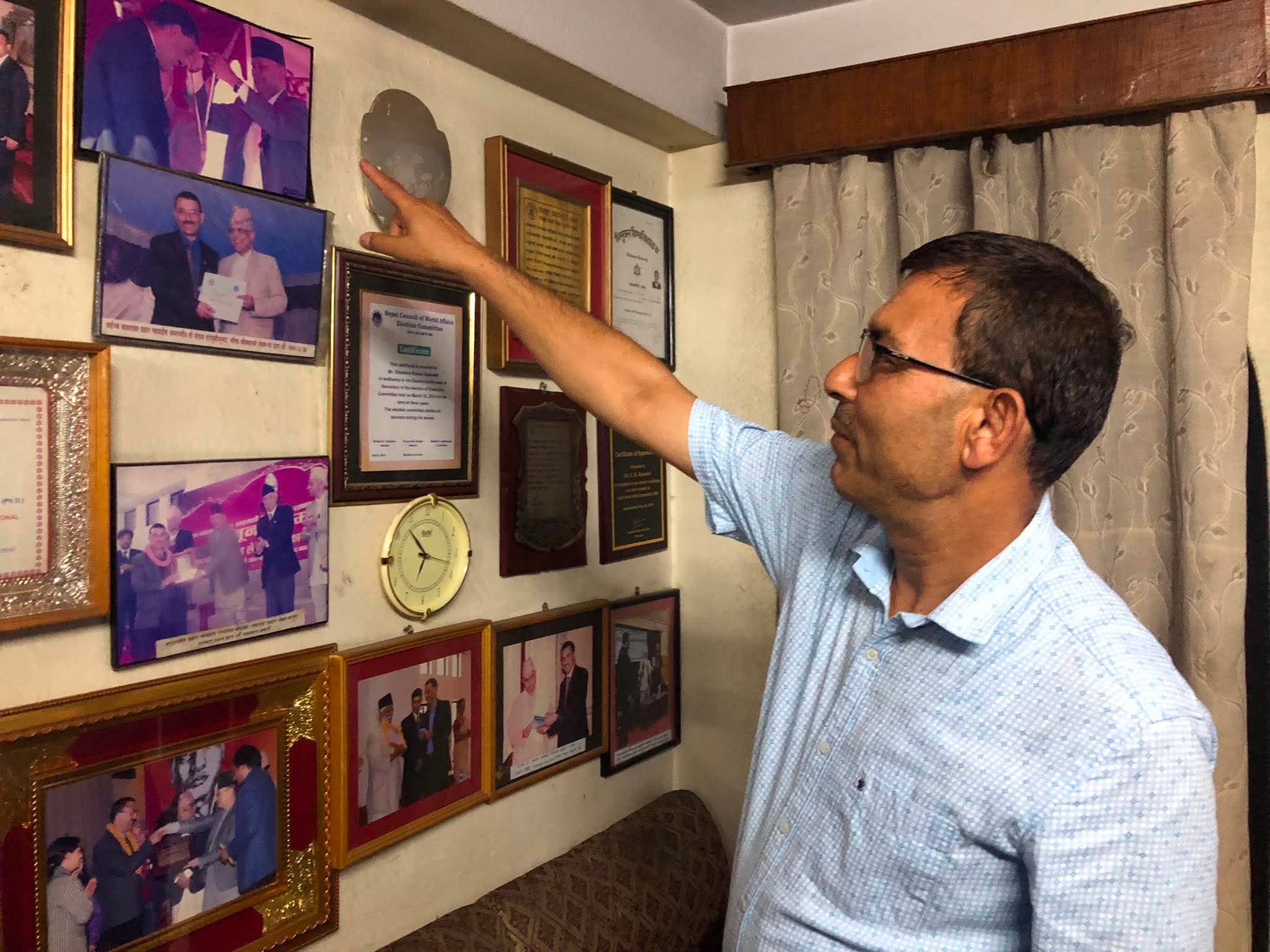
However, these committees are merely 'quasi-judicial' in nature, with a significantly limited jurisdiction. Bound to focus only on minor disputes and mediation, citizens are compelled to approach district and high courts even for trivial cases, making justice costly and slow. In this context, we present an edited excerpt of a conversation with senior advocate Dr. Chandrakant Gyawali.
- Where did the debate on establishing local courts in Nepal begin? What is its main constitutional basis?
The need for establishing local courts in Nepal and their basis were extensively discussed during the Constituent Assembly tenure. When the country decided to adopt executive federalism and parliamentary federalism, the question arose: why should only the judiciary remain unitary or centralized? The conclusion from eight years of clause-by-clause discussions by two Constituent Assemblies was 'easy access to justice for the people.'
_nVaKXFG4ot.jpg)
The primary point is that if the country's executive and legislature are to be federalized, the judiciary must also adopt a federal judicial system. In a democracy, governments at three levels have their own rights, and parliaments at all three levels legislate under those rights.
Since these laws are directly linked to the rights and entitlements of the people, the fundamental basis is that people should not have to travel far to seek justice when their rights are violated. This concept emerged by embracing the universal principle that in federalism, access to justice must reach the doorstep of the people.
- What fundamental difference do you observe in justice delivery between the old centralized system and the current federal system?
The state system of the past was unitary and centralized, hence the courts were also under central control and centralized in nature. The judicial structure did not reach the local level. But now, we are in a federal system. Federalism means not just the division of powers, but also the guarantee of protection and remedy for those powers. The fundamental and constitutional rights of the people reaching their doorstep is not enough; there must also be a nearby body to seek remedy if those rights are violated. Justice should not be confined to the center or districts; there must be a strong judicial system at the provincial and local levels as well.
Yesterday's federalism should ensure an environment where citizens from remote areas, for whom reaching the district court took many days, can get justice in their own villages today. Therefore, the main difference between yesterday's centralized justice and today's federal justice should be 'geographical and economic accessibility.'
- It seems our constitution does not explicitly address local courts. What is your argument on this?
Although the constitution may not immediately 'address' the establishment of separate courts in bold letters, Article 127 and Schedule 8, Clause 12 provide strong indications and authority. Article 127 mentions providing justice through 'alternative dispute resolution' and 'judicial bodies.' Here, 'alternative' refers to mediation and conciliation, while 'judicial body' envisions obtaining full justice through courts.
Article 127 empowers the establishment of judicial bodies at the local level. Similarly, Schedule 8, Clause 12, within the exclusive rights list of all 753 local units, provides for the establishment of local courts, arbitration courts, and mediation centers. This means the constitution has granted local levels full authority in justice delivery.
However, the implementation faces complexities because we interpret it with a unitary mindset. Bringing justice to the doorstep of the people is the essence of this constitutional provision.
- Judicial committees are active at the local level now. What is the difference between a local court and a judicial committee? Why is a court needed?
This is a very important question. Many people mistakenly equate judicial committees with local courts, which is incorrect. A judicial committee is only a 'quasi-judicial' body, not a full 'judicial' body. According to Section 47 of the Local Government Operations Act, it can only handle mediation and 13 types of minor disputes. It cannot adjudicate constitutional questions, interpret fundamental rights, or decide on serious legal matters.
We have implemented local governments and local legislatures (assemblies), but we have hesitated to establish local courts. Having only judicial committees is incomplete federalism. In a federal system, the local court is where people can seek remedy for disputes arising from the implementation of laws made by the local assembly and for violations of rights. Questions also arise about the impartiality of justice rendered by judicial committees, as political individuals are involved. However, a local court, with legal practitioners or expert judges, guarantees impartial and full justice.
- How do you analyze the current judicial system? Is it fully federal?
Looking at the practices of 27 federal countries worldwide, they have two or three tiers of government, two or three tiers of parliament, and corresponding judicial systems. Nepal's Constitution, Article 127, also opens the door for four types of judicial systems. However, in practice, we are currently in a unified judicial system. It is neither fully centralized nor fully federal.
If the judiciary were to follow a federal structure, there should be a Supreme Court, provincial courts, and local courts. The current high courts could have been transformed or restructured into provincial courts, and district courts into local courts. However, the structure of our judiciary still retains a unitary character. The essence of federalism is to grant the authority to handle cases at the local level to local courts, with appeals to provincial courts.
- What hardships do ordinary people in remote areas face due to the absence of local courts?
In the current unified judicial system, people from remote villages in Humla, Jumla, Kanchanpur, or Taplejung must travel to district courts for justice, and if unsatisfied, they must come to the Supreme Court. Reaching the Supreme Court takes years, and the cost runs into lakhs.
This situation means that justice is not immediate, swift, or reliable. The compulsion to travel to Kathmandu even for minor disputes creates the impression that justice is 'only for the rich.'
If local courts were established, lawyers residing in villages could be appointed as judges, providing remedies right there. This would save the time and money of ordinary people in remote areas, and they would receive justice in their own language and context.
- What is your suggestion regarding the jurisdiction and working style of local courts?
Local governments have 22 constitutional areas of authority, under which local assemblies legislate. When these laws are violated or legal and constitutional questions arise, cases should be filed in local courts. Local courts should have various divisions, such as family divisions (inheritance, divorce), tax divisions, domestic violence, theft, robbery, assault, or small loan disputes.
This would resolve local disputes within the local government's own courts. Local courts should have the capacity to interpret laws enacted by the local assembly and provide full judicial remedies to victims, going beyond the current limited jurisdiction of judicial committees. This arrangement would genuinely strengthen citizens' access to justice.
- If local courts are established, what impact will it have on the overall structure of the judiciary and the workload of the Supreme Court?
This would be very positive. With the establishment of empowered local courts in all 753 local units, the current form of 77 district courts would become redundant. Most cases would go to local courts, and appeals would go to 'provincial courts.' This would drastically reduce the backlog of approximately 27-28 thousand cases in the Supreme Court.
Only cases involving serious constitutional questions and complex legal issues would reach the Supreme Court. All other cases would be settled at the provincial and local levels. International practice also follows this model. This would help the Supreme Court focus on its primary role as the guardian of the constitution and the establisher of principles.
- Are there any legal or judicial initiatives currently underway for the establishment of local courts?
As the state has shown no interest in establishing local courts even after nearly 10 years since the constitution's promulgation, we have filed a writ petition in the Supreme Court to ensure the right to justice. This matter, demanding the establishment of local courts, is currently sub-judice in the Supreme Court. Fortunately, the Supreme Court has also ordered that it be heard with priority.
In accordance with the spirit of Articles 127, 148, and Schedule 8 of the constitution, this work should be done in coordination among the governments at all three levels. If the center creates umbrella legislation and local units implement it, it is not impossible. I am confident that this issue will soon reach a logical conclusion, and the Nepali people will be able to fully exercise their constitutional right to receive justice at their doorstep.
This specific news has been automatically translated by AI. As a result, there may be some inaccuracies or language errors.