Local Courts Unformed Despite Decade Since Constitution

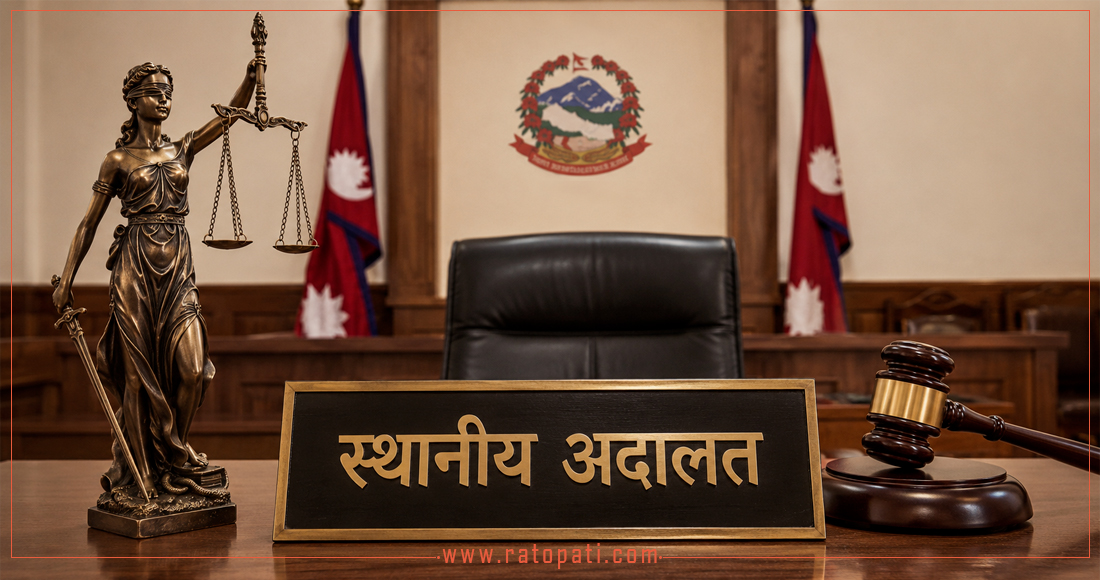
Kathmandu. A decade has passed since the constitution was promulgated. However, the local courts, which are mandated by the constitution, have not yet been formed. The constitution has provisioned for 'local courts' in the exclusive rights list of local levels, but local and provincial governments are unclear about their formation and necessity.
The issue of their formation has been raised, but the implementation of the constitutional provision has never progressed.
A 'judicial committee' led by the deputy mayor has been formed in all local levels, a provision also granted by Article 217 of the constitution. This judicial committee generally emphasizes mediation in local disputes, but it is repeatedly raised that it has not been able to provide complete justice. Questions are also frequently raised about the neutrality of justice dispensed by elected representatives.
There is a demand for the formation of such courts at the local level, to be under the district court, to resolve minor and local disputes.
Nepal's constitution specifies the concurrent and exclusive rights lists for three tiers of government. Accordingly, Schedule 8 of the constitution lists 22 items in the exclusive rights list of local levels, with 'local courts' mentioned at number 12.
_uwZqw7sHpf.jpg)
- Where is the process of forming local courts stuck?
Looking at the statistics of the last three years, domestic disputes are the most common at the local level. Following that are land disputes and other similar cases, which are increasing the workload of district courts. Some of these cases even escalate to the Supreme Court. The demand for the formation of local courts is growing due to the increased workload from cases that could be resolved early but are reaching higher courts.
However, ironically, a writ petition filed in the Supreme Court demanding the formation of local courts, despite being granted priority for over a year, has not yet been heard.
Advocate Santosh Kumar Mahato says it is ironic that local courts have not been formed even though the country has moved to a federal structure. He believes that the importance of local courts has increased due to the questions raised about the work of the judicial committees formed under the leadership of deputy mayors of local levels.
‘If local courts are formed, citizens will have the mindset that the court has delivered justice,’ Mahato says, ‘This will create an environment where citizens accept the impartiality of the court's orders.’
Another advocate, Kirtinath Sharma Poudel, who has been practicing at the Supreme Court for a long time, states that although the number of cases reaching from district to high and then to the Supreme Court is increasing, they are not being prioritized. He says that cases of public concern, serious constitutional questions, and those related to politics and government come to the Supreme Court, so cases of ordinary citizens receive less priority. ‘If such courts are formed at the local level, they will be resolved by the provincial courts, and the workload of the Supreme Court will also decrease,’ he explained the necessity.
Not only in the schedules of the constitution, but Article 148 also mentions that there will be 'local judicial bodies' according to provincial law, and such judicial bodies will be under the district court. That is, local courts formed according to provincial law will have to dispense justice under the district court. However, provinces and local levels have not discussed the formation of courts according to this article.
According to Section 47 of the Local Level Operations Act, 2074, local judicial committees have 13 types of rights. In addition, they have the authority to mediate in 11 more types of disputes. Provisions exist for judicial committees to mediate cases like defamation and divorce, which increase the burden on courts, but their effective implementation has not been achieved.
- Included in Lawyers' Manifesto
The umbrella organization of lawyers, the Nepal Bar Association, had also demanded the formation of local courts in a Kathmandu declaration two years ago. On Jestha 7, 2081, the Nepal Bar Association issued a 38-point Kathmandu Declaration.
The national conference of the Bar had put forward the agenda of forming local courts. Point 13 of the declaration states, ‘Limiting the role of judicial committees at the local level to mediation’, and ‘Forming local courts as per the provision mentioned in Schedule 8 of the constitution and sending cases that cannot be resolved through mediation to the local courts by the judicial committees.’
In that context, four lawyers have filed a writ petition in the Supreme Court, and preliminary hearings have already taken place. The Supreme Court has also sought responses from the government and concerned parties, who have been made respondents in the writ. However, although the Supreme Court has placed this case on priority for hearing, it does not appear to be moving towards a speedy resolution by placing it on its priority list.
Lawyers have initially demanded the formation of local courts and mediation in six metropolitan cities. Local levels state that local courts cannot be formed because the federal and provincial governments have not enacted laws.
It is mentioned that if local courts are formed, minor cases coming to other courts across the country will be resolved at the local level.
Local levels have the exclusive authority to manage local courts, mediation, and arbitration. Despite the constitutional provision, lawyers argue that local levels have not yet been able to work in a way that ensures access to justice at the doorstep of the people.
The writ petitioners hope that if mediation is managed at the local level, local commercial and trade disputes that can be settled through mediation according to law can be resolved, thereby establishing lasting peace in society.
- How many cases are in district and supreme courts?
The workload of district courts is overwhelming. Looking at the status of district courts over the past 10 fiscal years, in the fiscal year 2072/073, the number of pending cases was 39,251, with 79,758 new cases filed, making a total annual caseload of 119,009. Out of these, 74,212 cases were disposed of, leaving 44,797 cases pending at the end of the fiscal year.
In the fiscal year 2081/082, with 109,763 cases carried forward and 154,947 new cases filed, the total caseload became 264,710. Out of these, 164,171 cases were disposed of, leaving 100,539 pending.
The workload of district courts has increased by 122.42 percent over the interval of 10 fiscal years. The average number of cases carried forward over 10 years is 74,130.5, and the average number of new cases filed is 107967.1, making an average total caseload of 182,097.6, out of which an average of 101838.3 cases have been disposed of.
As these cases reach the Supreme Court via the high courts, a backlog of over 27,000 cases has accumulated in the Supreme Court.
Looking at the statistics of the last three years, although there has been a gradual improvement in the disposal rate, a large number of cases remain pending due to the burden of old pending cases and new filings.
- In which countries worldwide are there local courts?
Various countries around the world have provisions for 'local courts', 'community courts', or 'village courts'. These courts are generally established at the lower level to provide faster, more efficient, and less expensive justice to the general public.
In neighboring South Asian country India, there is a provision for 'Gram Nyayalayas'. Under the Gram Nyayalaya Act, 2008, these mobile courts operate at the village level, handling both civil and criminal minor cases.
Similarly, Bangladesh has a legal provision for 'Village Courts'. According to the Village Courts Act of 2006, such courts are formed in Union Councils to resolve minor disputes at the local level.
Likewise, in Bhutan, below the district courts, there are 'Dungkhag' courts that dispense justice at the local level. In Pakistan, 'subordinate' courts operate at the lower level, and in some areas, informal mechanisms like the traditional 'Jirga' are active.
In developed countries like Australia, various states have 'local courts'. These courts handle the initial hearings for most criminal and civil cases.
United States: In the US, there are local level (municipal courts), community courts, and small claims courts that handle everything from traffic violations to minor disputes.
In the UK, Magistrates' Courts are the backbone of the local judiciary. Over 90 percent of criminal cases are resolved here.
This specific news has been automatically translated by AI. As a result, there may be some inaccuracies or language errors.
_sucFhOEREN.png)