Young Nepali Man Earns Over NPR 2 Lakh Monthly from Dairy Farming After Returning from Saudi Arabia

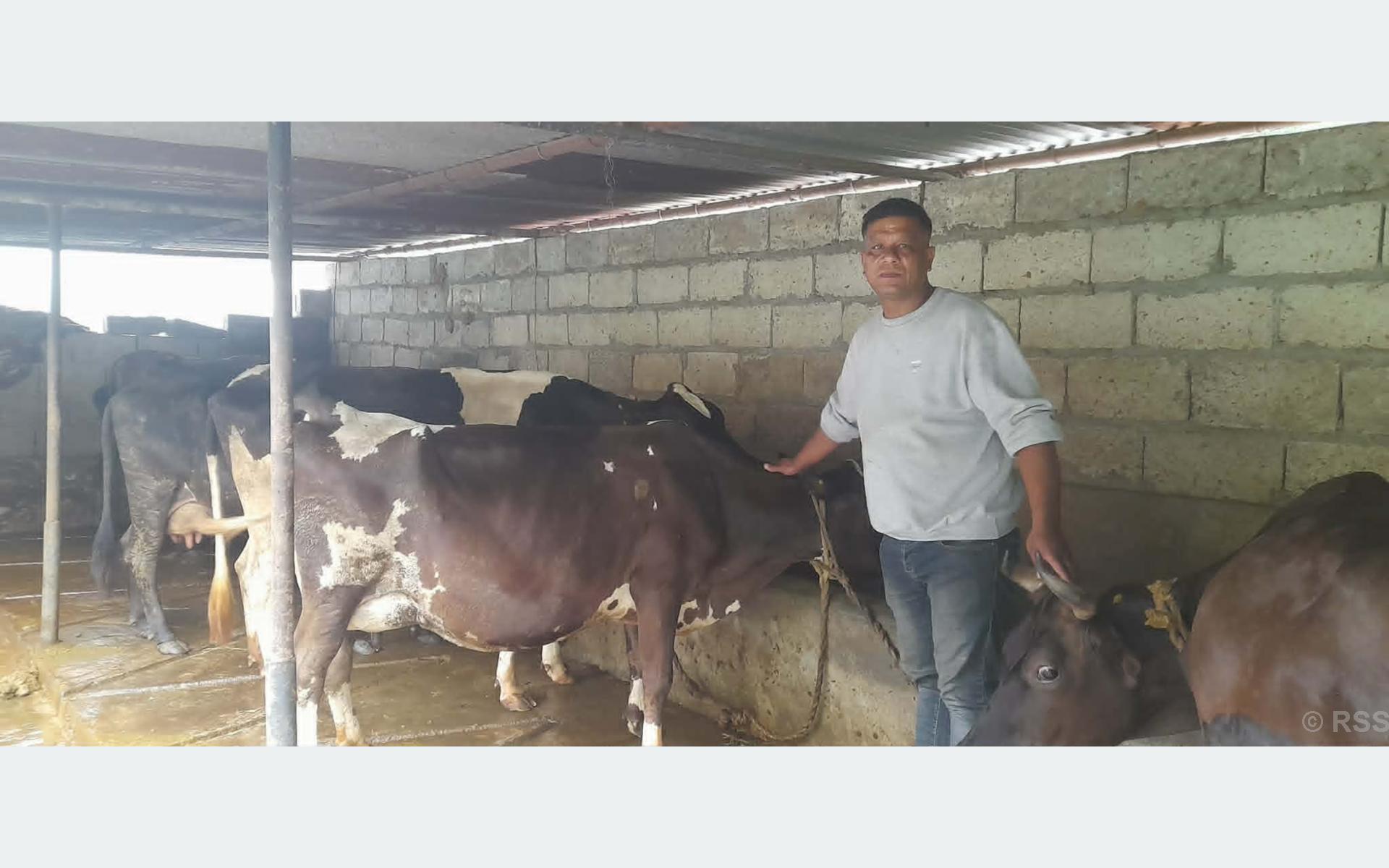
Parbat. Despite working in the Gulf country Saudi Arabia for eight years for employment, a young man from Parbat, unable to earn as expected, has returned home and started commercial dairy farming, earning more than NPR 2 lakh per month. Narayan GC, 45, from Farse, Jaljala Rural Municipality-8, Parbat, has succeeded in earning more than NPR 2 lakh per month by staying in his own country.
GC, who has been involved in commercial dairy farming for the past 13 years, has 12 cows and one buffalo in his shed. He informed that he produces 75 to 80 liters of milk daily and sells it in the market. "After starting dairy farming, I worked in Saudi Arabia for eight years, but since the earnings were not as good as at home, I returned and expanded the business," he said.
GC, who recently invested NPR 15 lakh to start milk production through dairy farming, said he is satisfied with this business. He stated that his annual income from milk sales is more than NPR 24 lakh.
He mentioned that the monthly expenses for feed, grass, and straw are around NPR 60,000, and after deducting expenses, he saves about NPR 17 lakh to NPR 18 lakh annually. According to him, the produced milk is sold at the Sangam Dairy Producers and Agricultural Cooperative Society's collection center located near his home.
GC mentioned that the cooperative pays farmers a minimum of NPR 96 to NPR 110 per liter based on quality. He said that he has achieved more success than expected in his business because he can sell from home and receive a fair price. "Since it is sold at a nearby cooperative, there is no problem with marketing, and I am confident because the price is determined based on quality," he said.
GC informed that he operates his farm by registering it with both the Integrated Development Office and the Rural Municipality Office. His experience is that the regular expenses are also reduced because he prepares the feed himself and produces grass and straw on his own land.
GC said that only family members work on his farm. He mentioned that he, his wife, and children take care of it regularly, and he has not had to hire external workers so far.
GC is encouraged by the good earnings. He also plans to expand this business. He said that he plans to increase the number of cows and buffaloes to 20 by expanding the shed and other structures.
Additionally, farmers receive a subsidy of NPR 5 per liter for milk transportation, which has further facilitated them. Operator GC said that the government's encouragement has increased interest in this sector. He advised young men and women who are wandering abroad like him to engage in agriculture and animal husbandry in their own country.
He said that if one produces in sufficient quantities, there will be no shortage of market, and GC shared his experience that even with half the earnings compared to sweating it out in the Gulf countries, it is more enjoyable to be happy in one's own country. In Farse village, not only GC but also 35 other youths are operating commercial dairy farms.
The District Veterinary Hospital and Animal Services Office informed that a total of 800 liters of milk is produced daily from this single village. Suresh Kumar Shrestha, the head of the office, said that the office has been providing a subsidy of NPR 5 per liter for milk transportation to encourage farmers. He also mentioned that the office provides assistance with materials such as improving sheds, purchasing mats for cows and buffaloes to sleep on, and milk collection cans.
This specific news has been automatically translated by AI. As a result, there may be some inaccuracies or language errors.
_SeiQOvgjUv.jpg)