
Former National Assembly Member Khim Lal Devkota Discusses Non-Party Local Governance

_Ato2pcdYoE.jpg)
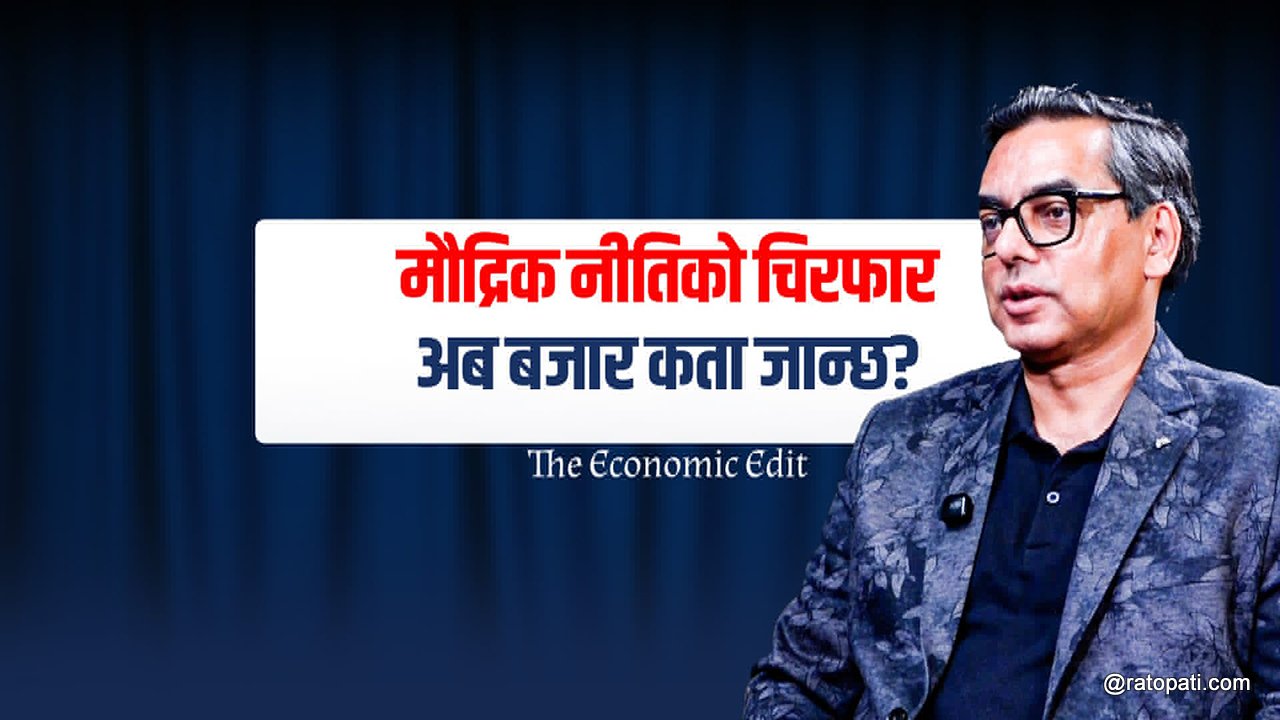
Kathmandu. Former National Assembly member Khim Lal Devkota is also a federalism and planning expert. Ratopati conducted a detailed conversation with Devkota, who also served as the coordinator of the Special Parliamentary Committee for the Study and Monitoring of Federalism Implementation, on the topic of how appropriate non-party local governments are.< /p>
Specifically, the ruling party, Rastriya Swatantra Party (RSP), has the concept of 'non-party local government'. The RSP, which won nearly a two-thirds majority in the House of Representatives election held in February, has formed a government solely on its own. The government led by Balen Shah has also formed a task force to identify necessary issues for constitutional amendment.< /p>
Ratopati's Phaneendra Nepal spoke with Devkota about the positive and negative impacts of moving towards non-party local governments. Here is the edited excerpt of the conversation with Devkota -< /p>
- Discussions and debates on constitutional amendment have begun. As a major topic in this debate, the concept of 'non-party local government' is being widely discussed. How do you view this?
This discussion started particularly after it appeared in the election manifesto of the Rastriya Swatantra Party (RSP). They have raised the issue that local level elections should be non-party or independent and that significant reforms should be made in the provincial structure as well.< /p>
_Ftfky4ahF0.jpg)
I have heard in the media that the Election Commission has also given a similar suggestion recently. However, I have not yet delved into the depth of that suggestion from the commission.< /p>
In my opinion, the rights of the provincial and local levels should be further institutionalized. Our constitution has divided state power in such a way that powers have reached the provincial and local levels. They should be allowed to work independently and effectively. As far as the issue of non-partisanship or independence in local elections is concerned, I have been advocating for this to some extent.< /p>
When discussing non-partisanship, we must not forget that every coin has two sides. It has both strengths and weaknesses. Let's look back a bit at the context of the 2079 local elections. When I was in the National Assembly, I repeatedly said, 'If political parties do not improve, Balen Shahs and Harka Sampangs will be born in this country.'< /p>
I spoke about this not only in parliament but also in a joint meeting of the National Assembly and the House of Representatives. As expected, the results were similar.< /p>
The reason I am bringing up this context is, when Harka Sampang in Dharan, Gopi Hamal in Dhangadhi, and Balen Shah in Kathmandu won independently, what was the attitude of the state and the old established parties towards them? We saw that. After they became independent, the old parties did not provide the kind of support they should have. Instead, an environment of non-cooperation was created. This has been reported in the media many times and is something we have all felt.< /p>
- How difficult is it for independently elected representatives to work? Can you give some examples?
Let's take the example of Kathmandu Metropolitan City. The first problem was seen in the management of the chief administrative officer. When the mayor said, 'I don't have a good tuning with this employee, they couldn't keep up with my work pace, send someone else,' the then government repeatedly did not cooperate.< /p>
Not only that, but the federal government also unnecessarily interfered in matters like building simple footpaths or constructing roads. What happened with the expansion of the New Road footpath is quite clear, isn't it?< /p>
I myself played the role of an independent member in the National Assembly. The attitude of the parties towards independent members or independent representatives is different. They consider independently elected representatives as outsiders. However, a big advantage of being non-party or independent is that the representative is not under any party's whip or pressure. They can work according to their conscience. They are directly accountable and responsible to the citizens, not to any party's interests.< /p>
Our constitution talks about multi-party competition. It is said that democracy and the rule of law are linked through parties, but when it becomes partisan, sometimes there is a compulsion to satisfy the party workers regarding consumer committees, contracts, and jobs. There may be compromises in transactions. Being independent removes such pressures.< /p>
Balen Shah tried to work in Kathmandu in that style, but the federal government did not cooperate with him. A similar problem was seen in Dharan. When I met Gopi Hamalji, he also shared the same experience – the attitude towards a lone mayor is somewhat different and uncooperative. This is because ward chairpersons and members belong to parties. They follow orders from above, which makes it difficult for an independent mayor to work.< /p>
_b3r3W3GovW.jpg)
- So, the concept of non-party local government as advocated by RSP seems good, doesn't it? But why the doubt?
Yes, it sounds good and is good in principle, but I have a big doubt now. Although RSP wrote this in their manifesto, are they ready to implement it now? I don't think so.< /p>
The Election Commission has also given some suggestions, but the parties are now more likely to back down from this issue.< /p>
I worked with old parties in parliament for a long time. Yesterday, the Maoists waged an armed struggle for ten years, there was the Madhesh movement, and the Janajati movement. On the strength of those movements, they came to power, but after coming to power, they forgot all the things they had spoken about during the movement and written in their manifestos.< /p>
Now RSP has nearly a two-thirds majority in parliament. At such a time, they might think – why should we go non-party at the local level? If our hold is strong, why give up the space? Yesterday, they just played a 'card', but my analysis is that they will back down when it comes to implementation.< /p>
- What could be the disadvantages of non-party or independent local governments? How would it affect democracy?
As I said earlier, it also has weaknesses. When elected from a party, there is a legacy of a certain ideology and discipline. If a provision can be made to sever party affiliation after being elected for at least five years, that could be an option, but being completely non-party has some risks.< /p>
First, the mayor or chairperson is not elected alone. There is an organization and policy behind him. When there is a party, there is a common manifesto and policy discipline across the country. If the representative starts to deviate, the party can rein them in by saying, 'Beware, we have made this promise to the people, and it must be fulfilled.'< /p>
Second, and most dangerously, in a democracy, if one person becomes too dominant, it can endanger democracy itself. Democracy is about collective leadership and institutional accountability. If elections are non-party and an individual becomes all-powerful, who will control them? Our party system already has problems – there are complaints that leaders like Deuba, Oli, or Prachanda have become centralized, and collective leadership has not happened. The state structure has become decentralized, but the party structure has remained centralized. If an individual becomes dominant in the local level as well, 'local democracy' can weaken. If parties become weak from the local level upwards, there is a fear that the entire democratic system will collapse.< /p>
_IZbJ3YUUqx.jpg)
- But there are examples of local bodies successfully operating on a non-party basis in some countries, aren't there?
Practices vary by country. Some have monarchies, some republics, some federalism, and some unitary systems. What path we have chosen is the main thing. Even during the past autocratic Panchayat system, it was non-party, but parties were active in some form or another. After all, it was the parties that brought about this change by agitating for democracy.< /p>
The practice you mentioned might be successful in a foreign context, but taking the multi-party parliamentary practice we are following onto a different path suddenly can be very risky. However, independent mayors have shown some good deliveries. It is true that in some places, 'veto power' and 'partisanship' have become dominant over development due to party affiliation, but the debate should be on whether to change the model or the working style to address this.< /p>
- Even in village school management committees or forest user groups, elections are often held on a party basis. Would making them non-party by law bring any improvement?
You have raised a valid point. Even where parties are not directly involved, there is party influence now. The talk of 'so-and-so party won' is heard throughout the village. Therefore, I don't think that writing 'non-party' in the constitution will make the influence of parties zero. Legal provisions alone will not make much difference unless political awareness and culture change.< /p>
What I say is that to strengthen the federal governance system, coordinating bodies at different levels should be active. In countries like America or Australia, some things have been established through practice even if not written in the constitution. Although structures like inter-provincial councils or national coordination councils exist here, they are not effective. Taking a society that is practicing one thing onto another path involves 'risk', but the model can be tested.< /p>
_WNY0dIOC9m.jpg)
- You mentioned that 'middlemen have influence' on bills, how is this possible?
This is my own experience. When I was on the Law Committee and the Committee on Delegated Management, I saw that some bills directly came under the pressure and influence of middlemen. There are many good honorable members in parliament who know with their conscience that it is wrong, but they cannot speak due to the party whip. Since I was independent, they would whisper to me – 'We can't speak, don't give up, keep raising your voice.'< /p>
Our political culture has become such that it seems like this country is run by mafias. It is widely known that even the Prime Minister's bed is accessible to brokers. This problem also exists at the local level. Therefore, political parties need to improve a lot. If RSP or other parties are truly honest, they can test this 'non-party model' in a specific area in the upcoming elections. The constitution does not prevent this.< /p>
- But why would the old parties (Congress, UML, Maoist) agree to such a proposal that would cut off their organizational 'roots'?
Certainly, they will not agree easily. Each of them is looking for an opportunity to 'roast their own bread'. They currently have a fear that the 'heat' of Balen Shah and RSP has not yet subsided. They fear that this wave might finish them in the next local elections.< /p>
The foundation of our democracy and federalism is the local level. The preamble of the 'Local Government Operation Act, 2074' also talks about strengthening local democracy. When I interacted with youths in all seven provinces, I found great talent and enthusiasm in them, but how these talents are utilized or suppressed by the parties is the main thing.< /p>
If we are to strengthen the pillars of inclusivity, secularism, and republicanism, it must start from the local level. How the issue of inclusivity will be addressed in a non-party system is also a challenge. In some cases, when an individual becomes dominant, minority and marginalized communities may be left behind.< /p>
_jjWwfE59tj.jpg)
- What do you think should be the way forward now?
In conclusion, the time has come for RSP to test what they wrote in their manifesto now that they are in government. They said they would bring experts into the government, but now their own party members have gone. If the constitution is a hindrance, let's amend it. There is a two-thirds majority in parliament, let's clear the way. But writing one thing and doing another should not happen.< /p>
My suggestion regarding the local level is this: either make a provision to give up party membership for five years after being elected (as the Speaker or President does), or let's test the 'non-party model' in some specific places. But whatever is done, democracy, the rule of law, and accountability to the citizens should not be weakened.< /p>
I say that the Chief Minister of the province should be directly elected, and the federal executive (Prime Minister) should be elected from parliament. This provides stability and maintains a balance of power. Regarding the local level, let's have a more serious discussion. Let's not just discuss for the sake of discussion; let it not harm the constitution. Reform is necessary, but that reform should strengthen the foundation of our system. It remains to be seen how well RSP and other parties live up to this.< /p>
This specific news has been automatically translated by AI. As a result, there may be some inaccuracies or language errors.


_Eqo5W0NMVM.jpg)