Supreme Court Halts Property Investigation for Former Judges and Military Personnel

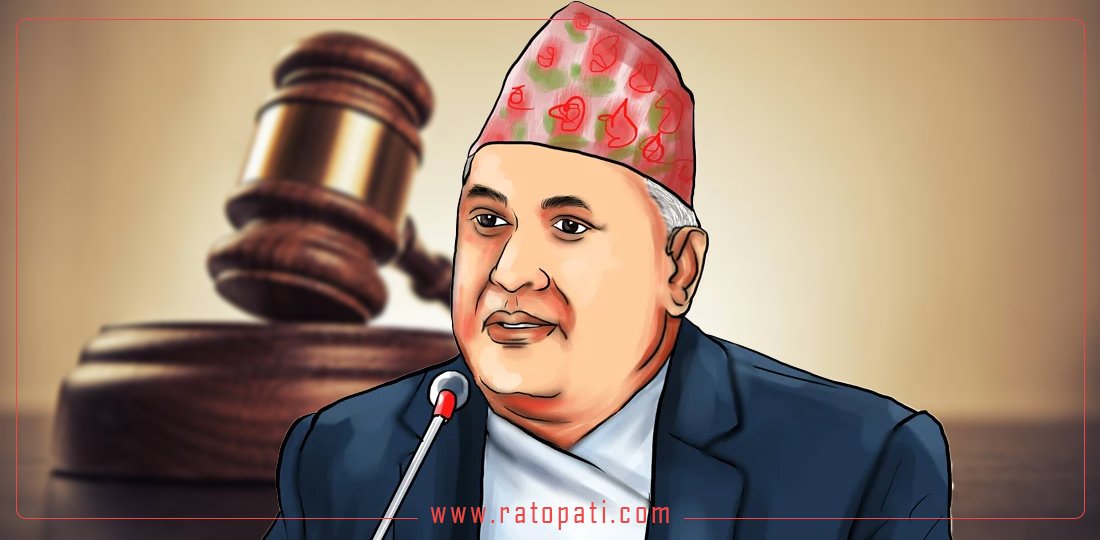
Kathmandu. The Supreme Court has issued an interim order not to compel former judges and former military personnel to submit their property details in a writ petition filed regarding the investigation of their assets by the property investigation commission formed by the government. A joint bench of Justices Tekprasad Dhungana and Shrikant Poudel had issued an interim order in the name of the property investigation commission on Asar 26. The Supreme Court has sent this matter to a full bench after questions arose about the jurisdiction of investigating the property of former judges and former soldiers when the interim order was issued.
The joint bench of Justices Tekprasad Dhungana and Shrikant Poudel, while hearing the writ filed by advocate Dr. Premraj Silwal on Friday, based its order primarily on the provisions of Article 239 of the Constitution. The court stated in its order: Article 239 (2) of the Constitution provides that the Commission for the Investigation of Abuse of Authority (CIAA) can investigate individuals who have been removed from office after an impeachment motion is passed, judges removed by the Judicial Council, and individuals subjected to action under the Army Act, after they have been removed from office. This means that the constitution itself has entrusted a specific body (CIAA) with the authority to investigate former judges and former soldiers. The Supreme Court concluded that when the constitution grants authority to the CIAA, the Council of Ministers forming a separate property investigation commission to demand property details and investigate former judges and soldiers would be a violation of jurisdiction.
Article 142 (1) (c) of the Constitution outlines the provisions for the vacancy of the Chief Justice or a Justice. Accordingly, the Chief Justice has the power to remove a judge from office upon the recommendation of the Judicial Council based on lack of efficiency, misconduct, failure to perform duties honestly, acting with malice, or serious violation of the code of conduct. Property investigation can be conducted for those removed from office, but if retired judges are to submit property, it will only fall within the jurisdiction of the Judicial Council.
Similar provisions exist for District Judges under Article 149 (6) (c). Likewise, Article 239 (1) states that the CIAA can investigate or cause to be investigated any person holding a public office for abuse of authority through corruption, in accordance with the law. However, it is stated that 'this subsection shall not apply to officials for whom a separate provision is made in this Constitution and officials for whom a special provision is made by other laws.' Article 239 (2) provides that for individuals against whom an impeachment motion has been passed and removed from office, judges removed by the Judicial Council, and individuals subjected to action under the Army Act, an investigation can be conducted or caused to be conducted in accordance with federal law after they have been removed from office.
The constitution itself has entrusted a specific body (CIAA) with the authority to investigate former judges and former soldiers. The Supreme Court concluded that when the constitution grants authority to the CIAA, the Council of Ministers forming a separate property investigation commission to demand property details and investigate former judges and soldiers would be a violation of jurisdiction.
Article 28 deals with the right to privacy. It states: 'The privacy of a person's body, residence, property, correspondence, and data shall be protected by law.' Regarding the Nepali Army, the Army Act, 2063 and the Army Regulations, 2069 clearly define the offenses committed by military personnel and the investigation process. In cases of violation of military discipline or any offense such as indiscipline, financial irregularities, loss of weapons, or accidents, a 'preliminary investigation committee' is formed to ascertain the facts first.
Section 62 of the Army Act, 2063, contains special provisions related to corruption and theft. It allows for investigation and prosecution of a soldier for corruption under that section. Section 63 (2) provides for a three-member committee headed by a Deputy Attorney General appointed by the Government of Nepal, along with the head of the legal branch of the Ministry of Defense and a representative of at least the rank of Lieutenant Colonel from the relevant department, to investigate offenses and file cases. The authority to conduct the initial proceedings and adjudication of cases based on the report submitted by this committee lies with the Special Military Court formed under Section 119 (1) of the Act.
According to Section 72 (1) of the Army Act, 2063, even if a person is released from the jurisdiction of this Act after committing an offense within its purview, they can still be held in military custody and prosecuted under this Act. According to Article 239 of the Constitution of Nepal, the CIAA does not have the authority to investigate corruption charges against officials of the Nepali Army. In the case of the army, there is a system for investigation through its own internal mechanism (court-martial or military court) as per the Army Act. However, this provision is more applicable to serving soldiers.
After retiring from military service, they become like ordinary citizens. If a former soldier holds any other public office after retirement and there is suspicion of corruption in that office, the CIAA can investigate. However, the CIAA does not have full authority to investigate corruption that occurred during their service in the army. Furthermore, it does not have the authority to investigate property by forming a separate property investigation commission. According to the Army Act, the authority to summon a military court to investigate and prosecute any soldier lies with the Chief of Army Staff or an officer authorized by him, as per Section 73 of the Army Act, 2063. Section 73 (2) mandates that the officer summoning the military court must do so within three days from the date the situation arises requiring the summoning of a military court.
This specific news has been automatically translated by AI. As a result, there may be some inaccuracies or language errors.
-(2)_QJLjKxR87n.jpg)