Finance Minister Dr. Swarnim Wagle States Upcoming Budget Construction Within Strict Resource Limits


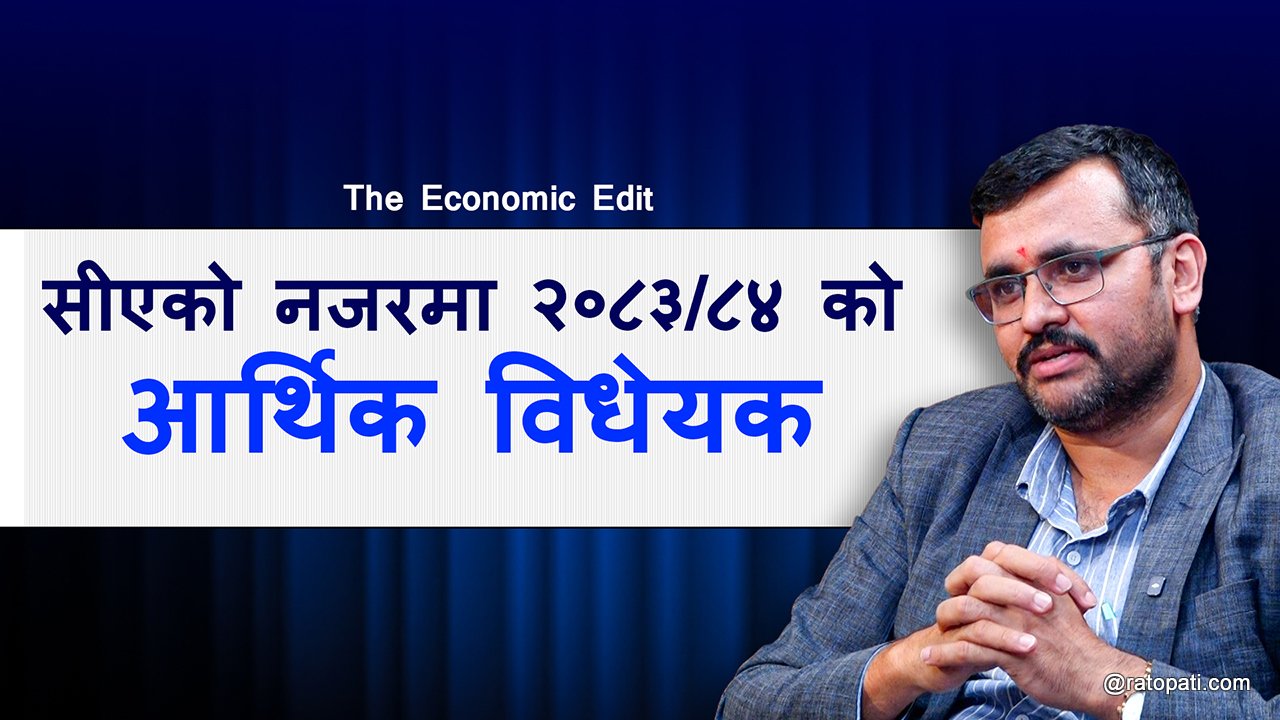
Kathmandu. Finance Minister Dr. Swarnim Wagle has stated that the budget for the upcoming fiscal year 2083/84 is being constructed within the strict confines of limited resources and means.
Speaking on the upcoming budget in a meeting of the Development, Economic and Good Governance Committee under the National Assembly, Finance Minister Dr. Wagle clarified that the Ministry of Finance is compelled to address the unlimited desires of citizens and people's representatives with limited resources.
'We are bound, our resources are extremely limited. However, our desires, wishes, and expectations for development are unlimited,' Finance Minister Dr. Wagle said in the committee meeting, 'It is very difficult for the Finance Minister to fulfill unlimited desires amidst limited resources. The challenge in running a state is similar to the difficulty a head of household faces in running a home.'
He presented the gap between the country's income and expenditure, illustrating a situation where the state cannot function without borrowing.
'Our mandatory liabilities alone amount to 13 kharba 30 arba, but revenue is expected to be only 11 kharba 80 arba. Even if we close our eyes and let the state sleep, we are in deficit; we need to borrow even to sleep,' Minister Wagle said.
Priority: Not Spreading Budget on New Projects, But Completing Old Ones
Due to limited resources, Finance Minister Wagle has clarified that the upcoming budget will prioritize projects nearing completion rather than spreading money on new and ambitious projects.
He stated that the government's goal is to allocate sufficient funds to complete projects such as drinking water, irrigation, and transmission lines, which are 70 to 80 percent complete but stalled due to lack of budget, within this year.
Public Debt and Realistic Budget
Finance Minister Wagle stated that he is aware of the increasing size of public debt in proportion to the Gross Domestic Product (GDP). He mentioned that such debt has increased from 25 percent in 2016 to 42/43 percent now, emphasizing that loans should not be spent on unproductive sectors.
He stated that this time, a budget of a realistic size will be brought by considering the GDP ratio and the capacity to spend, breaking the trend of bringing a large budget size where a significant portion remains unspent. He recalled that in the past, about 30 percent of the budget amount remained unspent.
New Modality for Large Projects
Finance Minister Wagle stated that for the construction of large infrastructure projects like the Nijgadh International Airport and the Budhigandaki Hydropower Project, the investment modality will be determined in a way that does not fall into a debt trap.
He informed that considering the bitter reality that Pokhara and Bhairahawa airports, built with loans, have not become operational, discussions are underway to bring private sector (PPP model) or foreign direct investment (FDI) for Nijgadh. He stated that for the Budhigandaki project, estimated to cost 6 kharba, investment needs to be mobilized by separating it into energy and non-energy (tourism, settlement development, etc.) sectors.
Health Insurance and Cooperative Problems
Finance Minister Dr. Wagle stated that the current modality of the health insurance program has proven to be a failure and that it will be restructured through the upcoming budget. To make insurance sustainable, he said that taxes on items like cigarettes and alcohol (sin tax) will be applied to the health sector, and an insurance modality based on citizens' income levels (premium for the rich, co-payment for the middle class, and fully free for the poor) will be implemented.
Regarding the resolution of cooperative problems, he clarified that the government will facilitate the return of funds for small savers up to 5 lakh, but taxpayer money will not be used for this. He stated that the problem will be resolved by selling cooperative assets or through a revolving fund.
This specific news has been automatically translated by AI. As a result, there may be some inaccuracies or language errors.

_jxKX1kXOlf.jpg)
_htFaNqpIDJ.jpg)