Nepal Considers Reducing Local Government Numbers Amidst Administrative and Geographical Challenges
Kathmandu. Dolpa district's Chharkatangsong Rural Municipality has a total area of 2,828 square kilometers. Bhaktapur district's Bhaktapur Municipality is only 6.88 square kilometers. Both are local levels in Nepal, with a difference of 411 times in their physical area.
In another municipality of Bhaktapur district, Madhyapur Thimi, more than 7,000 people currently reside per square kilometer. This is equivalent to about 4 annas per person. Whereas, if the area of Manang Narphabhumi Rural Municipality is divided, each person gets 2.68 square kilometers (about 5266 ropanis) of land. This is a difference of nearly 20,000 times.
The local level centers in the districts of Madhes are not more than 30 kilometers from the farthest settlement, which can be reached in half an hour's drive, but in the local levels in the hilly and Karnali regions where there are no roads, people are forced to walk for 3/4 days just to reach the local level center.
These are examples showing the difference in Nepal's geographical and demographic conditions. Our administrative division is determined within this cycle of remoteness in the remote areas and proximity in the accessible areas, and 753 local governments are accommodated within this.
Although there were dissatisfactions when this administrative division was made in 2074 BS, the practice of two terms of local government has already turned the administrative boundaries into a psychological map. However, about 8 years after the restructuring of local levels, a new debate and process of adjustment has started again.

A month ago, the Prime Minister's Office and Council of Ministers published a Good Governance Roadmap which included the issue of reducing the number of local levels. In point 2(a) 2.4 of the roadmap, it is stated – 'Merging compatible municipalities based on geographical proximity and resource availability to form larger municipalities or metropolitan cities and adopting measures to reduce structural administrative costs.'
A few days later, the Ministry of Federal Affairs and General Administration issued a draft of the 'Criteria for Readjustment of Boundaries of Rural Municipalities, Municipalities, and Wards, Merging, and Review of Municipality Classification-2083' and circulated a notice asking all local levels to provide their opinions and suggestions. The ministry has stated that based on the suggestions received, this criterion will be published in the gazette and come into effect.
This issue has not just surfaced now. The issue of adjusting local levels has been raised since the time of governments before the Janji movement.
The ruling party, Rastriya Swatantra Party, had proposed reducing the number of local levels even before that. The current new criteria seem to be pushing this forward.
- Preparation of Criteria: To Reduce Numbers or Manage?
The issue of reducing the number of local levels appearing in the government's Good Governance Roadmap and the government immediately bringing out a draft of the criteria has led to discussions about whether the government is preparing to reduce the number of local levels. Although the number to be reduced to is not mentioned anywhere, stakeholders have started raising the issue of reducing the current number of local levels to around 500 through various means.
The Federal Affairs and General Administration Ministry, which is responsible for coordinating with local levels, also states that it has started the process for the restructuring of local levels. Ministry spokesperson Ekdev Adhikari says that the process of facilitating boundary adjustments and upgrades of local levels has been initiated for the demands of local levels and improvement in service delivery.
According to spokesperson Adhikari, about 140 recommendations for boundary adjustments from various local levels are still pending. Decisions on boundary adjustments of those local levels could not be made due to the lack of criteria. The criteria will open this path. Besides, Adhikari says that this will also facilitate the merging and upgrading of local levels.
'The government's goal is for the public to receive services easily from the government. In some wards within local levels, if they are in a different local level than the current one, the local public will receive better services,' said spokesperson Adhikari. 'The current criteria are for facilitating this.'

- How Did the Issue of Reducing the Number of Local Levels to 500 Arise?
Currently, there are 753 local levels across the country. The voice that this number is too high and increases administrative costs has been raised since the past. In such a situation, experts have been suggesting that the number should be reduced without affecting service delivery.
Studies on local levels conducted in the meantime have also recommended reducing this number, but none have definitively stated how many local levels there should be.
The issue of around five hundred, which is currently being discussed, was given by the 'Local Level Restructuring Commission' formed after the promulgation of the constitution.
A study conducted after the promulgation of the constitution showed that around three hundred local levels would be appropriate for the country, but the commission formed thereafter recommended setting this number at 565.
Former commission chairman Balananda Poudel says that this number was recommended to create a local level structure that makes the public feel ownership and also considers the availability of resources.
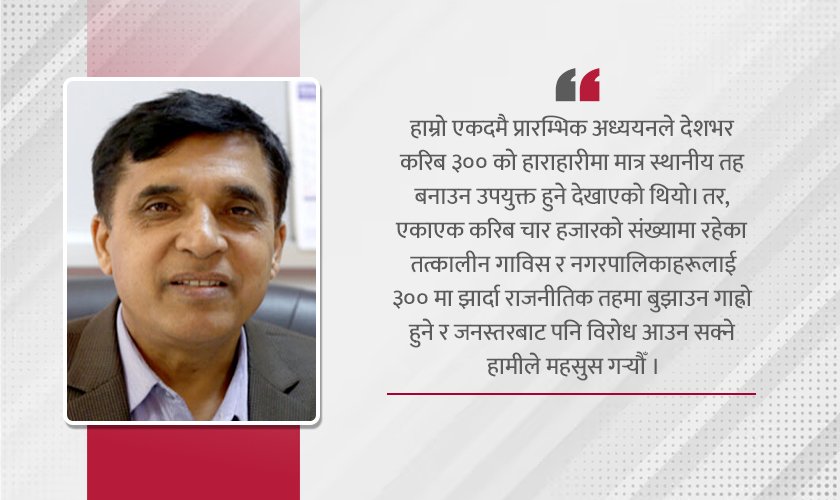
'When it was Village Development Committees, local governance operated differently. At that time, there were about 4,000 VDCs. Although studies at that time showed that around three hundred numbers would be appropriate, we said it should be kept above 500 fearing that it might not be accepted,' said Chairman Poudel. 'Accordingly, we prepared a report recommending the creation of 565 levels.'
The commission had completed the demarcation work in 54 districts based on the number 565, but the government later changed the commission's mandate. Poudel says that the commission had to recommend creating 719 levels after being given the mandate to determine the number and demarcation of local levels based on the previous electoral constituencies.
'According to the mandate given to us, it would have reached around 900, but we convinced the then government that such a large number cannot be sustained and recommended creating 719,' said Poudel. 'Ultimately, the government fixed the number at 753, accommodating political pressures.'
He believes that this is the right time to complete the number that could not be fixed at that time and make the local level governance system effective. He opines that the current effort is moving in a positive direction.
- Local Government Numbers Caught Between Population and Geography
However, reducing the number of local levels is not easy. In the hilly and mountainous regions, the current size of local levels is already large. In the Terai districts, there are dozens of local levels within the same area.
The biggest challenge in adjusting the numbers is the contradiction between geography and population. When making administrative divisions in Nepal, there is always a dispute over whether to base it on geography or population. Especially, people in densely populated areas give importance to population, while those with large geographical areas emphasize area.
Due to this dispute, parties concentrated in the Madhes region protested for months before the promulgation of the constitution. Under the pretext of this protest, India also imposed an undeclared blockade at that time. In the dispute related to electoral constituencies, the constitution had to be amended at that time to prioritize population.
At the time of classifying local levels, wards, which are the main service delivery units, were primarily classified based on population. At that time, 3 to 5 thousand people were allocated per ward in the hilly and mountainous regions, and 4 to 7 thousand people in the Terai region. Due to this criterion, residents in the hilly regions are forced to walk for hours to reach the ward office.
However, since the issue of ward determination has been settled, the government intends to adjust local levels while keeping the ward structure intact. In cases where local levels are far from the center or for other reasons are not suitable, the government appears to be preparing to merge entire wards into nearby suitable municipalities or merge municipalities and upgrade them.
Even now, local levels with large populations and resources remain at a higher level, and their service units are also accordingly. Kathmandu Metropolitan City has 32 wards within a single local level. Similarly, other metropolitan cities, sub-metropolitan cities, and large municipalities also have a large number of wards. Therefore, the government believes that moving forward with this approach will not pose a problem in reaching consensus at the local level.
Moreover, local representatives also seem positive about merging and upgrading local levels under this condition. However, they state that there should be a provision for adjusting the ward structure as needed to make local service delivery effective.
Narulal Chaudhary, General Secretary of the Nepal Municipal Association, says that while they agree with the merging and upgrading of local levels, the association's view that wards should not be split needs to change.

'Currently, it is inconvenient not only for wards to be with municipalities but also for different parts of a ward to be with the ward office. We have been saying that this also needs to be resolved,' said General Secretary Chaudhary. 'However, they say that wards cannot be split because it would cause problems with survey and land revenue records. This is the main problem right now.'
- Main Option to Reduce Numbers – Merging Expanding Cities
Commission Chairman Poudel says that merging nearby and expanding urban local levels is the best option to reduce the current number of local levels. He suggests connecting cities mainly along the East-West Highway and those below it.
'We can merge Butwal with Bhairahawa to make a single entity, and many cities like Kohalpur with Nepalgunj, Attariya with Dhangadhi can be brought under a single local level,' said Poudel. 'These cities are already expanding and connecting with each other, so making them a single local level will also facilitate service delivery.'
Besides these, he says that cities like Banepa, Dhulikhel, Panauti, and Panchkhal in Kavre can be merged to form a powerful sub-metropolitan or metropolitan city. However, Poudel recalls that discussions were held about this at that time, and even though the option of making it a provincial capital was given, it was not successful.
He also says that metropolitan cities can be formed by merging sub-metropolitan cities like Jitpur Simra and Kalaiya, Ghorahi and Tulsipur, Itahari and Dharan. He suggests merging local levels in the inner Terai districts while keeping the number of wards intact.
'We consider ward offices not as administrative centers but as points of service delivery, so they should be in accessible locations, and more work connecting with the public should be arranged to be done from the ward,' he said. 'Municipalities, on the other hand, are administrative centers, so they don't need to be that close. Rather, such centers should be strong and robust in terms of resources, so it doesn't matter if they are made larger.'
However, this issue of changing the number is not as easy as it sounds. According to the current system, to change the boundaries or numbers of municipalities, a two-thirds majority decision from the concerned municipality's assembly is required to proceed through the province. In doing so, there is also a compulsion to restructure in a way that the citizens of the local level feel ownership.
In this situation, there is an equal possibility of complications not only in merging geographies but also in deciding the name and the location of the center.
Moreover, Nepal's constitution itself has provisions for declaring special areas, protected areas, and autonomous regions in local levels according to their conditions. There is also a need to implement these provisions, which have not been implemented for a decade since the constitution was promulgated.
Currently, there are 25 to 45 employees in the executive office of just one rural municipality. Municipalities have 35 to 70 people, sub-metropolitan cities have 70 to 150 people, and metropolitan cities have 150 to 300 employees.
If the number of local levels is reduced by about 250, it is estimated that about 10,000 employees and the corresponding office operating costs will be saved. Stakeholders say that this will consolidate local resources and increase the capacity to plan large projects. However, this is not immediately feasible in the hilly and mountainous regions with large geographical areas.
This specific news has been automatically translated by AI. As a result, there may be some inaccuracies or language errors.