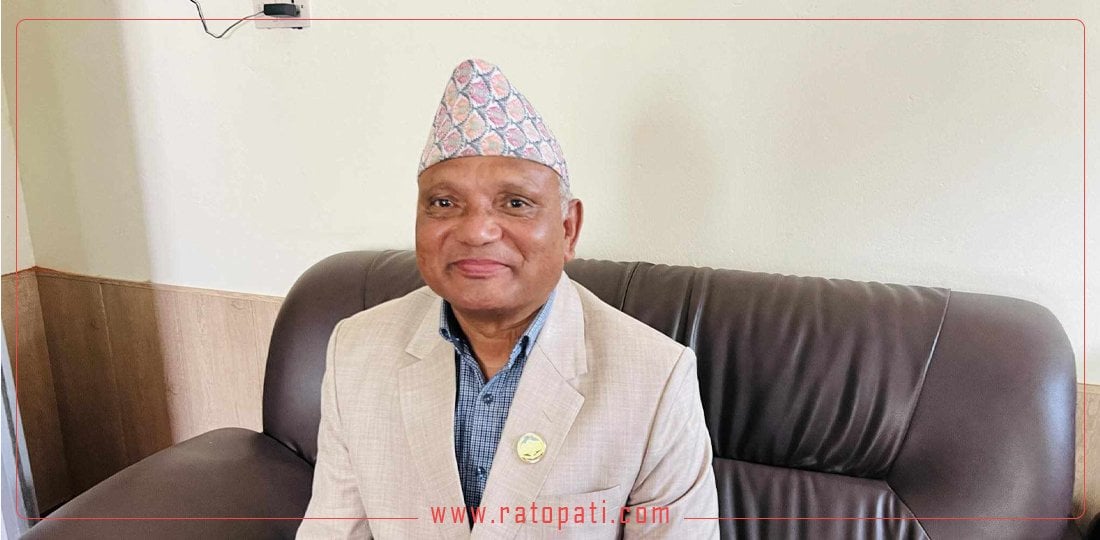
Province Governments Face Instability Amidst Shifting Alliances

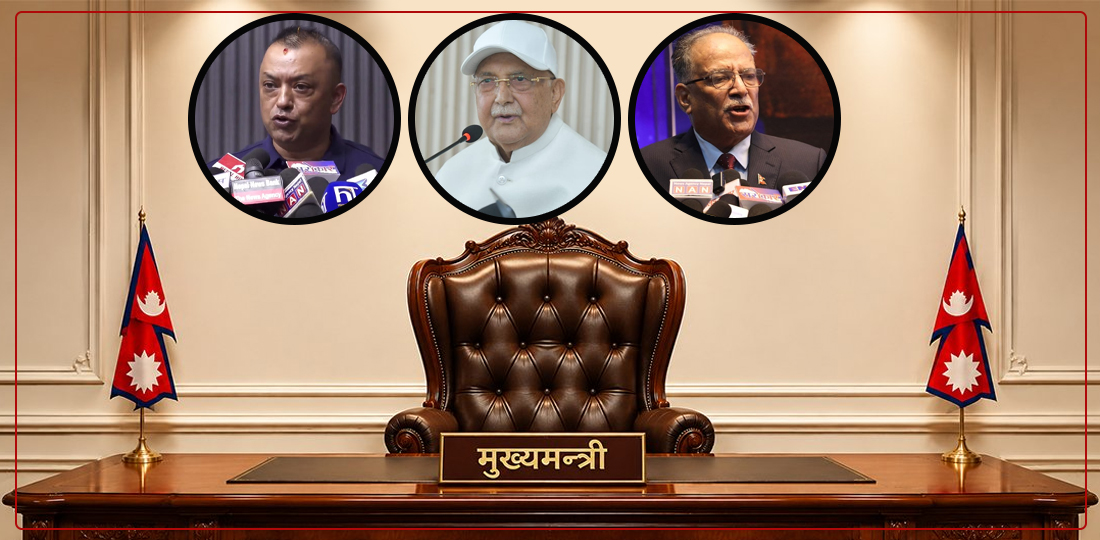
Kathmandu. The Chief Minister of Sudurpashchim Province, Kamal Bahadur Shah, dismissed the ministers from the ruling alliance partner CPN (UML) after the budget could not be passed. On the other hand, the leader of the Nepali Congress's parliamentary party in Karnali Province, Jeevan Bahadur Shahi, withdrew his ministers from the provincial government and registered a no-confidence motion against the Chief Minister in collaboration with the Communist Party of Nepal (Maoist Centre).
These two incidents caused ripples in the remaining five provinces as well as the center. The recent political events in these two provinces have not only raised questions about the future of the government but have also sought to establish an example that provinces can exercise self-determination as needed.
While the question of how appropriate it is to change the provincial government with about a year left in the term of the provincial assembly remains, Sudurpashchim and Karnali provinces are trying to send a message that the first decision regarding the provincial government will be made at the provincial level.
The Congress-UML alliance was formed on the basis of a seven-point agreement reached between UML Chairman KP Sharma Oli and Nepali Congress's then-President Sher Bahadur Deuba in Asar 081. Based on that, the federal government and all provincial governments were formed. Last year, the Oli-led federal government fell due to the Jenji movement in Bhadra. However, the provincial governments remained according to the same alliance.
Meanwhile, the Nepali Congress, through its special general convention, has ousted Deuba and elected a new working committee under the leadership of Gagan Thapa. The new leadership of the Congress had not officially said anything about the existing alliances at the provincial level and their future. In this situation, it was decided in Sudurpashchim and Karnali that the Nepali Congress itself would break the alliance with the UML. The Congress leadership has not made any official comment on the breaking of the alliance.
At first glance, it appears that the Nepali Congress has given the provinces the right to self-determination in accordance with the spirit of federalism. However, the Congress leadership is not without a role in the provincial power equation.
While expressing his views on the ongoing political developments in the provincial governments at a press conference on Monday, Nepali Congress Vice-President Bishwa Prakash Sharma clarified that provinces should not be without opposition. His statement came at a time when news was emerging about discussions between the CPN (UML) and the Communist Party of Nepal regarding cooperation for the formation of provincial governments.
Meanwhile, in Karnali Province, the Maoist Centre has already obtained the signatures of its lawmakers on a no-confidence motion against Chief Minister Yamlal Kandel, proposing Jeevan Bahadur Shahi, the leader of the Nepali Congress parliamentary party, as the Chief Minister. Shahi is a leader of the establishment-fringe group within the Nepali Congress. Therefore, the current leadership of the Congress does not seem to be in favor of his ascension to power.
On the other hand, the Chief Minister of Sudurpashchim, Kamal Bahadur Shah, had also come to Kathmandu before dismissing the UML ministers. Some believe that he was forced to dismiss the UML ministers because the party's central leadership did not provide the necessary support to resolve the dispute within the ruling alliance regarding the Sudurpashchim budget.
In this situation, the Chief Minister of Lumbini Province, Chetanarayan Acharya, also came to the center seeking support to save his government. However, speaking to RatoPati on Monday, he said that he had not met any leaders.
Karnali's Chief Minister Yamlal Kandel, who has already become a minority, is staying without resigning, hoping for some miracle from the center.
The CPN (UML), which was preparing to withdraw from the Bagmati government, has been stopped at the last moment. Leaders say that the UML has 'on hold' the decision to resign for a few days according to the directive from the party's center. The same situation exists in Koshi Province.
The formation of provincial governments is provisioned in Articles 168, subsections 1, 2, 3, and 5 of the Constitution. These subsections provide for the formation of a government with a single majority, a coalition government, a government led by the largest party in the provincial assembly, and a government that can secure a majority in the provincial assembly.
According to federalism, all parties have a provincial organizational structure. However, no party's provincial committee has the authority to exercise power in matters of power shifts or ministerial recommendations within their respective provinces.
In matters of power shifts and ministerial appointments, the central leadership of almost all parties takes the initiative. What is even more interesting is that leaders who complain that the federal government does not give power to the provincial governments are themselves in a constrained position, unable to receive authority from their own party leadership for provincial government changes and ministerial appointments.
The practice of making decisions regarding alliances at the center and pushing all provincial governments into instability accordingly has been ongoing, even though in some provinces the existing alliances have shown no signs of discord!
This specific news has been automatically translated by AI. As a result, there may be some inaccuracies or language errors.



_mKzzIyOWNL.jpg)
_kE6hmvuewe.jpg)