National Planning Commission Finalizes Implementation Plan for 16th Periodic Plan

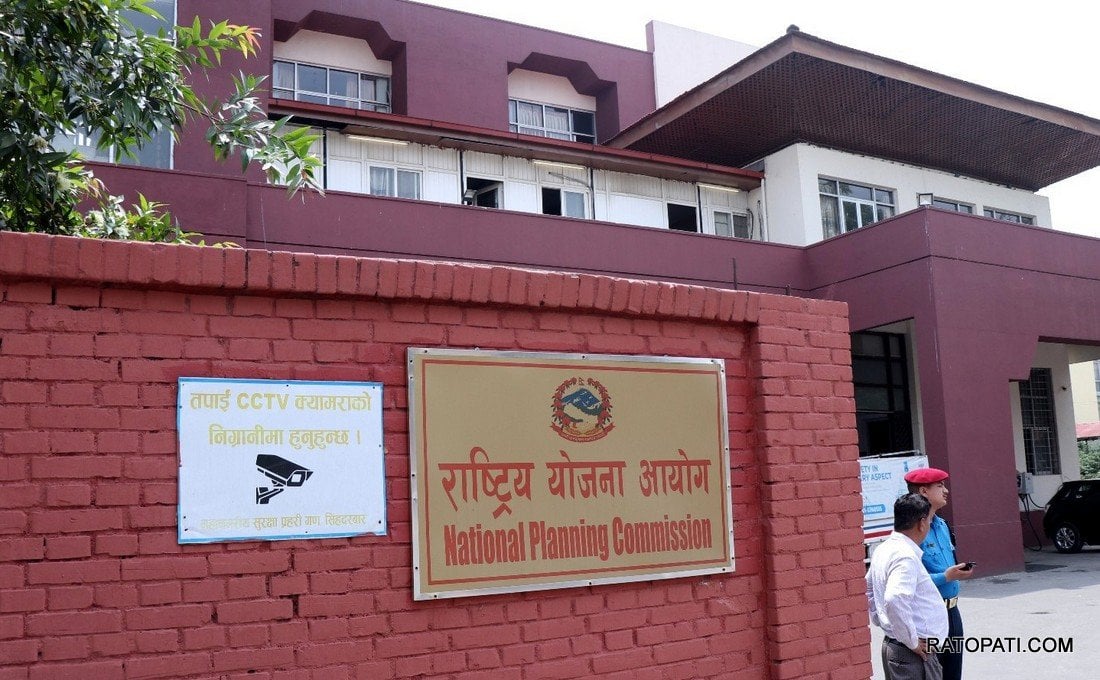
Kathmandu. The National Planning Commission (NPC) has prepared a detailed implementation work plan for the effective execution of the 16th Periodic Plan (2081/82–2085/86). This work plan has already been approved by the Council of Ministers in Falgun 2082.
The 16th Plan aims to achieve an economic growth rate of 7.3 percent by the end of the five-year period. Furthermore, the goal is to increase the per capita income from the current US$1,456 to US$2,351. Targets also include reducing absolute poverty to 12 percent, among others.
To achieve these goals, the prepared work plan adopts good governance, social justice, and prosperity as its main objectives. This work plan is expected to contribute significantly to strengthening federalism, enhancing the capacity of local levels, and promoting inclusive sustainable development.
This work plan aims to guide Nepal's overall development process. It outlines goals for achieving inclusive economic growth by prioritizing economic growth, human capital formation, infrastructure expansion, good governance, and environmental sustainability. The plan is deemed necessary to address weak implementation capacity, increasing climate change-related risks, and complexities observed in public service delivery.
The work plan has identified 13 thematic areas for overall development. It is stated that plan implementation will be systematized through cooperation and coordination between the federal, provincial, and local levels.
Key Subjects Included in the Work Plan:
Strengthening Overall Economic Foundations and High Economic Growth: This prioritizes the strengthening of the overall economic sector, the informal economy, the private sector, the cooperative sector, and public enterprises.
Enhancing Production, Productivity, and Competitiveness: Emphasis is placed on increasing the productive capacity in the sectors of agriculture, land management, industry, commerce, supply, and tourism.
Productive Employment, Decent Work, and Sustainable Social Security: The goal is to create productive employment through labor and employment, social security, and protection.
Building Healthy, Educated, and Skilled Human Capital: Importance is given to human capital development in areas such as population management, health and nutrition, education and skill development, science and technology, and youth and sports.
Development of Quality Physical Infrastructure and Intensive Inter-connectivity: Focus is placed on the development of infrastructure sectors such as road and rail transport, civil aviation, energy, water resources and irrigation, meteorology and hydrology, drinking water and sanitation, and communication and information technology.
Planned, Sustainable, and Resilient Urbanization and Settlement Development: This includes subjects like building, housing, and urban development, and improving rural access.
Gender Equality, Social Justice, and Inclusive Society: Gender equality, inclusion, social justice, and culture have been given a special place in the plan.
Strengthening Provincial and Local Economies and Balanced Development: Importance is given to inter-level coordination, inter-governmental relations, and inter-governmental finance.
Poverty and Inequality Reduction and Building an Equitable Society: Special emphasis has been placed on poverty reduction.
Effective Public Financial Management and Enhancement of Capital Expenditure Capacity: Management of revenue, public expenditure, public debt, and alternative financing has been prioritized.
Governance Reform and Promotion of Good Governance: Subjects such as statistical systems, justice system, electoral system, governance reform and good governance, corruption control, peace, order and security, plan formulation and implementation, and monitoring and evaluation are included.
Biodiversity, Climate Change, and Green Economy: Forestry and environment, climate change, disaster management, and the green economy are covered in this plan.
Smooth Graduation from Least Developed Country Status and Implementation of Sustainable Development Goals: Special strategies have been formulated for graduation from LDC status and the implementation of Sustainable Development Goals.
This specific news has been automatically translated by AI. As a result, there may be some inaccuracies or language errors.
_TCGzv8ozFM.jpg)