Minister Announces Kathmandu-Pokhara Expressway, Experts Question Feasibility Amidst Project Delays

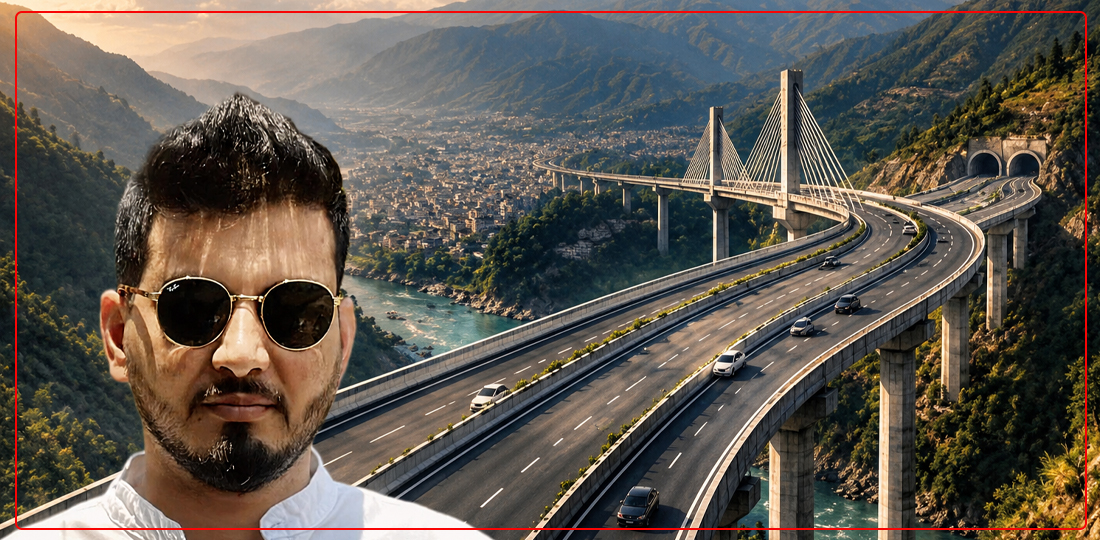
Kathmandu. It currently takes an average of 6 to 8 hours to travel from Kathmandu to Pokhara. Infrastructure Development Minister Sunil Lamsal announced on the rostrum of the House of Representatives on June 17 that an 'Expressway' would be built to reach Pokhara from Kathmandu in just 2 hours.
Minister Lamsal stated that the study for the Kathmandu-Pokhara Expressway would be advanced. While his announcement is as pleasant to hear as it is, looking at the extreme delays and chaos that have been occurring for the past 5 years to expand the same road to just 4/6 lanes, this plan seems like 'fruit from the sky'.
Infrastructure experts say that the 'Expressway' is technically possible using modern technology and tunnels, but serious questions arise as to how the government machinery, which has been extending deadlines for years without being able to move electric poles in the middle of the road, will build a high-speed road that allows travel from Kathmandu to Pokhara in 2 hours.
The Minister's Ambitious Announcement Was Like This
While answering questions raised by MPs in Parliament, Minister Lamsal had announced the construction of 8 tourist highways (Expressways) totaling 3,000 kilometers to connect the country's major tourist destinations. According to him, these highways will be built within the next 3 years with an investment of 600 billion rupees.
Under this, Rani-Biratnagar-Kimathanka, Birgunj-Rasuwa Gadhi, Bhairahawa-Korala, Koilabas-Dolpa, Jamuna-Simkot, and Gauriphanta-Badimalika will be developed as Expressways from north to south, and two additional highways will be built connecting east to west. Minister Lamsal claimed that tenders for the construction of the Butwal-Pokhara Expressway would be invited in the upcoming fiscal year, and the study for the Kathmandu-Pokhara Expressway would be advanced.
Experts Say - It is Technically Possible
Infrastructure expert Kishore Thapa says that the Kathmandu-Pokhara Expressway is technically possible. However, he stated that the government would have to mobilize significant resources for it.
While the common understanding is that an Expressway means building a new road in a new place, Thapa says that it is a method of upgrading existing road sections using technology. 'An Expressway does not mean digging a new road in a completely new place. It involves improving the existing road by utilizing most of its sections,' he said. 'Where there are excessive curves and steep cliffs, the road is straightened by building tunnels and bridges over deep gorges. Flyovers can be constructed in areas with heavy traffic to keep the journey smooth.'
He argues that since building a wide road of four or six lanes by cutting through hills in a hilly terrain is risky both geographically and environmentally, tunnels are the most effective option. According to Thapa, Nepal has already developed sufficient technical experience and capacity for tunnel excavation. He mentioned that Nepal's experience in constructing the Nagdhunga tunnel, long tunnels for hydropower projects, and the Melamchi tunnel has made it easier for Nepal to move forward in this direction.
According to Thapa, if the Expressway is built, the travel time between Kathmandu and Pokhara can be reduced to two hours. He stated that reducing travel time by half would lead to a significant decrease in fuel consumption and have a positive impact on the economy. Furthermore, he said that the tourism business would take a big leap forward as travel becomes easier for foreign tourists who hesitate due to long and arduous journeys.
Years of Delay in Expanding to Four to Six Lanes
On one hand, experts are showing the door to possibilities, while on the other hand, the project management of the government and the efficiency of the construction entrepreneurs are extremely dismal. The expansion work of the Nagdhunga-Muglin and Muglin-Pokhara road sections, considered the main 'lifeline' for entering and exiting the federal capital Kathmandu, has brought tears to the eyes of travelers due to its dilapidated state.
The approximately 95-kilometer Nagdhunga-Muglin road is being expanded with concessional loan assistance from the World Bank. This road has been under expansion for the last five years. In some sections, work has not been completed even within the second extended deadline. Instead of holding the construction parties accountable for the delay, the project has been extending the deadline again, citing reasons such as petroleum price hikes, bitumen shortage, and delays in moving electric poles.
Just last week, Infrastructure Minister Sunil Lamsal, who went to monitor the road, expressed angry remarks about 'breaking the legs of the construction entrepreneurs,' citing the failure to move electric poles on time and procrastination in the work.
Nagdhunga-Muglin: Disappointing Progress in Both Sections
The Nagdhunga-Muglin road expansion project's eastern section has been divided into two packages. According to project engineer Keshav Prasad Ojha, the physical progress in the first package (Nagdhunga-Naubise, 12.26 km) is about 88 percent, and in the second package (Naubise-Mallekhu), it is only about 59 percent.
Approximately 75 more poles need to be moved for road expansion. The project claims that the work is being affected due to the Nepal Electricity Authority not moving the poles on time. Out of about 20 kilometers of road in the eastern section that still needs to be blacktopped, only 9 kilometers of base have been prepared.
The contract for the first section was taken by Jangsu-Sagun JV for 1.30 billion rupees. The deadline for this section, with a contract signed in March 2021, has been extended multiple times to the end of February 2025. Similarly, the deadline for the second package, contracted by ZICG-Sharma-Lama JV for 5.33 billion rupees, has also been extended to October 2026.
Likewise, the work on the western section (Mallekhu-Muglin, 38.86 km) is slow. Its physical progress is only 43 percent. Although the prime coat has just started on this road, contracted by Sharma-ZICG for 4.80 billion rupees, work has stopped due to the arrival of only 30 tons of bitumen. According to engineer Sachedra Mishra, 107 more poles need to be moved. The contractor has requested an extension of the deadline, citing various reasons.
Muglin-Pokhara Road: Work Not Started in Some Places, Stuck at Bridges in Others
The condition of the road going towards Pokhara is also the same. In the Muglin-Aanbu Khaireni section under the Muglin-Pokhara road project, funded by the Asian Development Bank (ADB), physical construction work has not started at all due to compensation disputes. The government plans to start this work only from next year.
Out of a total of 41.45 kilometers of road, 32 kilometers of road expansion work have been completed in the Aanbu Khaireni to Jamune section, informed Bishnu Prasad Pandey, engineer and information officer of the Muglin-Pokhara road project's eastern section. He said, 'Other road construction and necessary infrastructure works in this section are almost complete. The road marking work, which is in the final stage, is also almost complete. Most of the other works in that section have been completed after the contract agreement ended.'
However, the progress of the Madhi River bridge construction is only 85 percent. The bridge construction party, whose deadline was until June 29, has corresponded with the project requesting an additional 303-day extension after failing to complete the work. The eastern section was contracted to China Communication Construction with a cost of 6.21 billion rupees. As per the road design, the road has been expanded to 41 meters in Damuali and Dumre Bazaar in Tanahu, and 25-25 meters in other places.
Similarly, the physical progress of the western section (Jamune-Seti Pul) of the Muglin-Pokhara road has reached 82 percent. According to Krishna Bahadur Kunwar, chief of the Muglin-Pokhara road project's western section, the main work of constructing the four-lane road has been completed. Out of a total length of 36 kilometers, 10 kilometers of service lane and road safety works remain. As the deadline for this section was until the 15th of this month, an extension is being prepared as the construction could not be completed.
Project Chief Kunwar said, 'It rained a lot in March-April, which disturbed the work for some time. We did not face a bitumen shortage for our project because we had stocked it earlier. It rained on 36 days out of two months, which affected the work. An extension is currently being prepared.'
In this section, contracted with Chinese company YNHUI Kaiyuan Highway and Bridge Construction for 7.40 billion rupees, which started in 2021, the contractor company has claimed that work could not be done for 75 days due to the monsoon and has requested a 6-month extension. However, the project office is discussing extending the deadline by only 2 to 4 months.
This specific news has been automatically translated by AI. As a result, there may be some inaccuracies or language errors.