Nepal Electricity Authority's Underground Wiring Project Nears Completion

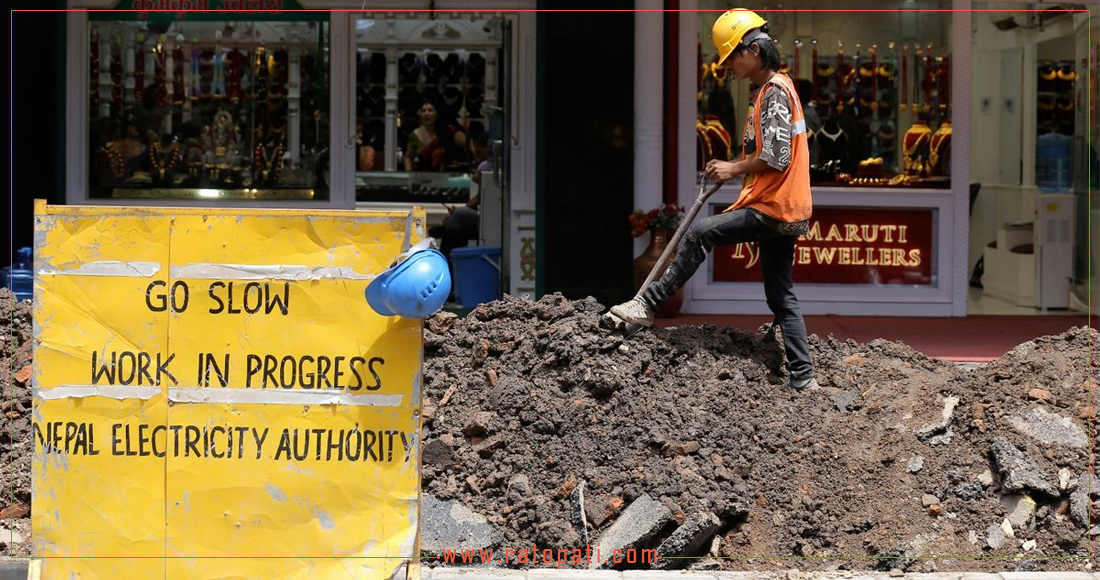
Kathmandu. The Nepal Electricity Authority has stated that the underground wiring project, which it started eight years ago, is in its final stages.
The Authority had started the campaign to make Kathmandu Valley a 'wire-free and safe city' eight years ago on February 17, 2020. The campaign to remove the unsightly tangled wires in Kathmandu Valley and urban areas and old poles leaning on the sidewalks was initiated by the then Managing Director of the Authority, Kulman Ghising.
The Authority believes that the 'underground cabling system' will enhance the beauty of Kathmandu Valley and make electricity distribution safer. The Authority had been advancing the underground wiring work with a soft loan of 100 million dollars from the Asian Development Bank.
This work was initially planned to be completed within 3 years. After not being completed within the stipulated time, the Authority has been working by extending the project deadline by approximately 3 years. However, the project is still not completed. The Authority has stated that it is working with the goal of completing the project within the next three months.
The Project Development Directorate of the Authority stated that the work could not be completed within the stipulated time due to reasons such as COVID, local obstructions, and delays in coordination with government agencies.
_0SOEgiMfCt.jpg)
Minister for Energy, Water Resources and Irrigation, Biraj Bhakta Shrestha, said that only 4 percent of the underground wiring work being carried out by the government remains. He informed that the government has made a plan to complete it soon by prioritizing it.
He said that a committee comprising physical infrastructure, urban development, and other stakeholders has been activated to expedite this work, which has been stalled for a long time due to a lack of coordination between inter-agencies. He said, 'Only 4 percent of the first phase of underground wiring work remains. This work will now be accelerated in potential areas within Kathmandu.'
Durganand Bariyat, head of the Project Management Directorate of the Authority, informed that the underground wiring work has been completed in some places and some packages are in the final stage. He said that the work of underground wiring has been completed in the area under the Ratnapark distribution center in Kathmandu.
He clarified that although the wiring work has been completed in many places, some tasks such as charging the lines and installing lights are still pending due to various problems.
Bariyat said, '95 percent of the work has been completed in the package covering Kathmandu West (Baneshwor, Kirtipur, Kalanki, Thankot, Balaju, Jorpati). Work has also been completed in the Kirtipur area and the lines have been charged.'
The Authority stated that the work on underground wiring started with the onset of COVID, and due to the unavailability of materials during that time, work could not be done for two years.
The Authority informed that after two years, the work could not be completed on time due to further problems caused by a lack of coordination between government agencies. According to the Authority, there was also a problem in obtaining permission for the roads in order to dig up the roads and lay wires.
According to Rajan Dhakal, spokesperson for the Authority, the project could not be completed within the stipulated time due to problems such as water pipes and various other issues underground where the wiring is to be done. He said that the work will be completed within the extended time.
Spokesperson Dhakal admitted that the work was prolonged because the work could not be done due to problems in bringing the necessary materials for the project as COVID started simultaneously with the commencement of underground wiring.
- 95 percent physical progress in Ratnapark and Maharajgunj areas
The project has stated that the work of making electrical wires underground in the Ratnapark and Maharajgunj areas of Kathmandu has reached the final stage.
In the Maharajgunj area, the project work was started by the Indian contractor company 'KEI Industries Limited' after signing the contract in March 2019.
_Z2rdctUHmM.jpg)
Underground lines of 11 thousand volts and 400 volts have been constructed in areas including Baluwatar, Panipokhari, Budhanilkantha, Tokha, Gongabu, Samakhushi, Dhapasi, Basundhara, Shivapuri, Chunikhel, Sukedhara, Dharmasthali, and Teaching Hospital under the center. Approximately 214 kilometers of high-tension lines and 352 kilometers of low-tension lines have been undergrounded there.
Additionally, approximately 200 kilometers of optical fiber have been laid along with it for modern communication infrastructure. The Authority has stated that this will facilitate the 'smart grid' and internet service delivery in the future.
The work of undergrounding wires under the Ratnapark distribution center is almost complete. In this package, which was awarded to the Indian contractor company 'KEI Industries Limited', only a few tasks such as charging the lines and installing lights remain.
The physical progress of the work under the Kathmandu Central and Northern Distribution System Strengthening Project has reached 94 percent. Under this, after undergrounding 246 kilometers of 33 kV wires, the work of laying 11 kV and 360 kilometers of 12 kV (LT) wires has been completed, the Authority stated.
According to the Authority, out of 283 kilometers of high-tension lines under the Ratnapark distribution center, 280 kilometers of wires have been undergrounded. Out of 382 kilometers of low-tension lines, 365 kilometers of work have been completed. The Singha Durbar package is also in the final stage.
The progress of the Kathmandu East and South Distribution System Strengthening Project is also the highest, at 97 percent. The work of 288 kilometers of HT and 367 kilometers of LT lines has been completed in this project.
Although it may appear that the work is not finished because poles are yet to be removed in some places, the Authority has stated that the process of charging the 11 kV lines from underground cables is continuously ongoing.
This project has been particularly successful in the New Road area. Both high-tension and low-tension lines have been charged there, and electricity is being supplied through the underground system. The Authority has stated that underground lines are already operational in tourist areas like Thamel, Naya Bazaar, Lazimpat, Panipokhari, and Baluwatar.
_Sbqa6tazTu.jpg)
- Rapid progress in West Kathmandu
The progress of the Kathmandu West Distribution System Strengthening Project has also reached approximately 95 percent.
The Authority has stated that this progress has been achieved in the package covering the western areas of Kathmandu (Baneshwor, Kirtipur, Kalanki, Thankot, Balaju, Jorpati). L&T Construction Company is carrying out the work in this area.
Under this project, the work of undergrounding 290 kilometers of HT and 240 kilometers of LT wires has been completed.
The Authority has stated that work has been completed and lines have even been charged in the Kirtipur area, and electricity is now being supplied through underground wires in areas such as Tribhuvan University entrance to Kirtipur entrance, surrounding areas of Tribhuvan University, Kirtipur Ring Road, Maitri Nagar, Balkhu Corridor, Bhatkepati, Nagau, and Dhalpachok.
Similarly, work on one side of the Kalanki-Thankot section is completed, while work is ongoing on the other side. Work in the Balaju area has also reached the final stage. The Authority has stated that new systems have been installed in the area from Kalimati Chowk to Balkhu Chowk and Chovar Gate. Work is also progressing rapidly in the Gaushala-Shankhamul section of the western region.
- Work slower in Bhaktapur-Lalitpur compared to Kathmandu
The Authority, which is dividing the valley into different packages for work, has stated that the pace of work in Lalitpur and Bhaktapur is somewhat slower compared to Kathmandu. Under the Lalitpur and Bhaktapur Distribution System Strengthening Project, the progress is somewhat less compared to other areas of the valley, at only 55 percent. So far, 180 kilometers of HT and 108 kilometers of LT lines have been worked on here.
The Authority has set a target to complete the central-northern, east-southern, and western projects in Kathmandu within the next 3 months (September-October). The Authority has informed that preparations are underway to complete the work in Lalitpur and Bhaktapur within the next 6 months.
- Lack of coordination between agencies is the main challenge
The project initiated by the Authority has proven to be challenging to implement. Residents have been suffering from dust and potholes for the past 3 years. Similarly, the Authority has stated that the undergrounding of electricity, water, and telecom wires has caused further problems.
_veWKUfswtR.jpg)
According to the Authority, local residents are obstructing the installation of poles, transformers, and distribution boxes in front of or next to their houses. The plan has not been able to proceed as per schedule due to delays in obtaining work permits from the Department of Roads and local municipalities. In particular, there has been a problem with the Kathmandu Metropolitan City not granting permission for the installation of service wires.
Due to traffic problems on the busy roads of Kathmandu, it is difficult to work during the day, and work has to be done only at night. During the laying of wires, work is significantly hindered by underground water pipes, sewers, and telecom wires.
The Authority has stated that other agencies (roads, sewers, etc.) damage the underground structures completed by the Authority during their work, and they do not even receive compensation for the damage.
Commissioning the new system requires a power shutdown. However, due to long power outages, customers face inconvenience, and it is very difficult to arrange shutdowns in sensitive areas (like Singha Durbar).
Despite various challenges, the Authority has stated that it is accelerating the undergrounding work to make the electricity distribution system in the valley modern and safe.
The Authority also stated that the implementation of the project is challenging due to a lack of coordination between government agencies.
This specific news has been automatically translated by AI. As a result, there may be some inaccuracies or language errors.