From snow peaks to smart farms: How technology is cultivating a new agricultural era in Xizang

Author: Wang Yangyang is a CGTN Radio Reporter and an editor of the podcast Round Table China.
Say Xizang, and most people think about snow-draped peaks, turquoise lakes, and spiritual serenity. Agriculture? Not so much. But while these postcard-perfect views haven’t change, a quiet agricultural revolution is underway, one rooted in technological innovation, scientific precision, and the enduring resilience of local communities.

On July 31, 2025, the waters of Pumoyongcuo in Shannan, Xizang, appeared a vivid blue, reflecting the distant snow-capped mountains. [Photo: VCG]
The plateau best known for its thin air is suddenly thick with agricultural innovation. Once constrained by rugged topography and limited infrastructure, Xizang’s agricultural industry is now being reimagined through precision farming, strategic public-private collaboration, and the efforts of bold local pioneers.
A high-altitude sweet spot for apples
In the southeastern city of Linzhi, often dubbed the “Switzerland of the East,” apple orchards have emerged as both a regional hallmark and a symbol of highland innovation. By 2024, the total orchard area had surpassed 74,000 mu, that’s about 4900 hectares, yielding approximately 30,000 tons valued at 376 million yuan (around $52 million USD), with apples accounting for over half of all fruit production.
So what’s their secret sauce? A climate cocktail: enough sunlight, clean air, and dramatic swings between day and night temperatures. These conditions accelerate the accumulation of natural sugars in the fruit. Varieties cultivated in the region are celebrated for their fine texture, juiciness, and well-balanced flavor.
And they’re not just staying local. In April 2024, 99 tons of apples from Linzhi’s Bayi District crossed into Nepal. Facilitated by customs authorities and 24-hour cross-border logistics channels between China and Nepal, this export not only reduced transportation costs but also signaled the emergence of a viable trade corridor linking Xizang with broader South Asian markets.
Fish above the clouds
If apples at altitude sound improbable, the idea of farming fish at over 3,000 meters above sea level might seem even implausible.
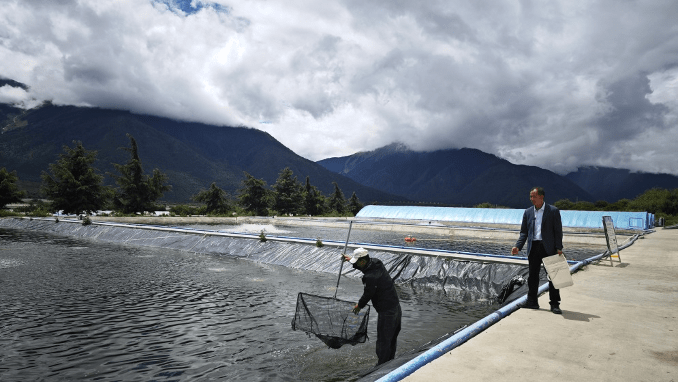
A view of a fishing farm in Linzhi City. [Photo: CGTN Radio]
Since 2022, a pioneering aquaculture team from Guangdong, one of China’s leading seafood provinces, tried to introduced high-altitude fish and shrimp farming in Linzhi. The environmental challenges were formidable: low oxygen levels, low temperatures, and limited water resources. The solutions? Solar-assisted thermal systems to stabilize tank temperatures, and artificial seawater to sustain shrimp.
Since July 2024, locally farmed fish and shrimp species have begun to enter the market in greater volume. Among the standout successes is the Sweetfish or affectionately dubbed the “Cucumber Fish” for its refreshing aroma reminiscent of cucumber, which has rapidly gained popularity in both restaurants and home kitchens.
Greenhouses of prosperity
High-tech farming isn’t just about apples and fish. In Kangma County, at an altitude of 4,400 meters, rows of connected greenhouses glow with the red of ripening strawberries. Inside, 25-year-old Laba Zhuoma, once a shepherd girl, now taps her smartphone to activate a drip irrigation system.
"Teachers from Shandong trained us in temperature control and pest prevention," she explains proudly. "Now I earn over 5,000 yuan (nearly $700 USD) a month!" In just a few years, she’s gone from tending sheep to being a skilled greenhouse technician.
And the success stories multiply armer, Ciwu, leases five greenhouses for watermelon and cherry tomato cultivation, earning over 100,000 yuan (nearly $14,000 USD) a year.
From strawberries at dawn to cherries selling at 120 yuan per jin, that’s about $33 USD per kg, greenhouses are turning once-barren land into engines of prosperity.
One of Xizang’s most well-known agricultural products is Cordyceps, a medicinal fungus used in traditional Chinese medicine, which is exported to countries such as Thailand, Malaysia, Vietnam, and Singapore.
Toward an innovative and resilient future
Looking ahead, stakeholders aim to build a diversified agricultural portfolio centered on highland fruit, complemented by growing aquaculture and specialty crops. While sectors like seafood face clear demand gaps, local production meets only a fraction of annual needs, this underscores broader opportunities for modernization. Experts emphasize that agricultural innovation will be critical to the region’s development, with strategic investments in infrastructure such as cold-chain logistics and processing facilities playing a vital role in enabling sustainable market expansion.
Xizang will always be the land of snow peaks and sacred lakes. But now, apples are nurtured under sapphire skies. Fish are swimming in tanks warmed by solar panels. Strawberries are thriving in greenhouses above the clouds... Xizang is positioning itself as a frontier of agricultural ingenuity. These efforts are enabling local produce to travel far beyond the plateau, delivering both flavor and innovation to tables across Asia and beyond.