Question Paper Leakage Undermines Nepal's Education System

Kathmandu. Questions have been raised about Nepal's secondary and higher education, as well as the overall examination system. The credibility and impartiality of the examination system are being questioned due to the lack of sensitivity among the concerned authorities.
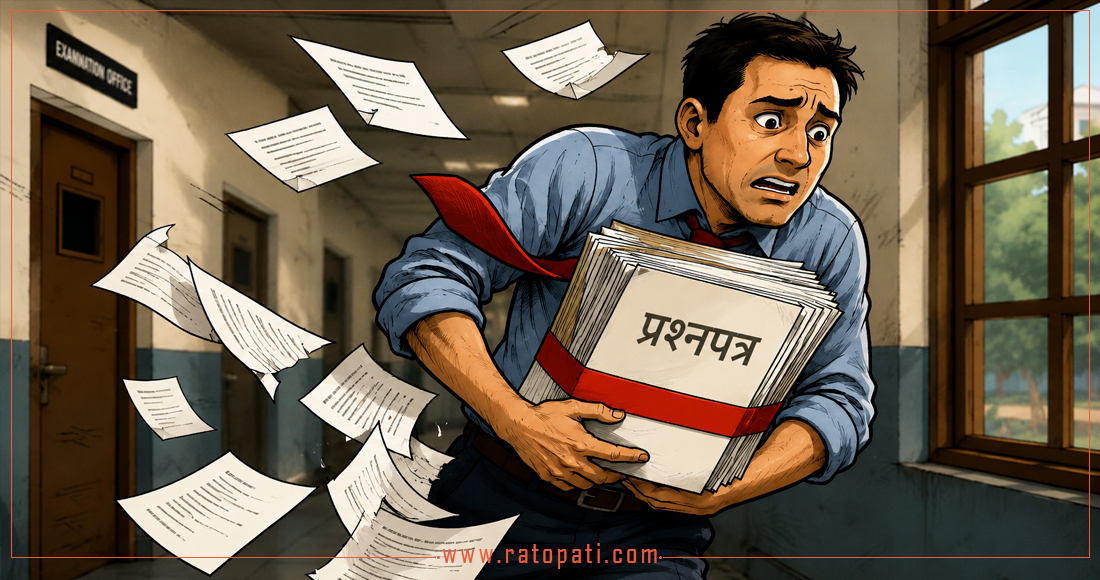
Recent events indicate that question papers have been leaked from examination centers. Most recently, the question paper for the MBS first-semester examination conducted by Tribhuvan University (TU) was leaked from the examination center. Such incidents have occurred before.
A similar incident occurred in Bhadra 2075 BS. At that time, the question paper for the M.Ed. first-semester Psychology subject was leaked. After the paper leak was proven, Tribhuvan University postponed the examination. At that time, before examinees reached the 38 examination centers across the country, the question papers had already spread across social media.
In Chaitra 2075 BS, an incident of the Secondary Education Examination (SEE) question paper being leaked from the Kalyanpur Area Police Office in Siraha, Madhesh Province, came to light. After the science and social studies question papers were leaked, the SEE was postponed. It was revealed that instead of distributing the regular question paper to the examinees, the English paper for the partial examination, scheduled to be held ten days later, was distributed.
Similarly, on Shrawan 22, 2078 BS, an internal examination conducted by the Police Headquarters for police personnel participating in the United Nations Peace Mission (UN Mission) became controversial. The UN branch of the headquarters conducted an internal 'Pre-SAT' examination. Only police personnel who pass the Pre-SAT are eligible to participate in the final UN Mission examination. However, the examination became controversial after the question paper was leaked before the exam. Despite the leak, the examination started an hour late. However, some participating police personnel complained that even the delayed examination's question paper was leaked.
A committee formed to investigate the 'Pre-SAT' question paper leak incident conducted by the Police Headquarters for the United Nations Peace Mission had to request details of all police personnel from 11 police offices participating in the examination.
On Poush 28, 2074 BS, the Special Court convicted Devi Ram Pandey, director of Golden Gate College in Kathmandu, and six others for leaking the question paper in the MBBS examination. The reason was that in the MBBS examination conducted by the Ministry of Education in Mangshir 2071 BS, the operator of Golden Gate, in collusion with others, leaked the question paper.
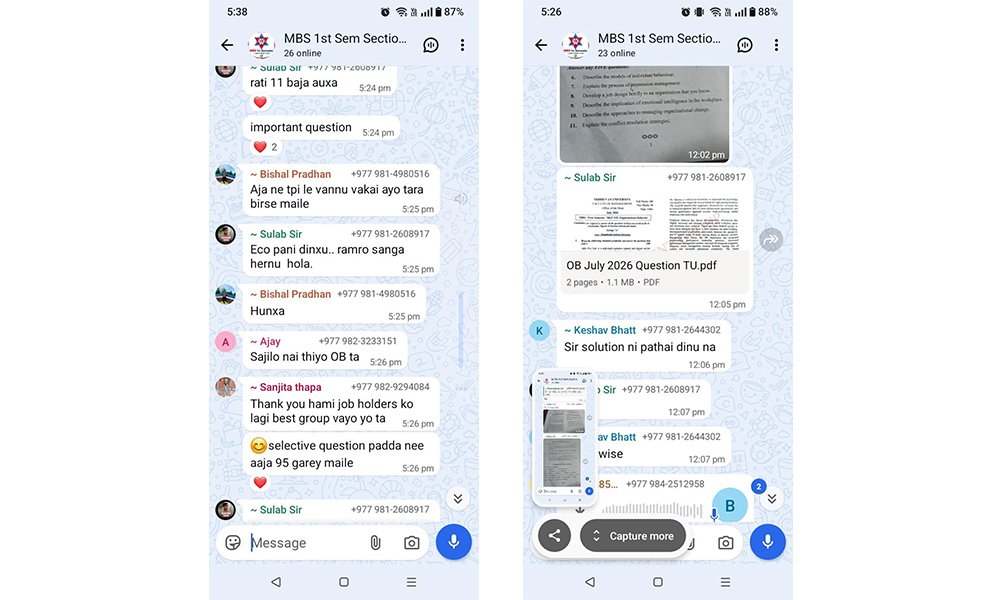
The recent incident of the MBS first-semester examination question paper from TU being leaked shortly after its release has been widely criticized. The examination for Organizational Behavior, held on Shrawan 8, saw its question paper leaked within a short time after it began. The question paper was found scattered across social media just minutes after the exam started.
Ratopati published news with evidence of question papers being leaked from various WhatsApp groups. Students have complained that the MBS first-semester question paper was leaked from some colleges. A three-member investigation committee under the coordination of Prof. Dr. Achyut Gyawali has been formed to investigate this matter, but its impartiality is also being questioned.
The impartiality of the investigation is questioned because the TU Management Dean's Office, which has the authority to designate examination centers, formed the investigation committee itself. A TU official stated that since the Management Faculty Dean's Office is the final decision-making body for examination centers and the investigation committee is also from the Dean's Office, its impartiality is questionable. He asked, "How relevant is it for the Dean's Office to form a committee and investigate itself?"
Police have arrested one person involved in the incident. The arrested Sandeep Singh Thakuri is working in a private college. Some allege that examinees, TU officials, and third parties are directly involved in question paper leaks. Such incidents also raise questions about the quality of examinations.
Sudarshan Dhungana, an associate professor at Nepal Sanskrit University, said that it is necessary to make timely changes in the examination system. He told Ratopati, "Some changes are essential in the rules, guidelines, and policies made for traditional examinations. Those in responsible positions must fulfill their responsibilities by maintaining official confidentiality within the examination policies, rules, and guidelines. Otherwise, incidents like those seen now occur and are leaked."
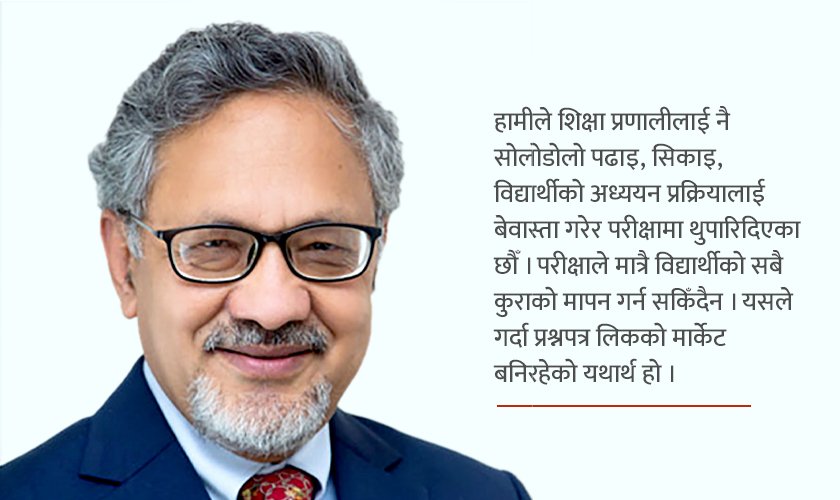
According to Dhungana, universities should provide necessary training to the Examination Controller's Office and the professors, staff, and individuals involved in examinations. He said, "Universities must be able to take action against professors, staff, and examination-related individuals who do not maintain their responsibilities and confidentiality. The same rule applies and should be applied to examinees."
He stated that the policies and rules are not robust, and the implementation aspect is also weak. He said, "Whether it is examinees, professors, staff, or examination-related individuals involved in the examination, those who act against the examination policies, rules, and guidelines must be investigated truthfully and dealt with ruthlessly."
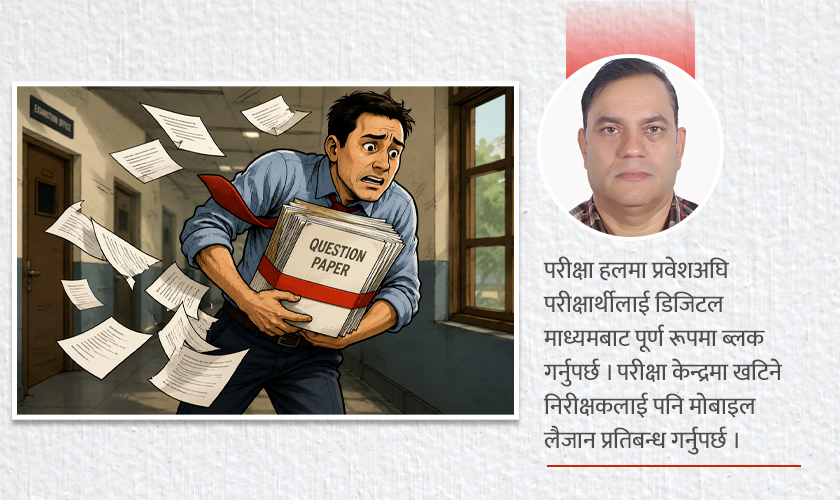
Dr. Khilanath Sapkota, an associate professor at Tribhuvan University, said that to improve TU's examination system, it is necessary to return the entire responsibility of conducting, managing, and publishing the results of all examinations to the Examination Controller's Office. He said, "If the university's examination system is to be truly improved, the entire responsibility for conducting, managing, and publishing the results of all examinations of Tribhuvan University must be returned to the Examination Controller's Office. This was the system in the past, and it maintained uniformity and accountability."
Currently, in TU, most semester system examination-related tasks are conducted by the respective Dean's Offices. Sapkota said, "This is not a good practice in the long run. It unnecessarily focuses the Dean's Offices on conducting examinations, whereas their main responsibility should be academic leadership, curriculum development, research, and quality enhancement."
Sapkota suggested that the Examination Controller's Office should be made more capable, resourceful, technology-friendly, and fully responsible, and the system of conducting all university examination-related tasks through a single body should be reinstated.
Kumar Bartoula, pursuing MPhil at TU, said that leaking question papers is an injustice to hardworking students. He said, "The leakage of question papers is not the first incident, but its continuous repetition reduces the credibility of the institution and will create negative problems in our learning culture in the future."
Navraj Dangi, studying MPhil-PhD in Conflict, Peace, and Development at TU, said that question paper leak incidents can tarnish the country's dignity. He said, "Such incidents bring our educational quality and weaknesses in our systems to the attention of the world community. Our dignity is also affected. Anyone involved in this should be given the harshest punishment."
Nabin Bhandari, spokesperson for Tribhuvan University, said that the question paper leak incident has been taken seriously. He said, "Fundamentally, it is necessary to create questions that can be answered through original writing. The style of the question paper itself needs to be changed. If digital materials are brought into the examination hall, an environment must be created where anyone involved, not just the examinees, can be punished."
Prof. Dr. Tankanath Dhamala, former head of the Central Department of Mathematics at Tribhuvan University, called leaking question papers an unethical activity and attributed it to administrative weaknesses. He said, "If the individuals involved in conducting examinations are honest and responsible, question papers will not be leaked. The Examination Controller's Office and the university administration must be responsible and accountable for solving this problem."
Dhamala stated that for a sustainable solution to question paper leaks, the education system and examination format need comprehensive reform. He said, "Instead of being limited to a three-hour theoretical exam, a student-centered teaching method should be adopted in line with international practices. Continuous internal assessment, project work, presentations, and group work should be prioritized. Question papers should be made conceptual and impossible to copy."
- What is the provision for punishment?
The Tribhuvan University Organization and Educational Administration Rules 2050, as amended, contain provisions regarding student conduct. According to the rules, any person deployed for examination conduct should not engage in indecent behavior, hooliganism, assault, or battery towards examinees.
Chapter 66 of the rules states that if an examinee commits such an act, the Central Examination Conductor Committee may cancel the relevant examination in proportion to the act committed and expel the examinee from participating in any examination for a period of 1 to 4 years. It is also mentioned that examinees are not allowed to disrupt examinations individually or collectively, and examinees who do so can be handed over to the local administration for action.
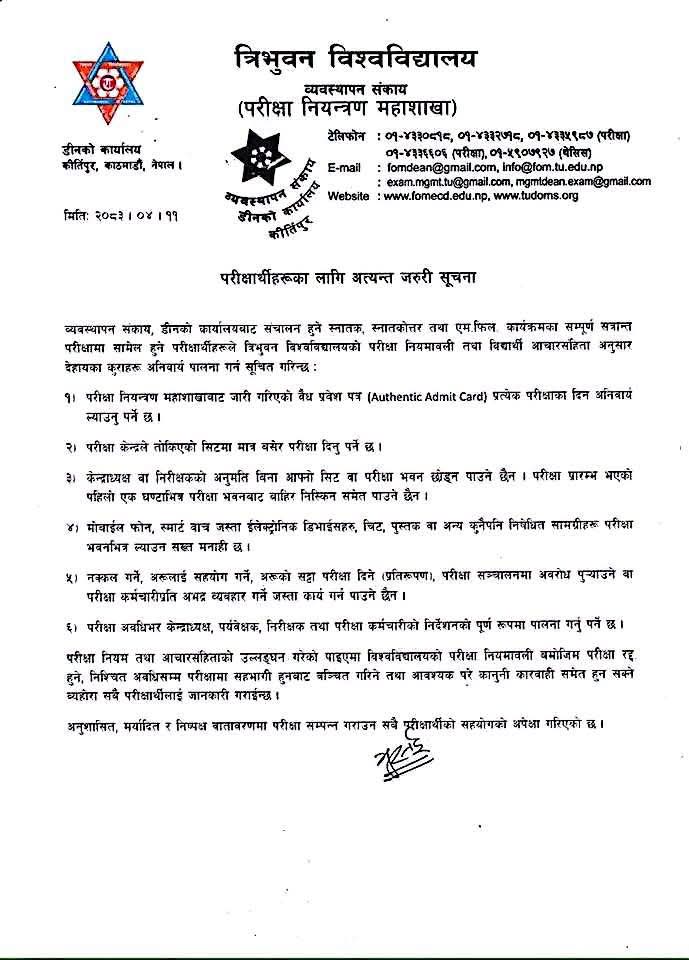
Similarly, the Dean's Office of the Management Faculty, TU, has issued a code of conduct for examinees participating in all end-semester examinations for Bachelor's, Master's, and MPhil programs. The code of conduct states that a valid admit card issued by the Examination Control Department must be brought on each examination day. Also, as per the rules, examinees must sit only in the designated seats at the examination center and cannot leave their seats or the examination hall without the permission of the center chief or invigilator. It is also mentioned that examinees cannot leave the examination hall within the first hour after the examination begins.
The code of conduct prohibits bringing electronic devices such as mobile phones and smartwatches, chits, books, or any other prohibited materials inside the examination hall. It also states that actions such as cheating, helping others, taking exams on behalf of others (impersonation), obstructing the examination process, or behaving indecently towards examination staff are not allowed. During the examination, the instructions of the center chief, supervisor, invigilator, and examination staff must be fully followed.
If the examination rules and code of conduct are found to be violated, the examination will be canceled as per the university's examination regulations, the examinee may be debarred from participating in examinations for a certain period, and legal action may be taken if necessary.
This specific news has been automatically translated by AI. As a result, there may be some inaccuracies or language errors.

_ylu0AjgUvp.jpg)