CPN UML and CPN Agree to Cooperate in Provinces

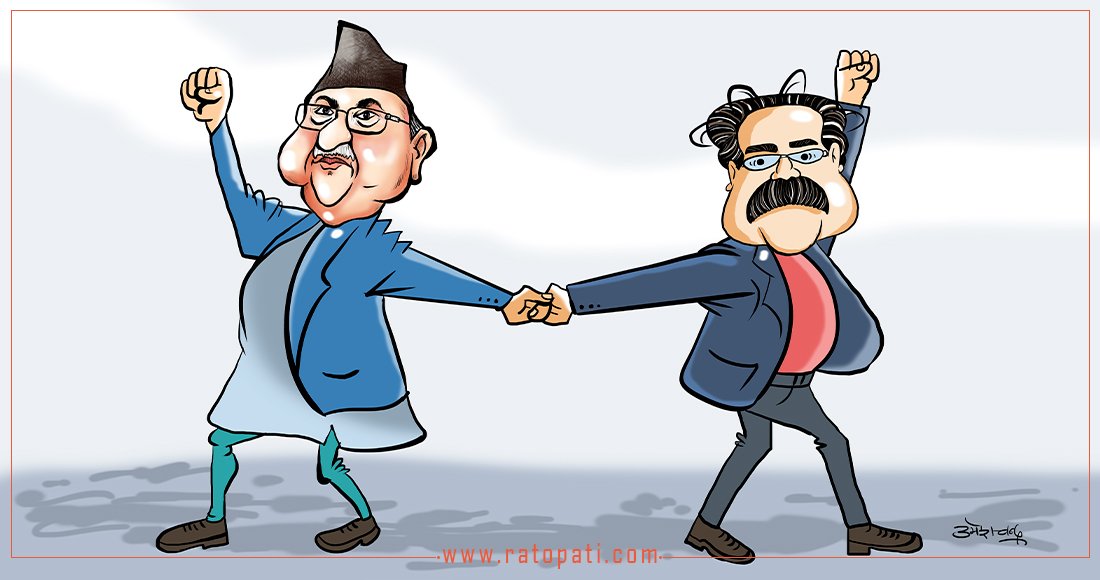
Kathmandu. With the collapse of the alliance between Nepali Congress and CPN UML in the provinces, UML and CPN have agreed to cooperate. For that, UML Chairman KP Sharma Oli and CPN Coordinator Pushpa Kamal Dahal 'Prachanda' have already reached a 3-point agreement on Saturday.
The agreement paper signed by Oli and Prachanda states that in the first phase, out of five provinces (Koshi, Bagmati, Lumbini, Karnali, and Sudurpaschim), governments will be formed under the leadership of UML in three and under the leadership of CPN in two.
After that, both parties are confident that cooperation can be extended to other provinces as well. According to the agreement, UML will lead the governments of Koshi, Bagmati, and Lumbini provinces, while CPN will lead the governments of Karnali and Sudurpaschim provinces. Except for a few leaders and cadres of UML and CPN, most have taken this agreement positively. However, some have reacted that it is difficult to trust an agreement made personally without discussion in the party committee.
While both types of reactions are coming in regarding the agreement, the question of how sustainable the cooperation between the two communist parties will be has also arisen. It is said that past events have startled the leaders and cadres of both parties, fearing that the cooperation may not be sustainable.
In the past, not only cooperation but even party unification occurred between UML and CPN.
However, neither the cooperation lasted, nor did the party unification! Therefore, the suspicion that the current cooperation might also be like the past remains, according to those leaders and cadres.
Some leaders say that since both sides have faced setbacks in the past, if the recent understanding is implemented honestly, they can reach party unification in the future, and Oli and Prachanda appear optimistic.
CPN leader Mahendra Shahi, who witnessed the three-point understanding between Oli and Prachanda, says that the recent understanding is a test for both sides.
Leaders say, 'Let's cooperate for now; rushing into unification might spoil things.' According to leader Shahi, who was directly involved in signing the three-point agreement and is also a former chief minister, the distance of mistrust still remains between the two leaders.
"If the current agreement is implemented honestly, we can even reach unification later," Shahi said, "Instead of unifying now, this three-point agreement should be understood as a test. Therefore, this is also a strategic agreement."
Similarly, UML Deputy General Secretary Lekhraj Bhatta interprets the three-point agreement as merely a power-sharing arrangement. "For now, the three-point agreement is just a power-sharing arrangement," Bhatt said, "For party unification, past shortcomings must first be seriously reviewed."
He stated that unification is not possible without agreement on ideology, principles, and direction, adding that if everything falls into place, it cannot be said that unification will never happen in the future.
"I am not aware of Oli proposing to Prachanda to become the parliamentary party leader and unify the party," Bhatt added, "Such a possibility does not seem immediate. I don't think there is any other agreement besides the one made yesterday."
CPN UML's Publicity and Publication Department Chief Niraj Acharya believes that the three-point agreement should be understood as a first step. According to Acharya, if both sides honestly adhere to the agreement and move towards provincial and local level elections, it will lay the foundation for unification.
"The agreement has been made purely for cooperation in the provinces for now," Acharya said, "If the agreement is implemented honestly and we reach the upcoming elections, it will lay the foundation for unification."
This specific news has been automatically translated by AI. As a result, there may be some inaccuracies or language errors.