Nepal's Foreign Trade Hits Record High, Trade Deficit Widens

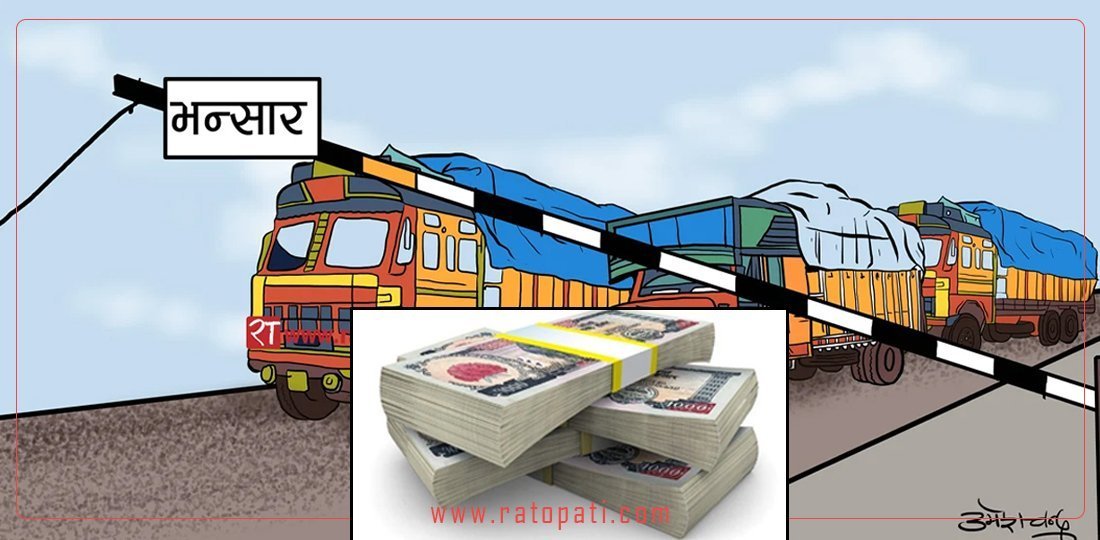
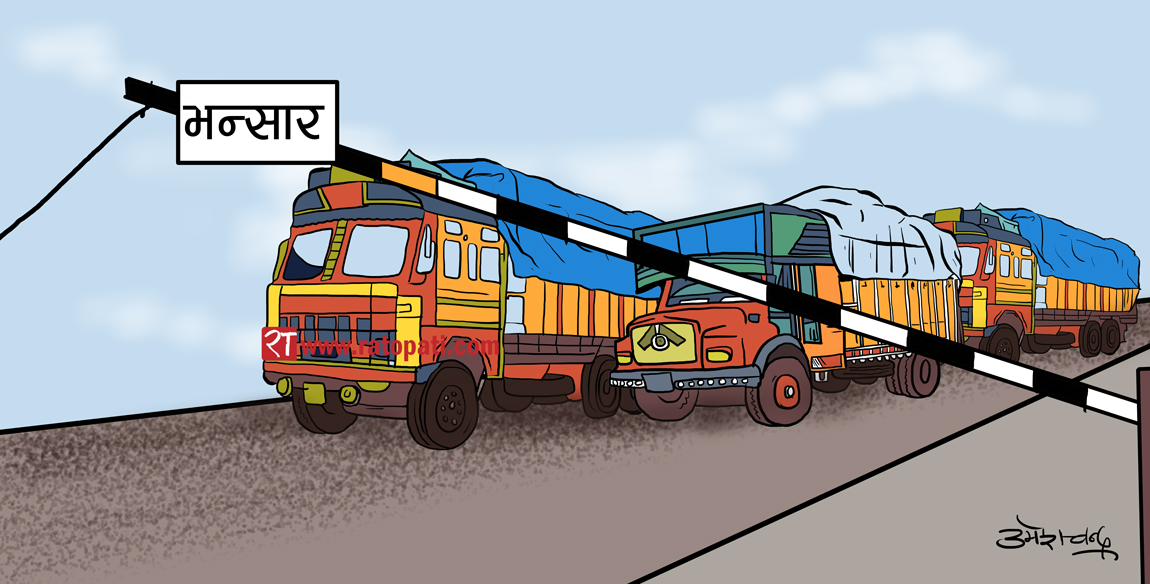
Kathmandu. Nepal's foreign trade volume has set a new record for the first time in history. According to the annual statistics for the last fiscal year 2082/83, released by the Department of Customs on Thursday, Nepal's total foreign trade volume, including imports and exports with various countries around the world, has crossed the mark of 24 trillion rupees. While the total trade volume has reached an all-time high, the gap between imports and exports is widening further. This data indicates that Nepal's economy is heading towards extreme dependence, reflecting the structure of Nepal's economy, the state of production, and consumption patterns. According to the Department of Customs data, Nepal's total foreign trade volume increased by 15.88 percent to 24 trillion 11 billion 66 million 954,500 rupees in the last fiscal year 2082/83. In 2081/82, Nepal's total foreign trade was 20 trillion 81 billion 15 million 293,300 rupees. In a single year, the volume of foreign trade has increased by more than three and a half trillion rupees.
Export Improvement, But Negligible Compared to Imports
Looking at the detailed data from the Department of Customs, imports constitute a very large portion of Nepal's total trade. During the review period, Nepal's total imports increased by 16.20 percent to 20 trillion 96 billion 37 million 907,000 rupees. In 2081/82, Nepal imported goods worth 18 trillion 4 billion 12 million 273,100 rupees. While the import rate in total foreign trade remains high, there are some signs of improvement in exports. However, compared to the massive volume of imports, the improvement in exports is like a drop in the ocean. In 2082/83, Nepal's exports increased by 13.81 percent. According to the data, goods worth 3 trillion 15 billion 29 million 474,500 rupees were exported from Nepal to various countries last year. In the previous year, such exports were limited to only 2 trillion 77 billion 3 million 22,000 rupees. Although an increase of about 38 billion rupees in exports can be considered positive, the slower growth rate of exports (13.81 percent) compared to the growth rate of imports (16.20 percent) has not had any positive impact on the overall trade balance. Due to the larger share of imports compared to exports, even a small percentage increase in imports adds a significant burden to the trade deficit.
Widening Trade Deficit: 17 Trillion 81 Billion Went Out
The most worrying issue for the country's economy is the growing trade deficit. Although both imports and exports have increased, the trade deficit has surged due to the significantly larger share of imports. According to the Department of Customs data, Nepal's total foreign trade deficit has increased by 16.63 percent compared to the previous year, reaching close to 18 trillion rupees. In the 12-month period from July 17, 2082, to June 30, 2083, Nepal's total trade deficit reached 17 trillion 81 billion 8 million 859,600 rupees. In the previous fiscal year 2081/82, this deficit was 15 trillion 27 billion 9 million 253,000 rupees. Economists say that a heavy increase of more than two and a half trillion rupees in the trade deficit in a single year indicates a rapid outflow of foreign currency from the country, which could have a negative impact on foreign exchange reserves in the long run.
Disappointing Situation
The ratio of imports to exports clearly shows how Nepal is trading in the global market. According to the data, there has been a slight increase in the import-export ratio. Last year, this ratio was 6.51, and in the last fiscal year, it increased by 2.10 percent to 6.65. This means that for every 1 rupee of goods Nepal exports to earn foreign currency, it is sending out currency equivalent to 6 rupees and 65 paisa by importing goods. Similarly, the share of exports in the total foreign trade has further shrunk. Last year, the share of exports in total trade was 13.31 percent, but during the review period, it decreased by 1.79 percent to 13.07 percent. In contrast, the share of imports in total trade has increased slightly (0.27 percent) to 86.93 percent, which was 86.69 percent in the previous fiscal year.
Trade Deficit with 134 Countries, Significant Losses with Neighbors
In the last fiscal year 2082/83, Nepal incurred a trade deficit with 134 out of more than 160 countries it traded with. Nepal is at a disadvantage with most of the countries it trades with. Trade with only 28 countries is in Nepal's favor, i.e., profitable. While the overall trade deficit reached 17 trillion 81 billion 80 million rupees, the largest share is accounted for by our two neighboring countries, India and China. Nepal's total imports were 20 trillion 96 billion rupees, while exports were only 3 trillion 15 billion rupees. The deficit with India, the largest trading partner, is the highest. According to the data, Nepal imported goods worth 12 trillion 10 billion rupees from India alone during this period. However, Nepal's exports to India during the same period were limited to only 2 trillion 58 billion rupees. Due to this vast gap between imports and exports, Nepal's trade deficit with India alone is 9 trillion 51 billion rupees, which is more than half of the total trade deficit. The second largest trade deficit is with our northern neighbor, China. Nepal imported various goods worth 4 trillion 25 billion rupees from China. However, exports to China are extremely dismal, only worth 1 billion 890 million rupees. Thus, Nepal has incurred a large trade deficit of 4 trillion 23 billion rupees with China. After neighboring countries, the country with the largest deficit for Nepal is the South American nation Argentina. Despite being geographically distant, Nepal imported goods worth 1 trillion 16 billion 38 million rupees from Argentina. The main reason for this is the import of edible oils, including crude soybean oil, from there. However, Nepal's exports to Argentina are unbelievably low, only 18,000 rupees. This has caused the deficit with Argentina to exceed 1 trillion 16 billion rupees. Besides these, Nepal has incurred significant trade deficits with other major economies of the world. According to the data, there is a trade deficit of 50 billion 32 million rupees with the United Arab Emirates (UAE), 21 billion 92 million rupees with Indonesia, 18 billion 32 million rupees with Thailand, 18 billion 26 million rupees with Australia, 17 billion 70 million rupees with Brazil, 15 billion 26 million rupees with Malaysia, and 11 billion 94 million rupees with the United States.
Nepal Profits from Trade with 28 Countries
Nepal has made a profit from trade with 28 countries. According to the Department of Customs, Nepal has the highest trade profit with the European nation Denmark. Nepal imported goods worth 216.2 million rupees from Denmark, while successfully exporting goods worth 1.02 billion rupees. As a result, Nepal has a net profit of 804.5 million rupees with Denmark. Similarly, Nepal has earned trade profits of 88 million rupees with Norway, 42.2 million rupees with Romania, and 26 million rupees with Iceland. Furthermore, Nepal has made trade profits with some countries from which imports are zero. Nepal has not imported any goods from countries like Grenada, Fiji, Bahamas, Barbados, Syrian Arab Republic, and Angola. Similarly, imports from American Samoa are extremely negligible, only 2,000 rupees, while exports sent there are worth 44.6 million rupees. Likewise, imports from the Cayman Islands and Panama were only 1,000 rupees each, while exports from Nepal were 14 million rupees and 337,000 rupees, respectively. Other countries where Nepal has made trade profits include Seychelles, Niger, Maldives, Iraq, New Caledonia, Yemen, Georgia, Colombia, Mauritius, Mali, Cyprus, Croatia, Ghana, Congo, and Jamaica. However, the profit amounts from these countries are not very large.
Top 10 Items Constituting a Large Share of Imports
During this period, petroleum products, machinery, and iron-based materials have been shown to constitute a large share of imports. With total imports exceeding 20 trillion 96 billion rupees, the largest amount has gone out for mineral fuels. According to the data, more than 3 trillion 86 billion rupees have been spent on mineral fuels (petroleum products and their derivatives), which is the number one import item. Second in place are animal and vegetable fats and oils. As Nepal imports crude oil (soybean, palm, sunflower, etc.) for processing and export, its import volume is high, approximately 1 trillion 79 billion rupees. Machinery and equipment worth about 1 trillion 56 billion rupees and iron and steel, used as construction materials, worth 1 trillion 41 billion 950 million rupees, are the third and fourth largest imports, respectively. Fifth and sixth places are occupied by electrical machinery and equipment, and vehicles, respectively. While imports of electrical materials were worth 1 trillion 41 billion 350 million rupees, vehicles and parts in the automobile sector worth 1 trillion 24 billion rupees were imported. Additionally, plastics and their materials worth 74 billion rupees and precious stones and metals like gold and silver worth 64 billion 670 million rupees were imported. Despite being an agricultural country, grains like rice, maize, and wheat worth 59 billion 660 million rupees, and chemical fertilizers necessary for agriculture worth about 50 billion rupees, were imported.
Top 10 Items Constituting a Large Share of Exports
In the last fiscal year, goods worth a total of 3 trillion 15 billion rupees were exported. The number one export item from Nepal is animal or vegetable fats and oils, which account for almost half of the total exports. Exports of items like palm and soybean oil, which are processed from imported raw materials, alone amounted to 1 trillion 48 billion 970 million rupees. Among Nepal's own products, tea, coffee, and spices like cardamom and ginger are the second largest exports, worth 18 billion 750 million rupees. Third and fourth places are occupied by man-made yarn worth 15 billion 510 million rupees and traditional Nepali carpets and rugs worth 11 billion 790 million rupees, respectively. Similarly, food industry residues used as feed and animal feed worth 10 billion 260 million rupees and wood and wood products worth 9 billion 870 million rupees are the fifth and sixth largest exports, respectively. Ready-made garments (unknitted) worth 8 billion 730 million rupees from the Nepali garment industry went to foreign countries, while jute and other vegetable fiber exports amounted to 8 billion 60 million rupees. Processed fruits and juices worth 7 billion 710 million rupees and handicrafts made from felt and other yarns (winding and non-woven) worth 6 billion 80 million rupees made it to the list of top 10 export items.
This specific news has been automatically translated by AI. As a result, there may be some inaccuracies or language errors.