Indian Ambassador Meets IPPAN, Discusses Energy Trade

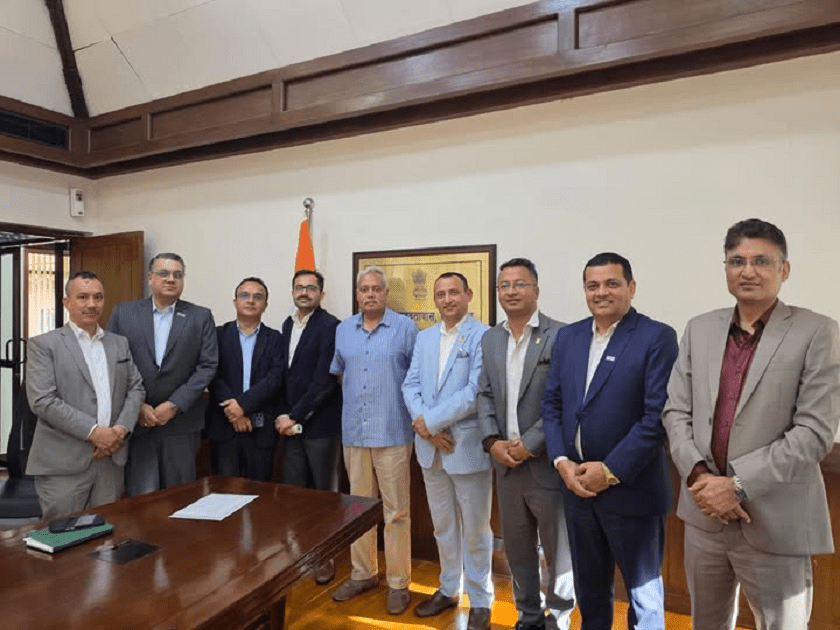
Kathmandu. A meeting was held between the Indian Ambassador to Nepal, Naveen Srivastava, and the new executive committee of the Independent Power Producers' Association, Nepal (IPPAN). The meeting, held at the Indian Embassy, discussed energy trade and cooperation between the two countries, the embassy stated.
During the meeting, the IPPAN delegation discussed cross-border electricity trade and import between Nepal and India, and issues seen in the electricity sector. IPPAN stated that private sector hydropower projects in Nepal have a significant contribution to the electricity being exported between the two countries.
In the meeting, Ambassador Srivastava said that the long-term electricity trade agreement and cooperation between the two countries in 2024 will continue. He stated that this agreement opens a door to great possibilities for cooperation in the hydropower sector. According to the agreement, India aims to import 10,000 MW of electricity from Nepal by the next 10 years, i.e., by 2034.
Ambassador Srivastava mentioned the important role of the private sector in Nepal's hydropower development. IPPAN stated that the active participation and investment of the private sector are necessary to achieve the goal of exporting 10,000 MW of electricity.
IPPAN's Senior Vice President Uttam Lama said that bilateral discussions were held between the new executive committee and the Indian Ambassador to Nepal, Naveen Srivastava, regarding the obstacles seen in energy trade and the hydropower sector. He stated that proposals were presented to the ambassador on topics including making energy trade between Nepal and India smoother.
IPPAN had primarily demanded access to India's Green Day Ahead Market. Currently, Nepal only participates in the Day Ahead Market. Lama stated that IPPAN has demanded facilitation because they are receiving less price per unit, from 75 paisa to 1 rupee, when competing with coal-based energy.
Similarly, IPPAN has also urged to solve the problems seen in transmission line charges. Currently, the private sector has to pay three levels of charges for electricity export: domestic, cross-border, and inter-state transmission.
He stated that a request was made for concessions in imports from Nepal, similar to how transmission charges are waived across India for projects with Indian investment.
During the discussion, issues related to the hassle in renewing the No Objection Letter for explosives required for hydropower projects and the problems faced by projects with Chinese investment were also raised.
He stated that IPPAN also expressed gratitude to the Indian Embassy for India's recent readiness to export an additional 1600 MW of electricity.
According to him, regarding IPPAN's demands, Indian Ambassador Srivastava expressed concern about the delays from various government bodies when operating projects with Indian investment in Nepal.
The ambassador's complaint was that projects are becoming less economically viable due to delays in forest ministry clearance, court injunctions on various projects, and the provision of 21% free energy demanded by the Nepal government.
Both sides expressed commitment to move forward by resolving policy and technical difficulties seen in energy trade in the coming days through mutual understanding.
This specific news has been automatically translated by AI. As a result, there may be some inaccuracies or language errors.