Nepal Communist Party's First Manifesto (1949)
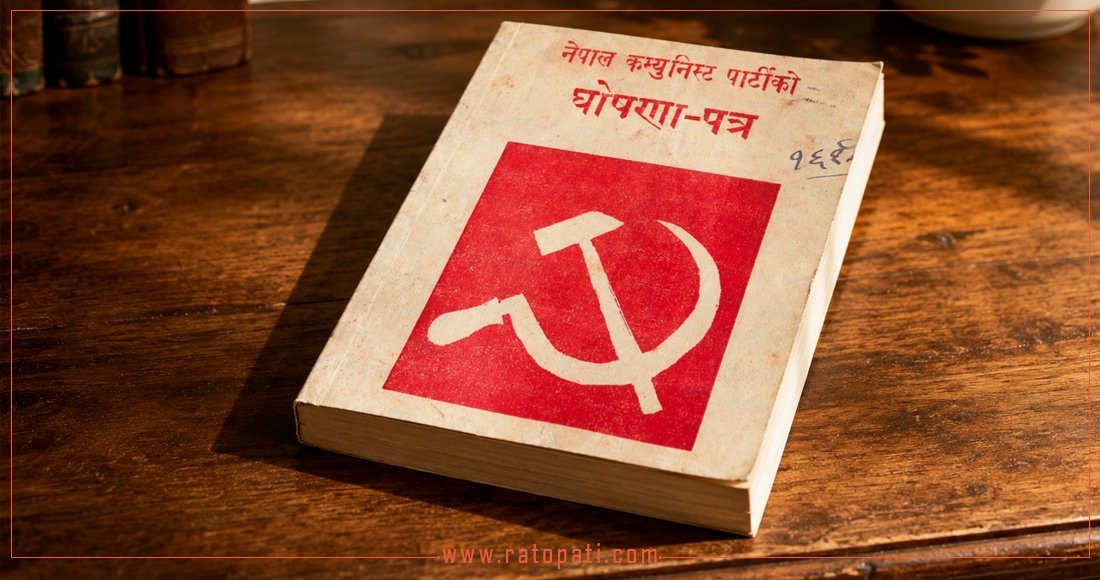
Nepal Communist Party's (First Manifesto)
(15 September 1949)
Mountains, hills, rivers, land, all of it
Why should we be slaves, owning everything!
In the past forty years, two world wars have occurred. As a result of the first world war, one-sixth of the world's landmass has been freed from the capitalist sphere, a great historical reality. This is a great historical reality, and the Soviet Union was born, and scientific socialism has been born, and it continuously calls upon the exploited and working people of all countries to rebel against capitalist and feudal slavery. Therefore, the capitalist ruling classes of Britain, France, and America raised Hitlerite fascism against the Soviet Union and directly paved the way for the Second World War, but as a result of the Second World War, not only was the Soviet Union not destroyed, but many countries in Eastern and Southeastern Europe freed themselves from capitalist-imperialist captivity and expanded the borders of the socialist world. As a result of the Second World War, the international labor movement has taken a great leap forward, and colonial peoples have taken the path of open armed rebellion. The fronts and rear of world capitalism are in grave danger.
The revolutionary wave currently sweeping Southeast Asia has also reached our beloved country, Nepal. Challenging the feudal oppression of an era, Nepal's working class entered the struggle for the first time in March 1947. Workers at the Biratnagar Jute and Textile Mills went on strike for a living wage and better working conditions. The labor union, formed secretly under the leadership of Comrade Manmohan Adhikari, led the strike. The leaders of the Nepali National Congress, supported by treacherous Indian socialist leaders and exiled Ranas, betrayed the strike. The wave of strikes also spread to the capital. In Kathmandu, government employees of the electricity and mint departments, and bank and hospital employees, went on strike with similar demands. The strikers were so determined that the government was forced to increase salaries and provide rations. Although salary increases and food procurement facilities were limited only within the Kathmandu Valley, the entire people of Nepal took it as their own victory and understood the need for public struggle to protect their rights.
1
Feudal autocrats have been ruling Nepal since 1385. The changes over these centuries have only strengthened the autocracy of the Ranas. Although a capitalist mode of production has been implemented in some parts of Nepal, feudal production relations and administration still have a decisive influence.
The country is still dominated by a self-sufficient natural economy, but it is in a dying state. Farmers produce not only their food but also most of the things they use themselves. The Ranas, landlords, Dwares, Thalus, and Mukhiyas spend the revenue collected from the farmers on their personal enjoyment. Previously, that revenue was used for barter. Although the feudal parasites have implemented such a system, it does not yet have a decisive impact.
Most of the land is owned by the feudal ruling class, i.e., the Ranas, Sahebjyu, Gharaniyas, Zamindars, and Gurujyus. Farmers own very little land, or no land at all. Farmers cultivate the land of their masters using their own tools and give three-fourths of their harvest to satisfy the greed of those masters. Although slavery was abolished in 1924, the practice of brutal physical punishment still exists. Feudal lords still have the legal right to imprison farmers for up to 15 days. In reality, the condition of the farmers is no better than that of serfs.
Farmers bear the unbearable burden of exploitation by all the Ranas and feudal lords, and in addition, they support the entire feudal bureaucracy and anti-people government army by paying tributes, taxes, and forced labor.
During the Malla dynasty, many feudal lords ruled Nepal. But since 1769, during the time of Prithvi Narayan Shah, Nepal has become a centralized feudal autocratic state ruled by the Ranas and their feudal stooges.
Nepali farmers have never enjoyed any personal, physical, or political freedom, neither in the past nor now. Due to the harshest exploitation and oppression by the feudal ruling clique, Nepal's social system has remained almost stagnant for centuries.
As soon as the Ranas came to power through a coup d'état known as the
This specific news has been automatically translated by AI. As a result, there may be some inaccuracies or language errors.



_dnA2Mt3ayJ.jpg)