Lumbini Province Government Fails to Meet Half of Internal Revenue Target

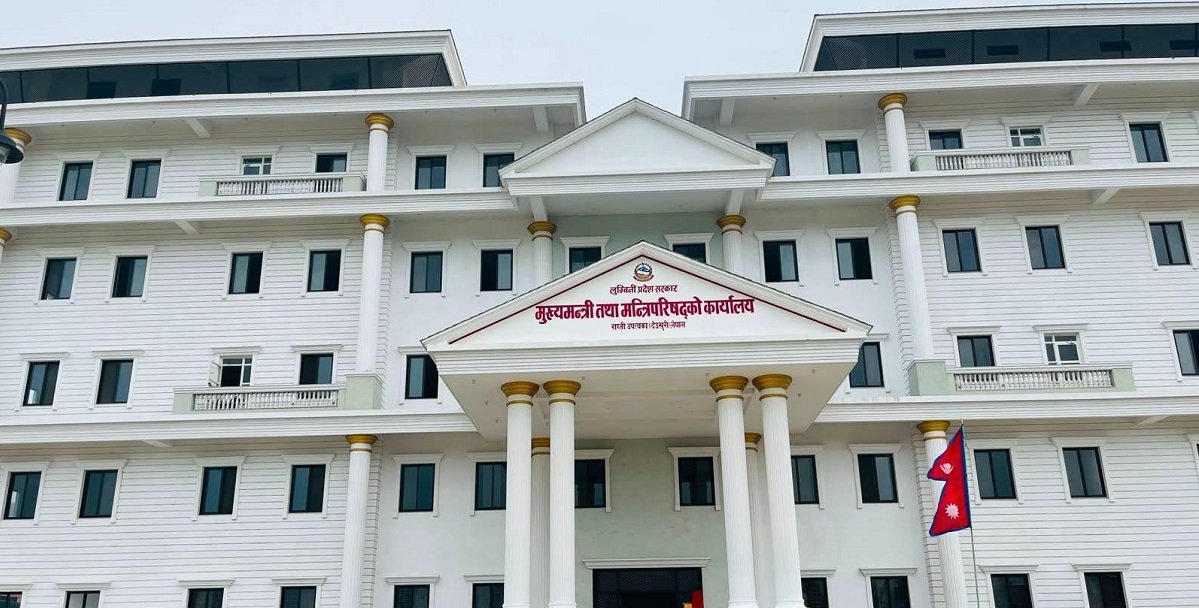
Butwal. The Lumbini Province government could not even meet half of the internal revenue collection target set for the fiscal year 2082/83. The provincial government had set a target of collecting Rs 4.88 billion from internal sources, but by the end of the fiscal year, it had only collected Rs 2.30 billion. This is 49.2 percent of the target. According to the data from the Provincial Treasury and Comptroller Office, out of the total budget of Rs 38.91 billion for Lumbini Province in fiscal year 2082/83, Rs 26.14 billion was spent. Of the Rs 15.43 billion allocated for current expenditure, Rs 10.46 billion was spent. This is 67.76 percent of the current budget. Similarly, out of the Rs 23.47 billion allocated for capital expenditure, Rs 15.67 billion was spent. Capital budget expenditure is 66.80 percent. However, economists have stated that with the provincial government unable to meet its internal revenue target, the province's financial dependence still lies on grants and other external sources received from the federal government. Humraj Bhusal, coordinator of the Lumbini Economic Research Center, said that the provincial government has to depend on external sources as it has not been able to improve internal revenue collection. 'The fact that the provincial government could not collect even half of its internal revenue target is a serious matter. This shows that the province's economic self-reliance is weak,' Bhusal said. What is the situation in which sector? According to the data from the Treasury and Comptroller Office, the transport sector has shown the best performance in the provincial government's internal revenue collection. A target of Rs 300 million was set for revenue collection from the transport sector, of which Rs 245.46 million has been collected. This is 81.82 percent of the target. Similarly, Rs 69.54 million has been collected against a target of Rs 80 million for administrative service fees. This is 86 percent of the target. Rs 83.97 million, or 55.98 percent, has been collected against a target of Rs 150 million for business registration fees. A target of Rs 1.80 billion was set for revenue from driver's licenses and vehicle-related revenue. Of that, Rs 818.56 million has been collected. Although this appears to be a large amount in terms of money, it is only 45.47 percent of the target. A target of Rs 1.99 billion was set for collection from forest sector income, of which Rs 764.22 million has been collected. This is 38.39 percent of the target. Rs 62.59 million has been collected against a target of Rs 150 million from examination fees. This is 41.73 percent of the target.
The provincial government has stated that the main reasons for the failure to meet the internal revenue collection target in Lumbini Province are the decline in economic activities, the lack of effectiveness in the tax collection system, and the failure to set realistic targets.Rs 19.11 million has been collected against a target of Rs 35 million from the sale of agricultural produce. This is 54.61 percent. The tax on agricultural income appears to be very low. Against a target of Rs 52,000, only Rs 15,300 has been collected, which is 29.72 percent. Rs 18.07 million has been collected against a target of Rs 8 million from government property rental tax. This is 22.59 percent of the target. The lowest revenue collection has been under the other fees related to water resources. Against the target, only Rs 2,000 has been collected as revenue under this heading. Overall, the main sources of internal revenue for the province, including service fees, duties, permits and license fees, and other non-tax revenues, have not been collected as per the target. Although significant revenue has been collected in some sectors in terms of amount, the collection is weak compared to the target. What is the government doing? The provincial government has stated that the main reasons for the failure to meet the internal revenue collection target in Lumbini Province are the decline in economic activities, the lack of effectiveness in the tax collection system, and the failure to set realistic targets. Dhanishwar Aryal, deputy secretary and spokesperson of the Provincial Ministry of Finance, said that there are various reasons for the revenue collection being less than the target. According to him, the target for the upcoming fiscal year has been set based on the actual potential for revenue generation. 'Revenue collection has decreased due to a decrease in economic activity, a lack of effectiveness in the tax collection system, and a lack of realism in setting targets,' he said. He said that in the upcoming budget, additional strategies will be developed to increase internal revenue collection. He stated that in the past, there was a tradition of setting high revenue collection targets, but now the focus is on setting realistic targets. Based on the suggestions given by the recently formed task force, the provincial government expects that internal revenue collection will improve in the coming days with the necessary legal reforms and the addition of skilled manpower. 'Necessary laws and legal reforms are being made based on the suggestions given by the task force. With the addition of skilled manpower, we expect an improvement in internal revenue collection in the coming days,' said spokesperson Aryal.
This specific news has been automatically translated by AI. As a result, there may be some inaccuracies or language errors.