Government Backtracks on Mandatory MRP at Customs

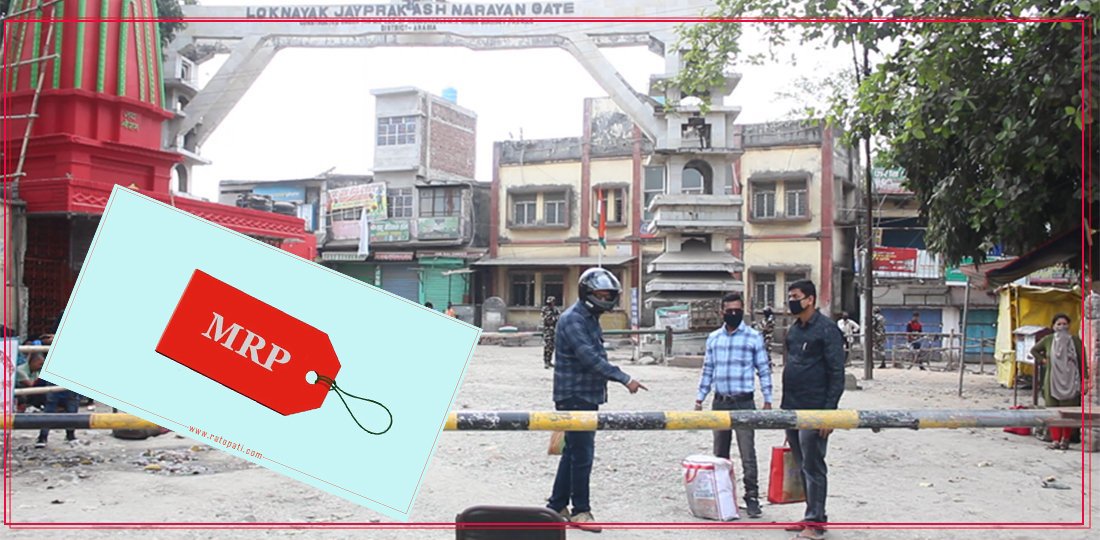
Kathmandu. The government has backed down from the rule to compulsorily set the maximum retail price (MRP) at the customs point for goods imported from abroad. The government has once again recognized the traders' 'self-declaration' by ignoring the provision that was to be strictly implemented from the 1st of Shrawan. This policy, brought to protect consumers from fraud and control artificial price hikes in the market, has been stalled due to a lack of coordination among government bodies. As no further new directives have been issued by the Department of Commerce, Supply and Consumer Protection, customs offices have stated that they are currently clearing goods according to the old style and procedure. Kishore Bartoula, information officer at the Customs Department, clarified that there has been no change in the goods import process even after the beginning of the month of Shrawan. 'Goods are being imported in the same way as they were in the past. We have not received any further directives from the Department of Commerce,' Bartoula said, 'We cannot implement a new rule without clear directives from the Department of Commerce.' This is how the MRP implementation effort began The Ministry of Industry, Commerce and Supply had directed the Department of Commerce to implement this policy after the government included the mandatory MRP in its governance reform plan. Accordingly, the department issued a notice on the 26th of Chaitra, setting a deadline of the 15th of Baishakh for importers. After MRP stickers became mandatory on goods entering Nepal from the 15th of Baishakh, cargo containers began to be stopped at customs points. Importers and traders strongly protested after goods were held at customs, causing the import process to halt for about a week. After extensive discussions between the Ministry of Finance, Ministry of Industry, and Department of Commerce to resolve the pressure from traders and the obstruction at the border, the government made a lenient arrangement for importers to bring in goods with self-declared MRP until the end of Asar. However, from the 1st of Shrawan, it was decided that MRP stickers must be affixed to the goods before they are brought to the customs point. This provision, which was supposed to be strictly implemented from the 1st of Shrawan, does not seem to have been implemented due to a lack of coordination among government bodies. This important step taken for market reform and consumer welfare has been limited to paper for now due to the lack of clarity between the Customs Department and the Department of Commerce. 'The government has fallen under the influence of middlemen and traders' Consumer rights activists have strongly objected to this. Consumer rights activist Bishnu Prasad Timilsina said that this move by the government is a serious betrayal of its commitment to consumers. He claimed that the government's reluctance to implement the MRP provision, which is clearly stated in the Consumer Protection Act, proves that the government has fallen under the influence of middlemen and traders. 'A strong government close to a two-thirds majority can do anything it wants. However, the inability to implement MRP, which is guaranteed by law and is an important tool to protect consumers from fraud, proves that this government belongs to middlemen and traders,' said activist Timilsina. He emphasized the need to strictly implement MRP at the customs point to ensure fair pricing for consumers and control black marketing and fraud in the market. The activists stated that the failure to implement the legal provision will increase the arbitrary behavior of traders in the market, and consumers will directly bear the brunt of it. Facility of Self-Declaration at Customs, but Strictness in the Market The Department of Commerce, Supply and Consumer Protection has brought market monitoring to strictly implement the provision that all goods sent to the market from the 1st of Shrawan must have mandatory MRP. The department has clarified that action will be taken according to the law if MRP is not found during monitoring. Anil Kirati, information officer at the Department of Commerce, said, 'From the 1st of Shrawan, all goods in the market must have MRP. If MRP is not found during monitoring, we will take action; we are implementing that decision.' According to Kirati, traders are not obligated to affix MRP at the customs point itself. The department has continued the old facility for importers to bring in goods with self-declaration at customs. However, these goods must have an MRP sticker compulsorily before reaching the market. 'We don't have time to monitor at the customs point; our monitoring is in the market,' Kirati clarified. 'Importers can bring goods with self-declaration at customs, but our decision is that they must have affixed MRP by the time they reach the market.' Previously, the department had also allowed traders to bring in goods with self-declaration, considering it as preparation time. Although stricter implementation was expected from the 1st of Shrawan, the department has stated that it has continued the provision of self-declaration at customs. However, the department says that for goods that have reached the retail market, no excuse will be accepted if MRP is not found. Ministry Says: It Became Difficult to Make it Mandatory at Customs, Bringing Policy Clarity Based on Goods The ministry has stated that the provision to make MRP mandatory for goods imported from abroad at the customs point has not been implemented for the time being. According to Ministry Spokesperson Netra Prasad Subedi, due to the current customs structure and practical difficulties, policy clarity is still needed on making MRP mandatory for all goods. Previously, when MRP was implemented in Baishakh, the provision to allow goods to be brought in with self-declaration at customs was made after protests from traders. Regarding the failure to fully implement the provision to make MRP mandatory at customs from the 1st of Shrawan, Spokesperson Subedi said that some points of the 18-point action plan formulated earlier for MRP implementation have proven difficult to implement in practice. 'Looking at the current customs structure and technical aspects, some points of the 18-point plan seem impractical to implement,' Subedi said. 'We have to move forward by considering not only policy matters but also practicality and the problems of our traders.' Spokesperson Subedi indicated that a strategy is being developed to proceed based on the specific problems of each commodity, rather than making MRP mandatory for all goods at once. According to him, efforts are being made to regulate items like footwear and clothing separately by issuing individual notices (item-wise). He informed that continuous coordination is ongoing between the Customs Department and the Department of Commerce for this. Traders are confused as the Department of Commerce has not given clear instructions regarding MRP at customs. In this regard, Spokesperson Subedi admitted that clarity is still needed on what to do at the customs point (border). However, he clarified that monitoring in the domestic market has not stopped. 'MRP monitoring is ongoing; it cannot be said that monitoring has stopped,' he said. 'Monitoring of MRP in markets and warehouses by the Department of Commerce is continuously happening. We are on a line of doing whatever is possible through the coordination of the Customs and Commerce Departments.'


This specific news has been automatically translated by AI. As a result, there may be some inaccuracies or language errors.