Power Outages Disrupt FIFA World Cup Final Viewing in Nepal, Authorities Cite Natural Disaster

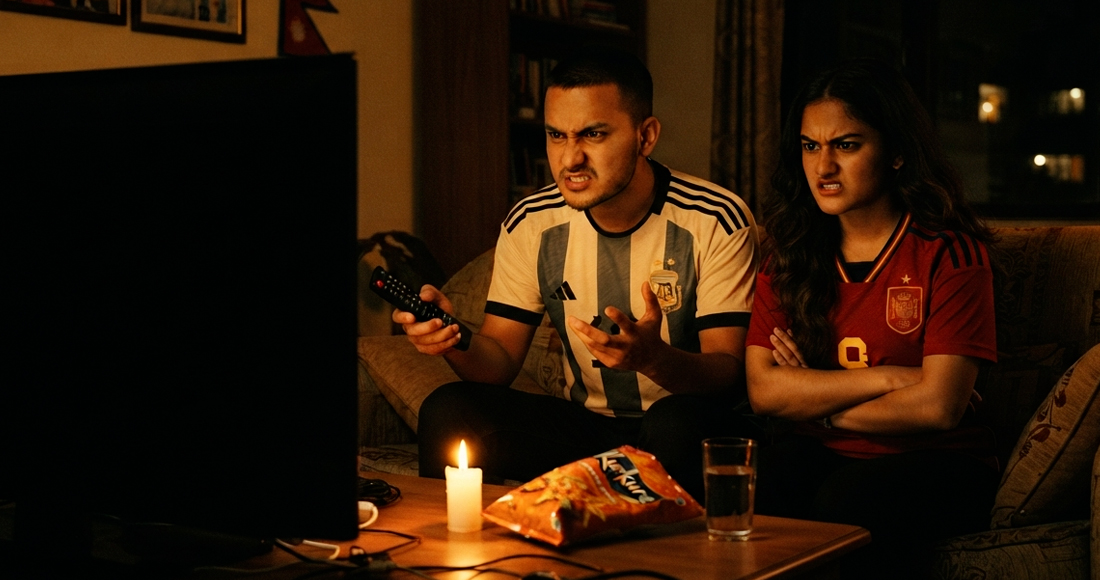
Kathmandu. It was around two in the night. It was raining heavily outside, but the atmosphere inside homes across the country was heated.
The FIFA World Cup 2026 final clash between Argentina and Spain had increased the heartbeats of Nepali football fans. Some had the remote in their hands, others had their eyes on the mobile screen. From hotels, restaurants to everyone's living rooms were resounding like stadiums.
But, as the excitement of the game reached its peak, the lights suddenly went out. In an instant, the entire country was plunged into darkness. The colorful screens of televisions turned black.
It was not just the electricity line that was cut; fans who were excited by the thrill of the game and worried about their supported team not scoring a goal became angry when the lights went out suddenly.
Within five minutes of the power outage, social media walls were filled with anger. Some cursed calling it an 'anti-darkness government', some demanded the resignation of the energy minister. Some remembered the past.
Social media walls were filled with complaints that even with a powerful and popular government, the game was tampered with. The disruption during that historic moment of football so agitated football fans that a barrage of curses began against the authority.
After a while, the lights came back on. Football fans in every home, at every junction, in hotels and restaurants felt relief. But that happiness did not last long. After the power was cut again, more curses were rained down on the government on social media.
After a short interval, when the power came back on, football fans started watching the game again after cursing the government on social media.
The Electricity Authority spoke about the reason for the power outage at 1:45 AM and 2:30 AM only on Monday morning. The authority informed that a problem occurred due to a large tree falling in the Pathalaiya-Dhalkebar 132 KV transmission line in the Pathalaiya wildlife area around 1:54 AM.
According to the authority, the same tree caused a ring break in the transmission line. The authority stated that this was an unexpected natural disaster caused by adverse weather and continuous rain, which plunged many parts of the country, including the Kathmandu Valley, into darkness.

The authority said, 'We had kept all substations and technical teams on standby with special attention to the World Cup final. But it was unfortunate for us too that the tree fell and the system was disrupted.'
As soon as the incident occurred, the authority's technicians worked to restore electricity by making alternative arrangements, braving the rain. But the few minutes of darkness in between had already deeply hurt the hearts of football fans. The authority has apologized to its consumers and sports fans.
However, not only the World Cup final, but the problem of intermittent power outages has been ongoing for a long time. Especially with the onset of summer, this problem is seen more in urban areas, Terai, and districts of Lumbini Province.
The problem of 'tripping', where electricity goes out intermittently in various places including the Kathmandu Valley, has increased. It has been a long time since load shedding was abolished, but the 'tripping' problem, reminiscent of load shedding, has appeared.
Electricity has been going out intermittently in the morning, afternoon, and evening in the Kathmandu Valley and across the country. Consumers are suffering due to this continuous problem of electricity coming and going in the morning, afternoon, and evening.
It is claimed that there is sufficient electricity production in the country and load shedding has ended. However, even with increased electricity production, consumers have started complaining about the 'tripping' problem, which is reminiscent of load shedding.
Consumers have complained about electricity going out multiple times a day in Terai Madhesh Province and various districts of Terai like Bara, Banke, Kailali, Rupandehi, long power outages at night, and in some places, not being able to run fans due to very low voltage.
After the power went out 4-5 times a day, some people are writing on social media that load shedding has started again. This issue has been acknowledged by the energy minister and the authority.
The acting executive director of the Electricity Authority, Dirghayu Shrestha, says that although production has increased, consumers are facing such problems due to some weaknesses in the distribution system infrastructure. According to him, the main reason for the recent intermittent power outages is the load on the distribution system.
Especially in the districts of Terai, the use of pumps and motors for irrigation has increased with the rise in temperature, increasing the load on transformers. He said that in some cases, tripping occurs when there is excessive load on only one phase of the transformer.
According to him, in rural areas, voltage problems and disruptions occur because the 11 KV transmission lines are more than 10-12 kilometers long. In some places, wooden poles and low-capacity wires are still being used.
Shrestha said that last night's problem was a natural disaster rather than a technical one. According to him, the system was also affected by the closure of some hydropower plants and damage to transmission lines due to reasons like floods and landslides.
Acting Executive Director Shrestha said that the authority is preparing to strengthen the distribution system with a large investment. He said that these problems will be solved once various substations and transmission lines are completed.
He said that the authority's priority is now not just to supply electricity, but to provide quality and reliable service.

However, the energy minister is also under stress due to the recent intermittent power outages. Energy Minister Biraj Bhakta Shrestha has been instructing the Nepal Electricity Authority and its subordinate bodies to resolve the problem immediately.
Minister Shrestha has been stating in various public forums and in parliament that providing easy, reliable, and quality electricity service to consumers is the first priority and responsibility of the Electricity Authority and the government, but the problem has not been resolved.
Even during a festival like the World Cup, Energy Minister Shrestha has to face criticism due to power outages. He has also formed a task force to ensure an effective solution to the problem of intermittent power outages. He has been stating that negligence, delay, or irregularity in electricity service delivery will not be tolerated under any circumstances.
- Tripping Decreased by 40 Percent, But Hassle Remains the Same
The Electricity Authority claims that not only electricity production but also the system has improved recently. However, the public is still facing the same hassle of intermittent power outages.
According to the authority, compared to the last two financial years, the rate of electricity line tripping has decreased in the last financial year. There has been a significant decrease in the rate of technical faults in the electricity system, i.e., line tripping.
The authority stated that compared to the financial year 2081/82, the number and duration of electricity tripping decreased by about 40 percent in the last financial year 2082/83 (up to Jestha 14). The authority claims that with a significant decrease in the rate of line tripping, the electricity service provided to consumers is becoming more reliable and of higher quality.
According to the data provided by the authority, in the financial year 2081/82, there were a total of 71 system trippings throughout the year. Due to this, the power supply was interrupted for a total of 8 hours and 11 minutes.
However, looking at the details until Jestha 14 of the last financial year 2082/83, the number of trippings has decreased to 42. This number shows an improvement of about 40.84 percent compared to the previous year.
Similarly, there has been a significant improvement in the total duration of tripping. While it was 8 hours and 11 minutes in the previous year, it has decreased to 5 hours and 5 minutes last year.
This data shows that the authority is succeeding in managing technical disruptions in the system. However, this is not reflected in practice. Consumers have always faced problems due to technical disruptions in the system.
- Monthly Analysis: Where Was the Improvement?
According to the data provided by the authority, the nature of tripping is different during the peak demand seasons of winter and summer. The period of high electricity load is Jestha and Asar. The system faced the highest pressure in the months of Jestha and Asar of the financial year 2081/82.
In these two months, there were 14 trippings each, respectively. However, in 2082/83, this number has decreased to 8 in Jestha and 7 in Asar (up to Jestha 14). The tripping duration in the month of Jestha has decreased from 1 hour 24 minutes to 1 hour 15 minutes.
_WaB8RtuGNH.png)
- Months of Zero Tripping
The authority stated that there were no trippings in the months of Mangsir, Poush, and Chaitra last year. The authority considers this a great success. In the previous year, there were 2 trippings in Mangsir, 3 in Poush, and 6 in Chaitra.
The authority stated that the reduction of tripping to zero during the winter, when electricity consumption is high, shows that the strengthening of the distribution system has been effective.
In the month of Ashwin of the financial year 2081/82, there were 10 trippings, causing a power outage of 1 hour and 48 minutes. However, last year, the number of trippings in the same month has decreased to 7, and the duration has been limited to 41 minutes.
- Past Dire Situation and Present Change
Over the past decade, tripping and load shedding were almost synonymous in Nepal. Before 2073 BS, Nepal experienced load shedding for up to 18 hours a day. Even in the initial years after load shedding ended, the problem of tripping, referred to as 'unannounced load shedding' due to the old and weak system, caused considerable hardship to consumers.
In previous years, tripping was common even with light winds or rain. Five to seven years ago, tripping incidents occurred in the hundreds throughout the year. Due to the lack of system improvement, transformers would explode, fuses would blow, and substations would face problems, causing significant losses to the industrial sector.
However, the data from the last two years shows that the authority has shifted its focus from 'quantity' to 'quality'. The reduction in tripping duration from 8 hours to 5 hours has had a positive impact on the safety of electrical equipment and industrial productivity.
Electricity tripping is not just a power outage; it has a multifaceted impact on the economy. When tripping occurs, large industrial machines stop, and it can take hours to restart them. This increases production costs. For domestic consumers, a reduction in tripping also minimizes the risk of damage to sensitive electrical appliances like televisions, refrigerators, and computers.
This specific news has been automatically translated by AI. As a result, there may be some inaccuracies or language errors.