First Monday of Saun Observed with Devotion

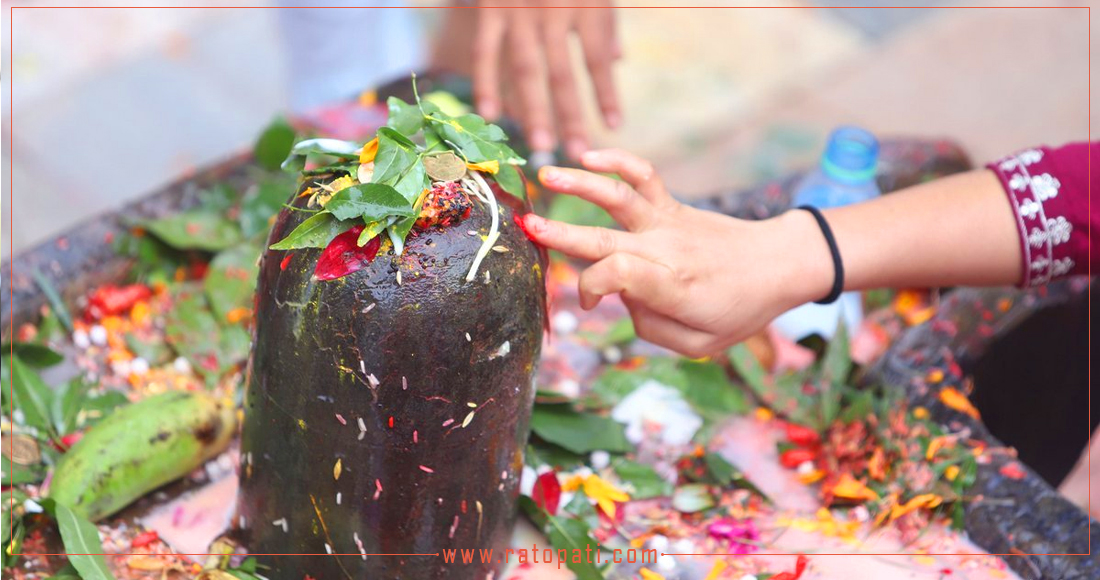
Kathmandu. The month of Saun is considered very dear to Lord Shiva in Hinduism. In this context, today, the first Monday of the month of Saun, is being celebrated with special devotion and reverence. Since ancient times, a tradition of fasting, worship, chanting, meditation, Abhishek, and charity- પુણ્ય on every Monday of Saun has been prevalent. It is a scriptural belief that observing fasts with devotion and worshipping Lord Shiva in this month fulfills desires, destroys sins, brings mental peace, and bestows happiness, peace, and prosperity upon the family.
In religious scriptures, the month of Saun is considered an auspicious time for meditation, chanting, fasting, charity, and devotion to Shiva. A religious belief connecting the month of Saun to Lord Shiva is also linked to the Samudra Manthan (churning of the ocean). According to the Puranas, when the gods and demons churned the ocean to obtain nectar, the first thing that emerged was the Koot (Halahal) poison. The entire creation fell into crisis due to the effect of that poison, and Lord Shiva consumed it for the welfare of the world, which was in the month of Saun. To reduce the heat of the poison, the gods continuously offered water to Shiva, and in remembrance of this event, the tradition of offering water to the Shivalinga throughout the month of Saun developed.
Monday is considered the day of Lord Shiva. In Sanskrit, the word 'Som' means moon. Lord Shiva, who wears the moon on his matted locks, is also called 'Chandrashekhar'. Since the moon is considered a symbol of coolness, mind, and peace, it is a religious belief that worshipping Shiva on Mondays brings peace to the mind, reduces mental stress, and provides positive energy. Especially, the Mondays of Saun are considered even more fruitful than the Mondays of other months. On this day, there is a tradition of observing fasts, chanting the mantra 'Om Namah Shivaya', performing Rudrabhishek, and listening to the Shiva Purana. The glory of Shiva worship is extensively described in scriptures like Shiva Purana, Skanda Purana, Linga Purana, and Padma Purana. The Shiva Purana mentions that devotees who worship Shiva with devotion are freed from all sorrows, while the Linga Purana highlights the special significance of Abhishek with water, milk, curd, ghee, honey, and sugar.
According to astrology, the moon is considered the planet of mind, water, emotions, peace, and mental balance. Since Lord Shiva wears the moon on his head, he is considered the presiding deity of the moon. Worshipping Shiva strengthens the moon, leading to peace of mind, self-confidence, and the development of positive thinking. It is believed that health improves for those suffering from depression, lung problems, or asthma by fasting and worshipping Shiva in Saun. Since the moon is also considered the ruling planet for the stock market and financial sectors, worshipping the moon and Shiva can lead to financial prosperity.
Furthermore, the moon is also considered the ruling planet for land and mother, so fasting in Saun strengthens the moon, leading to the acquisition of more stable assets and a stronger relationship with the mother. Although Jupiter has become combust since Asar 32, daily rituals such as bathing, Sandhya, Panchayan Puja, Chaturmasya Vrat, Tulsi Puja, and vows like Ram Navami, as well as unavoidable daily rituals and funeral rites, mourning periods, death rituals, and eclipse bathing, can be performed without hindrance. During this period, specifically on Saun 9th, which is the day of planting Tulsi (Harishayani Ekadashi Vrat) and the beginning of Chaturmas Vrat, these activities are not scripturally obstructed.
The tradition of observing Saun Monday fasts is believed to have gradually developed since the Vedic era. Initially, sages and hermits used to stay in one place during the rainy season for meditation, chanting, and Shiva Sadhana. Later, during the Puranic period, as devotion to Shiva became widespread, the practice of special worship and adoration in the month of Saun began among the general public. In Hindu society, the tradition of women observing Saun Monday fasts for the welfare of their husbands, families, and children became even more widespread. Over time, men, young men and women, and the elderly also began observing this fast, wearing green attire, bangles, and applying mehndi, believing it would fulfill their respective desires.
The main objective of Saun Monday is to express devotion, reverence, and surrender to Lord Shiva. The fast observed on this day develops self-control, discipline, tolerance, and spiritual consciousness in individuals, as well as helps in keeping the mind, speech, and actions pure. Therefore, special importance is given to practices like speaking the truth, renouncing anger, eating sattvic food, not harming living beings, donating, and chanting Shiva's name on this day.
Unmarried girls observe the fast with the wish of obtaining a suitable spouse, and married women observe it for the long life, health, happiness, and prosperity of their husbands and families. On Saun Mondays, there is a special crowd of devotees at Pashupatinath, Doleshwor Mahadev, Halesi Mahadev, Kirateshwar, Gosainkunda, and Shiva temples across the country, where devotees bathe and offer water, Belpatra, Datura, flowers, and fruits to the Shivalinga.
This specific news has been automatically translated by AI. As a result, there may be some inaccuracies or language errors.