Poet Dipendra Acharya's 'Byapar Prithivi Ko' Explores Identity and Commercialization

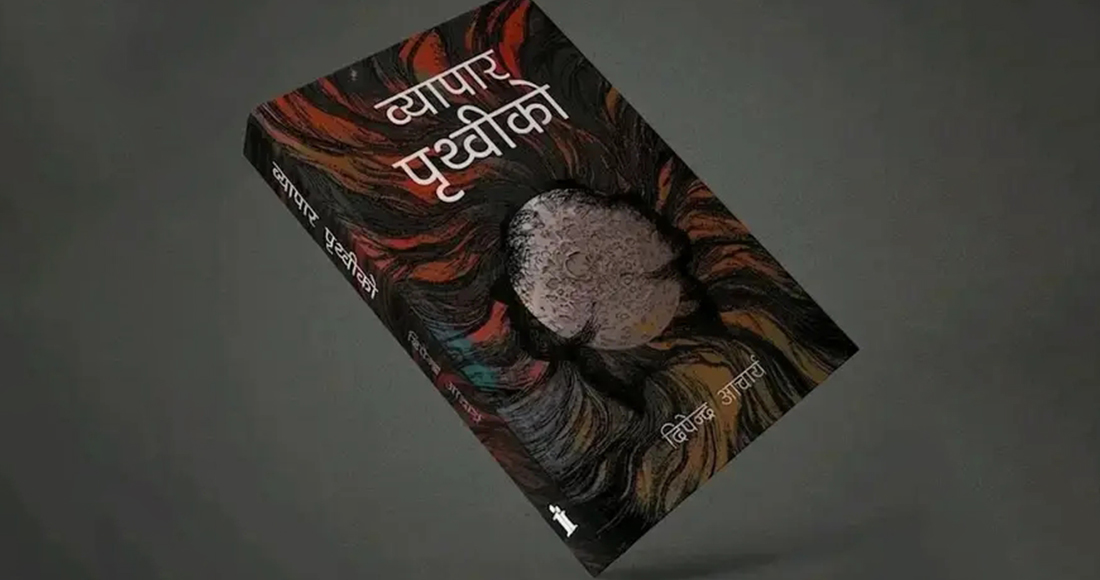
In the crowd of contemporary Nepali poetry, poet Dipendra Acharya is a strong voice with distinct ideological integrity and intense human emotion. In an age entangled by the market, he has arrived in this market with the poetic offering 'Byapar Prithivi Ko' (The Business of Earth), searching for human existence and identity.
Published by Indigo Ink in Bhadra 2082, Acharya's work is not just an adornment of words. It attempts to view one's identity and society with a new perspective. It has established itself as a strong social and cultural document, particularly highlighting the conflict between ethnic identity deeply rooted in Nepali society and the consciousness of global humanity.
Poet Acharya has strongly attacked the artificial ethnic hierarchy and narrow-mindedness that have been constructed in society for centuries. In the central poem of the collection, 'Timi ra Ma' (You and I), he realistically portrays the gap between biological equality and social discrimination. The poet strongly disagrees with the historical discriminatory regime that created an institutional structure of oppression by highlighting differences in the height of a person's nose and the shape of their eyes, and by distinguishing water sources. Declaring that vision, smell, breath, and mind have no caste or geography, the poet proclaims that human identity acquired by birth is paramount.
Similarly, the poems 'Ishwor-1' and 'Ghaau' (Wound) voice the pain of the marginalized 'Bhuimanche' (ground dwellers) in the name of ethnic identity. The poet poignantly yet rebelliously presents the state that remains a mute spectator when a Dalit's house is burned and the identity of oppressed castes used merely as vote banks during elections.
Poet Acharya does not fall into narrow communalism when discussing ethnic identity; rather, he joyfully embraces the beauty of multi-ethnic and multicultural Nepal as a shared identity. In poems like 'Hami' (We) and 'E Gham! Na Astaunoo Timi' (O Sun! Don't Set), he presents Nepal's geographical and cultural diversity in an integrated manner. His view is that scriptures like Mundhum, Vedas, Tripitaka, Gita, Bible, and Quran, as well as philosophical and cultural symbols like Sumni-Paruhang, Shiva-Parvati, and Buddha, are not the pride of any single caste but are the shared pride of all Nepalis. This interconnectedness within diversity is the true identity of being Nepali.
This cultural coordination is also evident in the poems 'Mero Begonia' and 'Pashupatinagar ko Nyaano Gham' (The Warm Sun of Pashupatinagar); where, although geography is divided by borders and nationality, the shared sun, Buddha's message of peace, and intimacy continue to bind humanity in a single thread.
The poem 'Byapar Prithivi Ko', which carries the title of the entire collection, is a strong and serious socio-political satire. It sharply attacks the extreme selfishness, extreme commercialization, and moral decay of modern humans. The poet vividly portrays deceitful people like watermelons with different exteriors and interiors, political merchants selling dreams in the name of revolution, and the plight of ordinary people and the exploitation of their sweat.
The poem symbolically and subtly depicts how humans have made the Earth, Moon, Mars, and even great ideas and philosophies a tool for their commercial interests and divisions. He believes that humans have lost their human sensitivity and hearts, leaving only stones. The poet exposes the bitter reality through this excellent creation: humans are killing the entire living Earth for their self-interest, putting it in a plastic bag, and trading nature and existence itself.
Another strong aspect of this collection is the revelation of how the modern consumerist market is disfiguring indigenous ethnic and cultural identities. In the poems of the 'Byapar' (Business) and 'Kaanch' (Glass) series, the truth is revealed that today's humans, in their haste to become postmodern, are living in cosmetic and fake appearances, forgetting their primitive indigenous values, the scent of sweat, and the history of labor. In the poems 'Viral' and 'Phaledo' (a type of fruit), the poet sharply satirizes the fake virtual identity of people lost in Facebook, TikTok, and Reels.
Through the destiny of youth forced to migrate to the Gulf and Europe with a green passport, leaving behind their soil, indigenous musical instruments like Damphu, Chyabrung, Madal, and the original fragrance of stone spouts, the poet poignantly captures the helplessness in the poems 'Yuwa' (Youth) and 'Dozar' (Bulldozer), showing how the country's identity has reached a fragile and breakable state like glass.
Ultimately, Dipendra Acharya's 'Byapar Prithivi Ko' urges humans to break free from the illusion of imaginary geography or artificial identity. As stated in the poem 'Bhuimanche' (Ground Dweller), a person's true and pure identity lies not in the stars or the moon, but in living in unison with their own earth's fields and granaries, sweat, and the entire nature. Ethnic identity should not be made a politics of negation; rather, it should be made a basis for cultural enrichment and oriented towards a grand human identity – this is the most outstanding aspect of this creation.
Congratulations to poet Dipendra Acharya and publisher Indigo Ink for this rare confluence of thought and craft!
This specific news has been automatically translated by AI. As a result, there may be some inaccuracies or language errors.




_iL3K2wYemS.jpg)