Nepal Launches Five-Year Plan to Revitalize Carpet Industry

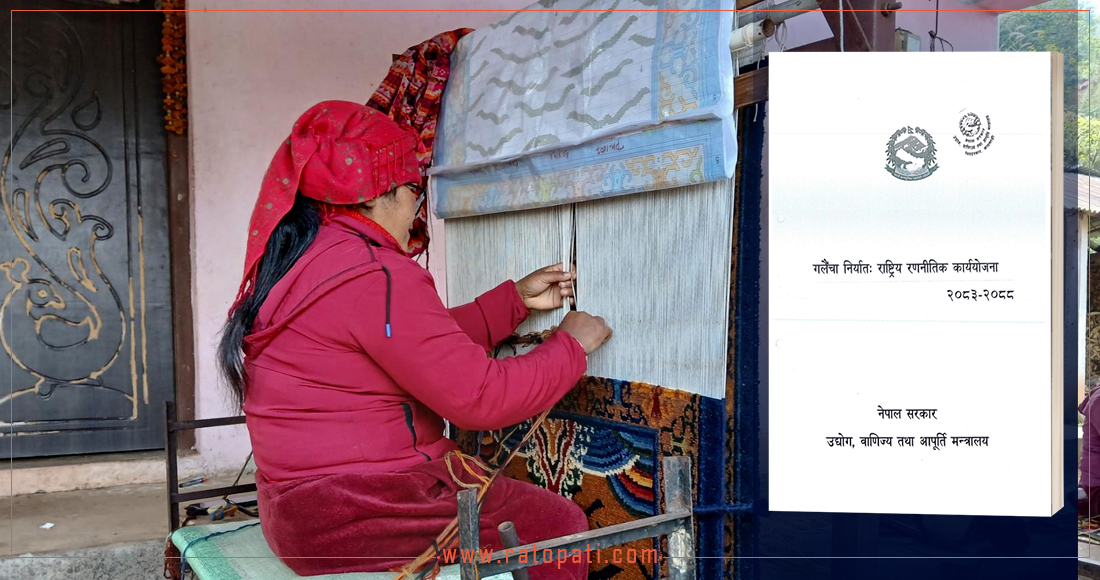
Kathmandu. The government has put forward an ambitious five-year plan to bring the Nepali carpet industry, considered the main backbone of Nepal's economic transformation, job creation, and foreign exchange earnings, back to its old rhythm.
The Ministry of Industry, Commerce and Supplies has approved and implemented the 'Carpet Export: National Strategic Action Plan (2083-2088)' through a ministerial decision on Ashad 17, 2083.
This strategy has been prepared with the main idea of establishing Nepal as a high-value carpet production and export center in the world market by stopping the continuous decline in carpet exports over the past two and a half decades. This strategy, prepared by a task force formed in coordination with inter-ministerial bodies and umbrella organizations of the private sector, aims to enhance the global competitiveness of Nepali carpets.
- Historical Background and Grim Current Statistics
The history of hand-knotted carpets in Nepal is very old. Although the beginning of weaving culture is believed to be around 3000 BC, commercial and export-oriented production began with the arrival of Tibetan refugees in the 1960s. Nepali carpets, first exported to Switzerland in 1962 with the help of a Swiss agency, dominated the luxury markets of Europe and America by the 1990s.
However, according to data from the Trade and Export Promotion Center (TEPC), this industry is currently in serious crisis. In 1999 (2056 BS), Nepal exported 2.5 million square meters of carpets and earned 142 million US dollars. But currently, exports have shrunk to about 600,000 square meters and 90 million US dollars.
According to the strategic report, carpet export volume has declined by approximately 81.89 percent in the last 25 years, while the decline in dollar value has been 24.33 percent. However, the price per unit of carpet has increased about 5 times since 1999. Due to high costs, Nepali carpets are now limited to a niche market for high-value goods in the global market.
Looking at the share of industrial exports, carpets accounted for 11.98 percent of total industrial exports in 2016. In 2021, this decreased to 4.44 percent, and in 2022, it increased slightly to 7.41 percent.
_IFYuXkAXLR.jpg)
- Contribution to the Economy: Employment for 300,000
Despite the decline in exports, its strategic importance to Nepal's economy remains. Currently, this industry provides direct and indirect employment to about 300,000 citizens. Of these, 65 percent are women workers. It provides meaningful employment to the marginalized and poor in rural areas.
The strongest aspect is that 80 percent of the total value addition in the carpet sector occurs within Nepal. In 2024/25 alone, woolen carpets earned foreign exchange worth 10.78 billion rupees, accounting for 3.9 percent of Nepal's total exports. In that year, carpet exports increased from 414,000 square meters to 472,000 square meters, a growth of 13.93 percent compared to the previous year.
- Reasons for Decline
The strategic action plan has conducted a detailed analysis of the main weaknesses and challenges of the carpet industry. Currently, the main raw material required for carpets (especially Tibetan wool) is fully imported. This leads to fluctuations in production costs and market prices.
Similarly, increasing dependence on Indian migrant workers, traditional technology, misuse of Nepali brands in the international market, expensive certification facilities compared to competing countries (India and Pakistan), and high air freight due to being landlocked have reduced the competitiveness of Nepali carpets.
- 4 Main Objectives of the Strategy and New Plans
To solve the problems, the strategy has set 4 main objectives:
1. To enhance carpet production, productivity, and competitiveness.
2. To strengthen quality, certification, branding, and value addition.
3. To strengthen international market access.
4. To strengthen institutions and develop a conducive business environment.
- Carpets to be Produced from Allo, Hemp, and Banana Fiber
The most interesting and innovative aspect of the action plan is finding alternatives for raw materials. To reduce dependence on imported wool, research and development will be promoted to produce unique, high-value carpets using natural raw materials available in Nepal such as allo, hemp, banana, and bamboo fiber. Collaboration with universities and research institutions will be undertaken for this.
Similarly, in the context of products from other countries being sold under the name of Nepali carpets and brand misuse in the international market, the government has planned to develop, register, and promote a 'Nepali Carpet Collective Brand and Trademark'. Furthermore, in addition to traditional markets (Europe and America), the Middle East and Asian countries will be developed as new markets. The use of e-commerce platforms and digital marketing will be increased to reach international customers directly, instead of relying on intermediaries.
- Social Security and Training for Workers
To attract the younger generation to this industry, training in modern technology and design will be provided through the Council for Technical Education and Vocational Training (CTEVT). Additionally, to ensure social security (pension, health, accident insurance) for workers in the carpet industry, they will be enrolled in the Social Security Fund.
Similarly, programs will be included in the annual budgets of the federal, provincial, and local governments for the implementation of this five-year strategy. The Ministry of Industry, Commerce and Supplies will lead, with active participation from the private sector including the Federation of Nepalese Chambers of Commerce and Industry (FNCCI), the Confederation of Nepalese Industries (CNI), and the Federation of Nepalese Export Entrepreneurs.
In accordance with the provisions of the Nepal Trade Integration Strategy, 2080, the National Program Implementation Unit will regularly monitor and evaluate its implementation as stated in the report. If this joint effort of the government and the private sector is successful, it is expected that Nepali carpets will re-establish their lost historical glory in the world market.
This specific news has been automatically translated by AI. As a result, there may be some inaccuracies or language errors.
_iL3K2wYemS.jpg)