Journey as a Process of Self-Discovery and Connection with Nature

The journey always begins from the moment the mind asks the first question. Long before a person closes the door of their home, they have set out on a journey carrying their memories, aspirations, and unanswered questions. Therefore, a journey is not just a process of reaching a destination, but also a practice of rediscovering oneself. All paths in the world eventually lead to some geography, but every true journey is complete only when it reaches an unseen region of the inner self.
The path does not just show people new sights, it also gives them new perspectives. Mountains teach patience. Rivers teach continuity. Forests teach the language of silence, and the sky explains the meaning of boundlessness. Every turn encountered on a journey is a question. Every bridge is a possibility. Every river is a philosophy. Every unfamiliar face is a new chapter of life. Perhaps this is why travel is an art of expanding consciousness.
Sometimes we set out to see a place, but when we return, we realize—we have seen ourselves more than the place. Travel diminishes our ego and expands the world. It teaches that 'the earth is not ours to own.' We are merely its temporary travelers—wanderers for a few days on the endless highway of time.
Carrying this feeling, one morning I set out from Kathmandu towards Baitadi. The destination was Jhulaghat, on the banks of the Mahakali. But my quest was not just for a border market; I was searching for—the silence of the mountains, the eternal song of the rivers, the spiritual pulse of the Four Kedars, the self-pride of the birthplace of the immortal martyr Dashrath Chand, and a living chapter of Nepali civilization preserved in the soil of the Far West.
Kathmandu was still asleep. The first golden light of morning was slowly spreading over the Nagargun hills. The roads were quiet. The city had not fully opened its eyes. But my mind had awakened long before, because some journeys begin not with sunrise, but with curiosity. The car turned towards the Prithvi Highway. The mountains were calling me back into their embrace. At that moment, I realized—I was not walking on the road, the road itself was carrying me towards another chapter of life.
As I descended towards Mugling, the Trishuli River flowed alongside as a silent companion on the journey. Sometimes splashing against huge rocks, sometimes disappearing into the blue peace within deep gorges, and sometimes flowing swiftly in its own rhythm towards the sea. As the golden morning sun fell on the river's surface, the water shimmered like countless diamonds. The green hills standing on both sides of the river looked as if they were embracing it with maternal affection. Thin veils of mist were slowly lifting from the lap of the mountains, as if nature was slowly revealing its beautiful face.
Small villages perched on the laps of cliffs looked even more charming in the morning peace. Stone houses, tin and slate roofs, blooming rhododendrons, marigolds, and local flowers in the courtyards brought rural life to life. Smoke rising from the hearth mingled with the air and rose towards the blue sky, giving a sense of warmth and intimacy of home and family.
In the terraced fields, green paddy, corn, and millet plants swayed to the rhythm of the wind. The sweet chirping of birds, the murmuring of waterfalls, and the continuous roar of the river created a unique symphony of nature.
Amidst this beauty, farmers heading to the fields early in the morning looked like true companions of nature. Not only were the fields green with their sweat, but this labor also sustained life in the mountains. At that moment, it felt that the beauty of nature is not limited to sights alone. It lives equally brightly in the flow of the river, the silence of the mountains, the greenery of the fields, and the dignity of hardworking hands.
The atmosphere had changed by the time I reached Narayangadh. Here, the Trishuli and Narayani rivers merge to form a vast life stream. Looking at the confluence of the two rivers, a thought came to mind—difference is not division, union is the law of creation. Rivers do not lose their identity; they become bigger by merging. Humans should also learn this.
I stood by the Narayani River for a while. The water was dividing the sunlight into thousands of pieces. Each sparkle looked like a hope. Nature knows how to make light into poetry.
The car sped west again. The greenery of Chitwan slowly spread into the flat plains of Nawalparasi. Vast Sal forests on both sides of the road stood like silent sentinels of nature for centuries. As the gentle morning breeze rustled the Sal leaves, it felt as if the forest was welcoming the traveler in its own secret language. Rays of sunlight pierced through the branches of the trees, drawing countless patterns of light on the ground. The fragrance of the forest was an invisible poem born from the cycle of life of soil, leaves, and fallen leaves over the years.
Sometimes, troops of monkeys could be seen leaping nimbly from one tree to another. Their agility was like the vibrant heartbeat of the forest. Herds of deer were grazing somewhere. The calm gait of nilgai added further dignity to the forest. The world of birds was even more wonderful. The sweet song of the cuckoo, the cooing of the dove, the pecking of the woodpecker on the tree, the flight of the green parrot, the circular flight of the eagle in the sky, and the collective chirping of countless small birds transformed the atmosphere into a natural concert hall. It felt as if every creature here was adding its voice to the grand orchestra of nature.
Upon reaching Butwal, the Chure hills welcomed me with their green embrace. Here, there is no division between the Terai and the hills; both embrace each other intimately. The forests of Sal, Khair, Saj, Sisau, and Sal growing on the slopes of the Chure decorated the geography with colorful greenery. Bushes clinging to the hilltops, cool spray of waterfalls, rows of bamboo groves, and vegetation adorned with vines and creepers adorned nature in its own rhythm.
West of Butwal, the vast plains of Kapilvastu and Dang opened up. As far as the eye could see, fields of wheat, paddy, corn, and sugarcane stretched out. White egrets fluttering in the fields, storks walking in the water, eagles circling in the sky, and mynas perched on the edge of the fields showed the unique coexistence of agriculture and nature. Clean water flowed in the irrigation canals. Bees and butterflies were busy collecting nectar from the wild flowers blooming on the banks. Colorful butterflies seemed to dance in the air, as if nature had painted dynamic colors on its canvas.
Reaching Kohalpur, the nature of western Nepal felt even more open, cleaner, and more intimate. The air here was not just cool, it was full of life. Somewhere in the forest, one could easily imagine peacocks dancing with their feathers spread. As Bardia National Park approached, the invisible presence of elephants, rhinos, tigers, spotted deer, wild boars, and countless wild animals gave the forest a sense of mysterious dignity.
Every tree, every vine, every flower, and every creature in the forest proclaimed the same truth—nature is a living civilization. It must be understood. It must be respected. This untouched and life-giving natural beauty transformed the journey into a soul-purifying spiritual experience.
As I moved from Kohalpur towards Bardia, the vast Sal forests gave a new rhythm to the journey. The trees stood like thousands of silent ascetics. They do not speak. But within their silence lies centuries of knowledge.
Near Bardia National Park, nature appeared in its most original form. Dense forest. Chirping of birds. Footprints of deer. Possible elephant trails somewhere. The mystery of tiger presence somewhere. The forest never reveals itself completely. It always keeps some secrets. Perhaps mystery is another name for beauty.
Tharu settlements began to appear. Mud houses. Thatched roofs. Clean courtyards. Life here was simple. But within that simplicity was self-respect. Modernity can be measured by convenience, but civilization is measured by the ability to live a simple life.
The evening in Bardia was wonderful. The western sky was ablaze with red. The Sal trees were bathed in golden sunlight. When the wind moved the leaves, it felt as if the forest was chanting an ancient mantra.
After a while, I reached Chisapani. Suddenly, the magnificent form of the Karnali River opened before my eyes. Standing on the bridge, it felt as if the river was measuring not my height, but my ego. Born from the snow-capped peaks of the Himalayas and having traveled thousands of kilometers through difficult journeys, the Karnali flowed here with the same calmness, the same generosity, and the same humility. This river, cutting through rocks, crossing gorges, embracing countless tributaries, was telling a great truth of life—greatness lies not in displaying power, but in the continuous generosity of giving.
Looking down from the Karnali bridge, the blue water of the river sparkled like millions of silver particles in the morning sun. The green forests stretching on both sides, the sandy banks, the rocky cliffs, and the distant hills adorned the river with a natural crown. As the wind created gentle ripples on the water's surface, those ripples played with the sun's rays, creating an eternal music. Egrets flying over the river, aquatic birds diving in search of fish, white storks standing on the banks, and eagles circling in the sky made the entire scene lively.
The vegetation at Chisapani was equally enchanting. Large trees of Sal, Saj, Sisau, and Khair were in gentle dialogue with the wind. Bees and butterflies were busy in the wild flowers blooming in the bushes. Troops of monkeys watched the travelers with curious eyes from the treetops. The silent presence of spotted deer, wild boars, nilgai, and rare wild animals in the depths of the forest made nature even more mysterious. Here, every tree, every stone, the sound of every bird, and every gust of wind told an invisible story.
I held the railing of the bridge and looked at the Karnali for a long time. The river was in no hurry. It was flowing in its own rhythm. At that moment, I felt that those who conquer time are not the ones who run—but the ones who do not lose their rhythm. The Karnali taught me that the beauty of life is not only in the destination, but also in the courage to keep traveling. The river reaches the sea because it never forgets its source and never stops its flow. Human life is also like this—one who maintains connection with their origin and moves forward embracing change, achieves the true vastness of life.
Looking down from the bridge, the water was flowing, carrying the blue sky. The sand on the banks was catching the colors of the sunset. Fishing boats moved with the rhythm of the river. Time seemed to stop for a moment.
Night was approaching. The next morning, the journey continued towards Ghodaghodi Lake.
As soon as I reached Ghodaghodi, the atmosphere changed. There was a wonderful peace in the air. The surface of the lake was still like a mirror. The surrounding wetlands, Sal forests, lotus leaves, and the sweet chirping of birds made the entire area a meditative ashram.
The lake held the sky in its lap. Clouds seemed to be swimming in the water. A light touch of the breeze created small ripples on the water. Those ripples slowly disappeared. At that moment, I understood that thoughts are also like this. They come. They spread. They dissolve back into silence.
Ghodaghodi is not just a lake. It is meditation created by nature. Sitting there, I remained silent for a long time. Because in some places, words are unnecessary. Silence writes the most beautiful travelogue.
As I rose from Ghodaghodi Lake, there was a unique peace in my mind. The lake was still there. But its reflection was now within my mind too. Perhaps this is the meaning of travel—we leave a place and move forward, but that place continues to travel within our consciousness.
The car headed west again.
The vast plains of Kailali began to recede. Fields of paddy, sugarcane groves, the open sky, and the greenery stretching to the horizon showed the prosperity of the western Terai. When the wind made the crops in the fields sway in the same direction, it felt as if the earth itself was singing a silent hymn. There is no ego in nature. All celebrate the festival of existence together.
After a while, I reached Attariya. This is the gateway to entering the soul of Far-Western Nepal. Arriving here, it feels like the journey has begun a new chapter. The endless flat plains of the Terai gradually recede, and green hills approach on the horizon. The temperature of the air changes. The smell of the soil changes. The form of the vegetation changes.
Not only the geography, but the rhythm of nature itself begins to change. The flat land gradually surrenders to the embrace of the hills, as if the earth wanted to show the traveler its own different form.
From Attariya, the ascent towards Dadeldhura began. At the very first turn, I realized—the mountains never let the traveler hurry. Here, every turn is a test of patience. Every ascent is a lesson in self-confidence. Every bend is an invitation to a new view. A straight road may show the destination quickly, but a winding road reveals the world more deeply.
The road was narrow, but the views were limitless. On one side, towering cliffs touching the sky stood like silent witnesses of time for centuries. On the other side, immense gorges seemed like deep meditation of the earth. Small streams flowing below sparkled like silver threads. The blue sky above played with white patches of clouds. Forests of pine, banjh, rhododendron, utis, and kaphal on the green hills adorned nature with green attire. Rays of sunlight pierced through the branches of the trees, painting golden pictures in the lap of the mountains.
Sometimes, waterfalls cascading by the roadside seemed to fall like free laughter on the rocks. The cool breeze carried the spray far away. The sweet chirping of birds brought the forest to life. Eagles circling in the sky, doves perched on trees, the sweet melody of the cuckoo, and the sounds of unknown birds within the forest transformed nature into a grand music assembly. Terraced fields on distant slopes were adorned in green and golden colors. Farmers were working in the fields somewhere, cattle were grazing somewhere, children were playing under the open sky somewhere.
Looking at that scene, I felt that distance in the mountains is not measured in kilometers, but in experience. Every turn not only shows a new view, but also gives birth to new ideas. Here, nature teaches that life is not always beautiful on a straight path. Sometimes, ascents, bends, and difficult turns lead to the most beautiful views of life. At that moment, I realized, we were not just climbing towards Dadeldhura; we were also climbing towards patience, humility, and a deep philosophy of nature.
Bends came one after another. Each turn created a new view. Sometimes mist had draped the hills in white attire. Sometimes the sun had turned the green slopes golden. Sometimes waterfalls fell from rocks, singing their eternal song.
I watched a waterfall by the roadside for a long time. It was continuously falling down from the lap of a high cliff. At first glance, it seemed as if it was falling down. But looking closely, I understood—it was not falling, it was moving forward towards its own destination. The cliff could not stop it. Gravity had not defeated it. Rather, with each descent, it became purer, more playful, and more beautiful. As the sun's rays fell on the water particles, a rainbow of seven colors shimmered. Small drops of spray sparkled like pearls in the air. The sweet murmur of the waterfall made the entire forest meditative.
At that moment, I felt that life also sometimes brings us down. But not every descent is a symbol of defeat. Some descents give birth to new rivers. A waterfall descends to become a river. A river becomes the sea. Therefore, every difficult turn in life can also be the beginning of another possibility. Nature does not give any sermons. It teaches philosophy through its very existence.
Upon entering the forests of Dadeldhura, the fragrance of the air changed. The Sal forests of the Terai gradually disappeared. They were replaced by pine, banjh, utis, rhododendron, kaphal, and oak trees. Tall pine trees climbed towards the sky. Their green peaks seemed to be in dialogue with the clouds. The red flowers of rhododendron gave the green forest a bright color of life. Sunlight filtering through the leaves of the trees cast golden light within the forest. As the cool breeze rustled the pine needles, it felt like an invisible flute was playing.
Just then, my gaze fell towards the roots of the trees. As tall as they were, they were deeply connected to the earth. At that moment, a truth dawned in my mind—the higher a person wants to rise, the more humbly they must connect with their roots. A tree without roots falls in the first storm. Culture, memory, and connection with one's soil are a person's roots. Trees do not speak, but their silent existence stands as the deepest philosophy of life.
The hilly settlements of Dadeldhura began to appear. Stone houses, tin roofs, marigolds, velvety flowers, and local flowers blooming in the courtyards made the village intimate. Cows and buffaloes tied in sheds, goats grazing on the hills, children playing in the courtyards, and farmers working in the fields made life in the hills vibrant. Women were carrying grass on their shoulders up the slopes. Elders sat on roadside resting platforms, welcoming travelers with smiles. There was fatigue of labor on their faces, but the light of contentment in their eyes.
That scene touched me deeply. Life here was not easy. There were ascents. There was hardship. There were limited resources. But life was not meaningless. The mountains offer less convenience, but teach self-reliance. Here, every step makes one understand the value of struggle. Every ascent tests patience. Every day's labor teaches the meaning of respect. Perhaps this is why people in the mountains, though not wealthy, appear prosperous. They have proximity to nature, the dignity of labor, and the rare wealth of contentment. That wealth makes the mountains of Dadeldhura not only beautiful but also inspiring.
After reaching Dadeldhura, I rested for a while. A cup of tea was in my hand. Mist was slowly rising around. The market was small, but intimate. Even the smiles of strangers gave travelers a feeling of home.
Perhaps in the mountains, people learn to open their hearts before opening their homes. After leaving Dadeldhura for Baitadi, the journey took another form. The road became more winding. The mountains became taller. The gorges became deeper. Nature became more silent.
The journey was now happening more within than outside. The wind touched my face, but it felt like it was washing away the dust from my mind.
Somewhere on the road, women were returning carrying grass on their shoulders. Somewhere, elders sat on roadside resting platforms telling stories of life. Somewhere, the laughter of children returning from school echoed across the hills.
These scenes were ordinary. But within this ordinariness lay the extraordinary beauty of life.
Upon reaching Baitadi, I did not see a new world; I learned to see my own world with new eyes. The mountains here taught the language of silence. The Mahakali taught the courage of continuous flow. The peaks of the Four Kedars made me realize that faith extends far beyond the temple walls. Here, nature is not a sight, but a philosophy. Culture is not tradition, but the continuity of life. And man is merely a temporary bridge between time and nature.
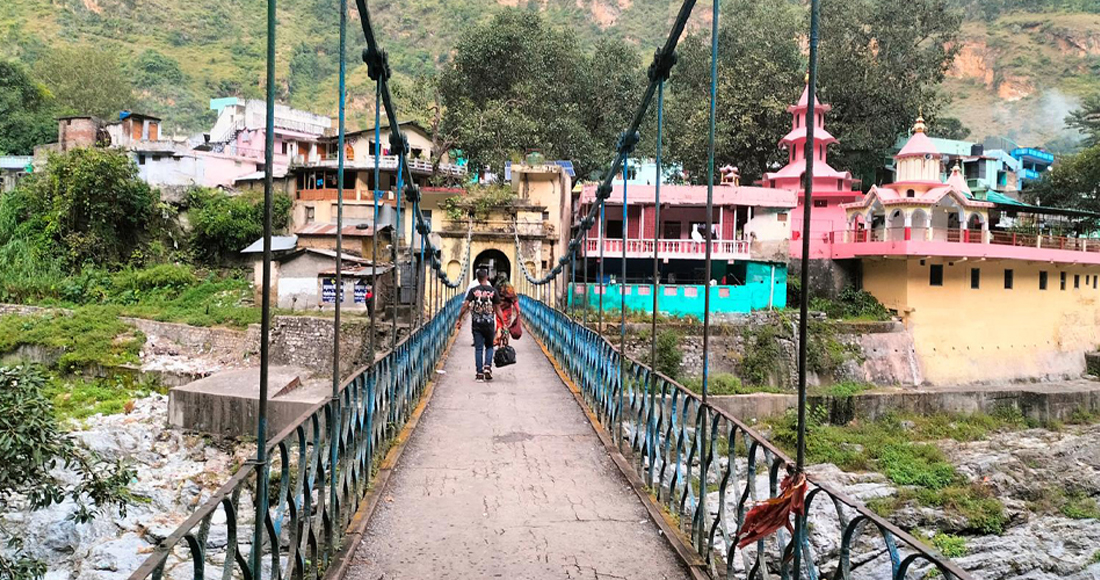
The next morning, I headed towards Jhulaghat. The Mahakali River, despite being the border between two countries, did not seem like a symbol of division. It was an intimate dialogue connecting the two banks. Standing on the suspension bridge of Jhulaghat, the wind gently swayed the bridge. Below, the Mahakali flowed ceaselessly. The water recognized no borders. The wind carried no passport. The birds had read no maps. Nature reminded me again—borders are made by humans, vastness by nature.
I looked at the Mahakali one last time from the bridge. Time flowed in the river's current. History spoke in the waves. Footprints of civilization were preserved in the stones on the banks. At that moment, I realized that travel is not just about seeing new places; it is also about changing one's old perceptions. Every journey is more a birth of new consciousness than a search for a new geography.
On the way back, the road was the same. The mountains were the same. The rivers were the same. The waterfalls were murmuring as before. The forests were fragrant as before. What had changed was only the traveler. I had walked to Baitadi, but on returning, Baitadi had settled within me.
Then I understood, journeys never end at the destination. They live on in memory. They flow in thoughts. They echo in life's decisions. One day, the sound of the Mahakali's water will be remembered again. The mist-covered hills of Dadeldhura will appear before my eyes. The bridge at Chisapani, the vastness of the Karnali, the silent waters of Ghodaghodi, the forest of Bardia, the greenery of Chitwan, and the ceaseless flow of the Trishuli will all travel again within my mind.
Perhaps this is why the real end of a journey does not exist. The road ends, the journey does not. Because a journey is not the distance covered by feet; it is the expansion achieved by the soul.
Even today, when I close my eyes, the cool breeze of the Mahakali touches my face. The peaks of Kedar appear standing in silent meditation. The mountain trails call again. And the heart silently accepts. Some places are not just for seeing and returning. They are for carrying within one's soul for a lifetime.
Baitadi is such a land, where nature writes a new philosophy every morning. The Mahakali sings the eternal song of time. The peaks of Kedar spread the light of spirituality in silent meditation, and the mountains teach the eternal lesson of patience, labor, and coexistence. Here, the traveler does not witness new sights; they encounter the depths of their own consciousness.
When the journey ends, the road is left behind, but Baitadi remains forever in the mind as a bright memory, a silent prayer, and a life philosophy. Only then do you realize—the greatest achievement of a journey is not finding a new place, but finding the more generous, more humble, and more awakened person hidden within oneself.
This specific news has been automatically translated by AI. As a result, there may be some inaccuracies or language errors.




_iL3K2wYemS.jpg)