Freed Kamaiya Families Face Unresolved Resettlement Issues

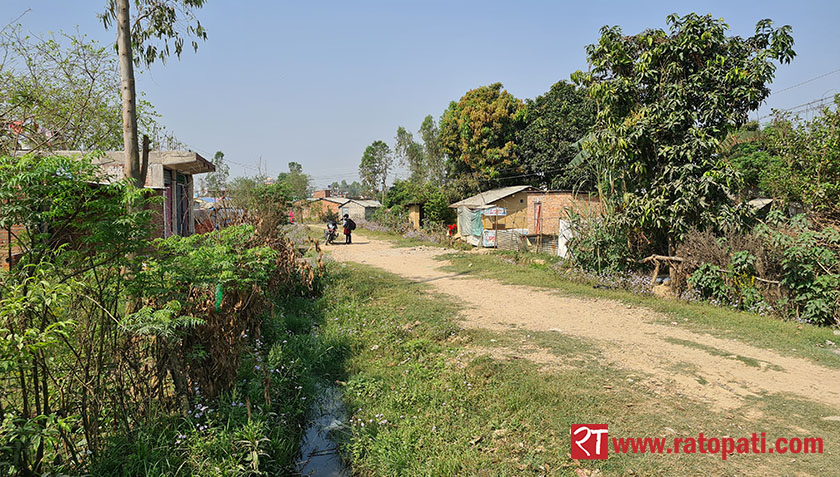
Kailali. Two decades ago, 22 freed Kamaiya families of Bijaypur camp in Godavari Municipality-1, Kailali, dreamed of a new life. With the government's announcement of Kamaiya liberation, they believed they would get their own homes, their own land, and a dignified life.
The government also gave them land ownership certificates, but their registration was not finalized. Years have passed going to the land revenue office since then, but the problem remains the same.
"We have the certificate, but not the registration. Therefore, we haven't been able to do anything with our land," says freed Kamaiya Phoolmati Dagora Tharu, "This is not just our problem, such problems exist in many places."
Phoolmati's story is not just about one family. Even after 26 years of Kamaiya liberation, hundreds of freed Kamaiya families are still facing various resettlement problems. Some have identity cards but are not included in resettlement. Some have land ownership certificates but no registration. Some have received land that is at risk of flooding and river erosion.
Their complaint is that the pace of solving these problems has slowed down further since the fiscal year 2075/76. The reason given is the same – uncertainty about who has the final responsibility for resettlement according to the federal structure after 2075 BS.
"The federal government says it has handed over the responsibility to the provinces and local levels. The provinces do not clearly consider it their duty. Local levels have neither the budget nor the authority to distribute land," says freed Kamaiya rights activist Pashupati Chaudhary, "Due to the unclear responsibilities among the three tiers, the remaining resettlement work has almost come to a standstill."
Historical Achievement
On July 17, 2000 (2057 BS), the Government of Nepal took a historic step towards ending bonded labor by announcing Kamaiya liberation, including the waiver of inequitable loans (saukhi). A year later, the Kamaiya Labour (Prohibition) Act, 2001 (2058 BS) legally banned bonded labor completely.
All loans against Kamaiyas were waived. Old deeds and agreements became automatically invalid. The government operated programs for resettlement, including housing, land, cash assistance, and skill development.
According to government data, identity cards were distributed to 32,509 families in Dang, Banke, Bardia, Kailali, and Kanchanpur. Among them, 27,570 families were deemed eligible for resettlement, and 27,021 families have received houses or land. As of 2075/76, 19,531 people have also received various skill training.
"This changed the lives of thousands of families. Those who were bonded laborers yesterday are now entrepreneurs, public representatives, and social leaders," says advocate Balaram Bhattarai, "However, by not solving the remaining problems, this achievement itself is being questioned."
Picture of Achievement and Incomplete Reality
Government records show that most resettlement work has been completed. According to government data, resettlement work in Dang, Banke, and Kanchanpur is almost finished. In Bardia, some families have been handed over to local levels, and in Kailali, most of the work is claimed to be completed.
According to government data, identity cards were distributed to 32,509 freed Kamaiya families in Dang, Banke, Bardia, Kailali, and Kanchanpur prior to that. Among the 27,570 families in categories ' क' and 'ख' deemed eligible for resettlement, 27,021 families have already received housing and land facilities. In Bardia, 30 families, and in Kailali, 270 families, totaling 300 families' work has been handed over to local levels.
The data from the Freed Kamaiya Society shows a different picture. According to the society, not all families deemed eligible for resettlement have received land. Out of the 27,570 Kamaiya families eligible to receive land, only 25,195, or 91 percent, have received land.
Moreover, 661 families have received unsuitable land. Four thousand four hundred and sixty-three families have not received identity cards at all. Four hundred and sixty-three families who received identity cards but did not receive resettlement packages. 173 families' certificates have been canceled. "This means that even with all the proof, nine percent of freed Kamaiyas have been deprived of receiving land. Furthermore, the number of freed Kamaiya families who have all the necessary documents to receive an identity card is also significant," says Chandra Prasad Chaudhary, Kailali Chairman of the society, "It cannot be just for families who meet the same criteria to receive all facilities while others receive nothing."
Why Did the Pace Stop After 2075 BS?
Most of the freed Kamaiya resettlement programs were conducted until the fiscal year 2075/76. After that, the programs have become almost inactive.
According to Hukam Sarki, Executive Director of the National Dalit Network, despite sufficient budget, the decision was made to transfer resettlement work to local levels, but no plan was made or necessary preparation was done for it. "In the budget of fiscal year 2075/76, the state allocated about two and a half trillion rupees for resettlement. Instead of implementing it, it was suddenly announced that all work, including that of freed Kamaiyas, was essentially completed, and the remaining work would be done by local levels without prior preparation. Since then, the pace of problem-solving has come to a standstill," he said.
The report of the Study Committee on the Status of Freed Kamaiya, Kamlari, Halia, and Harwacharwa, 2078, also reached the same conclusion. The report states, "After the unexpected announcement of the completion of resettlement work, the remaining budget for that year could not be implemented and was frozen in most places. Thus, an invaluable opportunity to complete the resettlement work of Kamaiyas, Halis, and Kamlaris was lost when there was sufficient budget for resettlement work."
The federal government has been stating that the responsibility has been transferred to the provinces and local levels. However, Hiralal Regmi, Chief District Officer of Kailali, says that facilitation work is being carried out at the local level as a representative of the federal government in the areas of resettlement, skill development, and livelihood. "We are providing suggestions to the central government based on the complaints of individuals and rights activists from organizations active in the freed Kamaiya sector. Responsibilities should be fulfilled according to sectoral duties," he said.
The Sudurpashchim Province Government, however, states that it is working with its own procedures amidst resource and policy uncertainties. According to Shankar Shah, Secretary of the Ministry of Land Management, Agriculture, and Cooperatives, the provincial government has constructed 50 houses in Kanchanpur in collaboration with development partners and is also conducting livelihood and training programs.
He said, "There are some policy uncertainties, including resources, but we are carrying out resettlement work in collaboration with other development partners. In the fiscal year 2082/83 alone, we have constructed 50 houses in Shuklaphanta and Belauri of Kanchanpur in collaboration with development partners. This year too, we plan to continue this and build more houses. We are also providing support in training and livelihood."
The central and provincial governments have transferred most of the responsibilities to the local levels, but the local levels have their own constraints. "We do not have sufficient budget, nor the legal authority to distribute land," says Ganesh Chaudhary, Chairman of Janaki Rural Municipality, "The problem has arisen because the central government has treated freed Kamaiyas the same as other landless people. It is necessary to solve the problem through special programs."
Currently, there are mainly three major challenges. Addressing the problems of families who have identity cards but have not received resettlement packages, families who have land ownership certificates but whose registration has not been finalized, and families who have received land in flood-prone, river-eroded, or unsuitable areas.
Rights activists say that a clear division of responsibilities among the three tiers of government and a special mechanism are necessary for this. "The state that announced liberation must also clarify the final responsibility for resettlement," says rights activist Chaudhary, "A separate commission or empowered mechanism is necessary for this."
Advocate Bhattarai also believes that since most of the work has been completed, there should be no delay in solving the problems of the remaining families. "Most of the work has been completed. Everyone is thanking the government for that, but those who have not received their rights, even if they are few, will always be dissatisfied with the state, so there should be no delay in addressing them."
Freed Kamaiya Dagora still has the same expectation. "We don't want to keep making demands and complaints all the time," she says, "We just need our certificates and registrations to be sorted out. The state should solve our problems just as it declared us free. Then we too can move forward with our lives like other citizens."
The Kamaiya movement legally ended bonded labor in Nepal, but at the final stage of resettlement, the division of responsibilities seems to have created new challenges. Therefore, the current debate is not about liberation, but about how to end incomplete resettlement. Rights activists believe that it is necessary to focus on solving the problem by finding the reality between the government's claim that the problem is over and the freed Kamaiyas' data that the problem still exists.
This specific news has been automatically translated by AI. As a result, there may be some inaccuracies or language errors.