Economic Review of Fiscal Year 2082/83: Political Turmoil and Budget Implementation Challenges
Kathmandu. Fiscal year 2082/083 became a year of political ups and downs. Looking at the political ups and downs, this fiscal year has become a base year for political generational change.
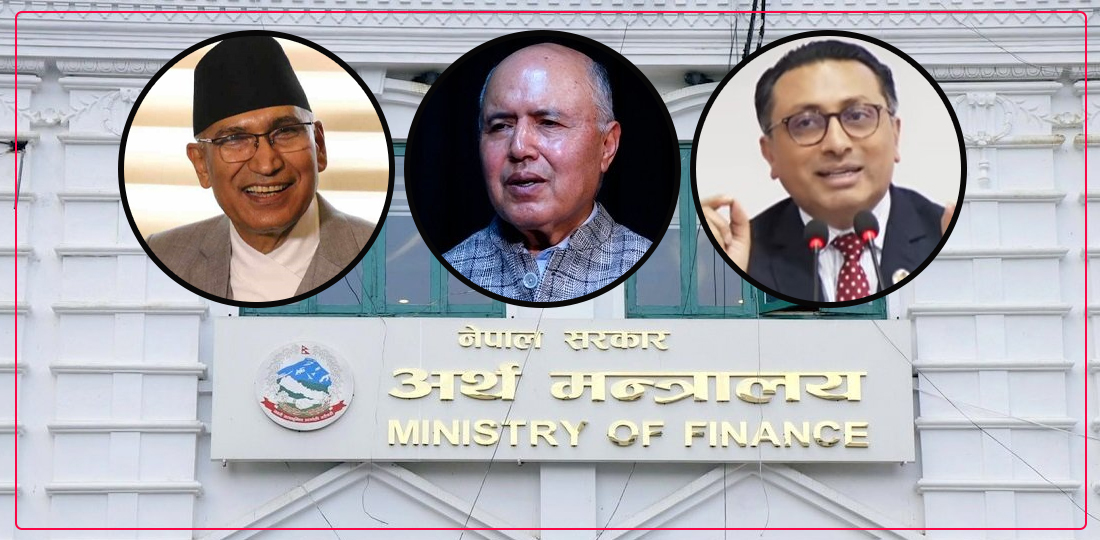
Due to political ups and downs, the budget implementation of the previous fiscal year 2081/082 was carried out by two finance ministers, but this fiscal year's budget was fortunately implemented by three finance ministers.
The then Finance Minister Bishnu Prasad Paudel had made it public in Jestha 2082. Less than two months after he started implementing the budget he brought, the Gen Z movement occurred. Due to the movement, the then government fell.
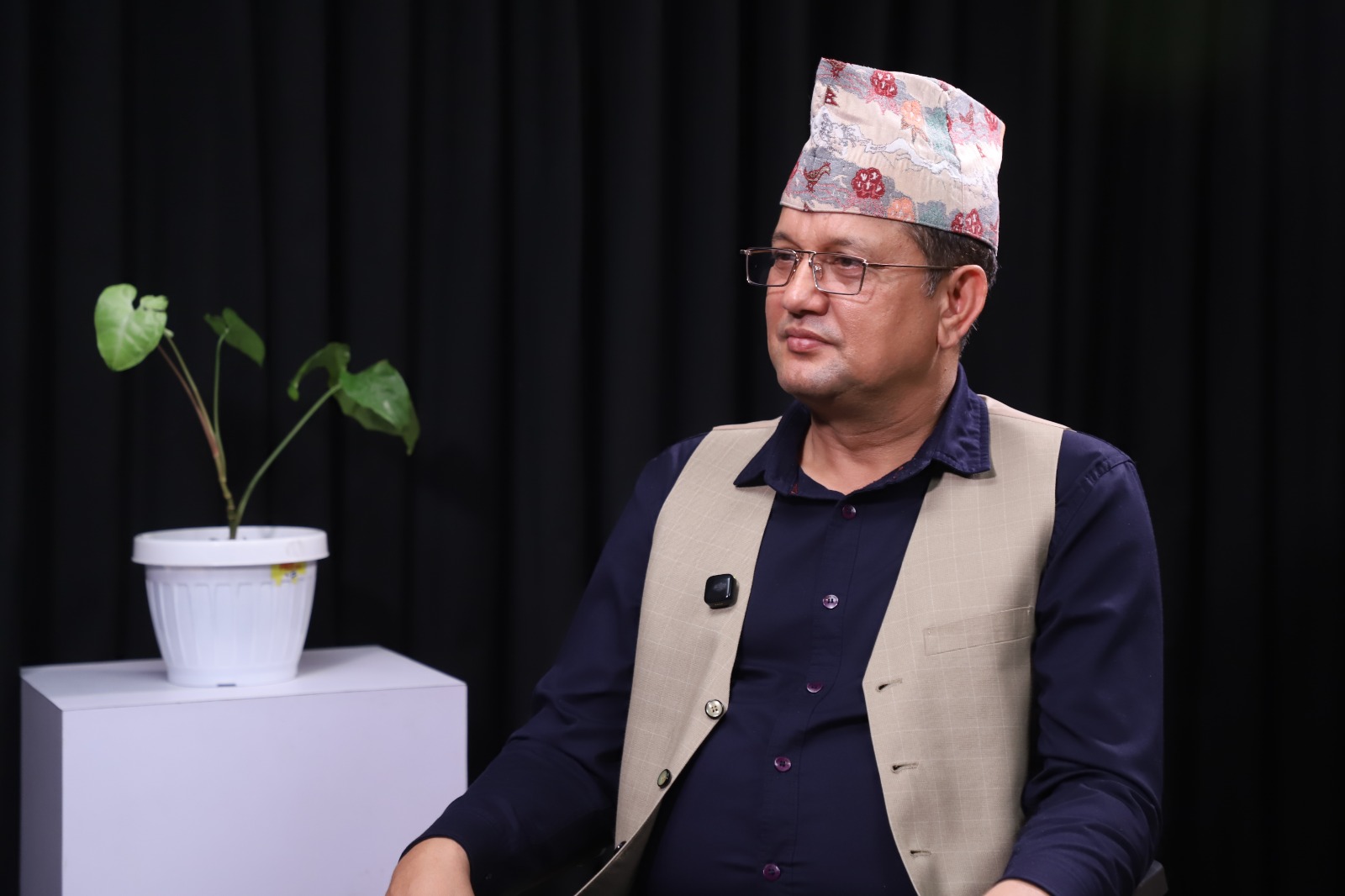
With the fall of that government, an interim government was formed. Economist Rameswor Khanal was appointed as the Finance Minister of the interim government. Khanal started implementing the budget that Bishnu Paudel had started implementing after Bhadra 2082.
Finance Minister Khanal worked on implementing the budget from Bhadra 2082 to Chaitra. He left after the completion of the House of Representatives elections.
In the new election, Economist Dr. Swarnim Wagle took charge as the Finance Minister in a government with a two-thirds majority. Appointed as Finance Minister on Chaitra 13, 2082, he also took on the responsibility of implementing the same budget.
The budget of this fiscal year was implemented by two expert finance ministers of the country. Both made policy and practical efforts to remove the 'Ashare Bikas' (development expenditure at the end of the fiscal year) focused spending trend.
However, there has not been much improvement in capital expenditure and overall budget expenditure. The then government had presented a budget of Rs 19 kharba 64 arba 11 crore for the fiscal year 2082/083. However, it was revised to Rs 16 kharba 88 arba 32 crore 67 lakh in the mid-term review. Rs 11 kharba 80 arba 98 crore was allocated for current expenditure.
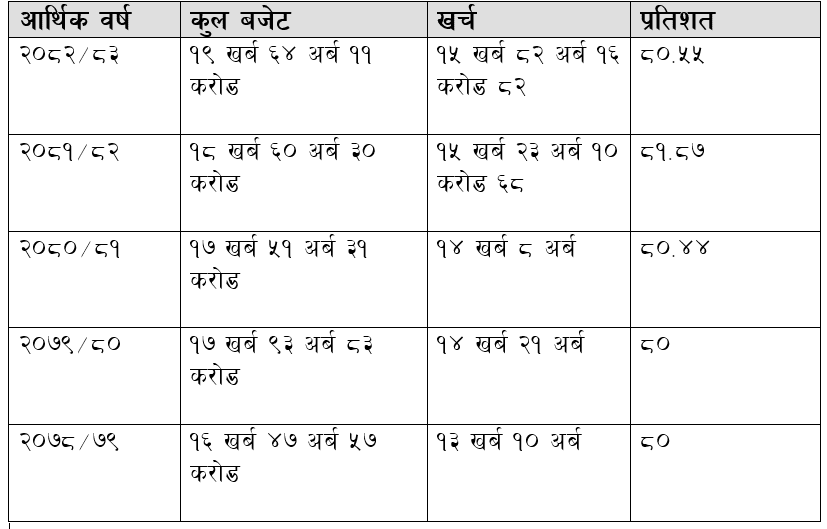
According to the data from the Office of the Controller General of Accounts, although revenue collection appears satisfactory compared to the government's target, capital (development) expenditure appears disappointing. Looking at government expenditure, out of a total budget allocation of Rs 19 kharba 64 arba 11 crore, Rs 15 kharba 82 arba 16 crore 82 lakh (80.62 percent) has been spent.
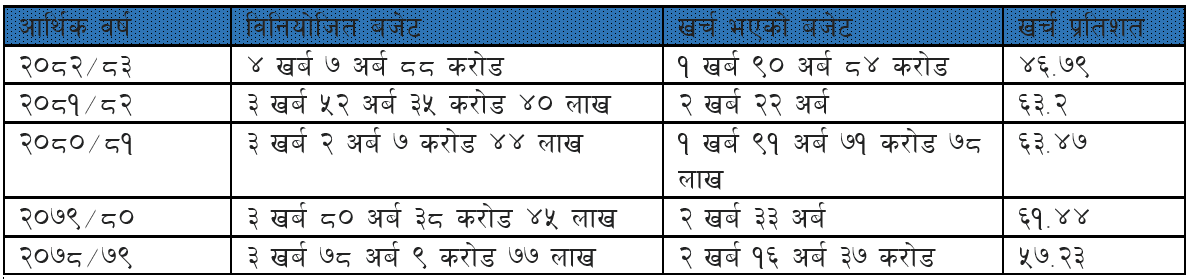
What percentage of the budget was spent in which year in the last five years?
Looking at the nature of expenditure, current expenditure of an administrative and general nature is high. Out of a target of Rs 11 kharba 80 arba 98 crore, Rs 10 kharba 45 arba 25 crore (88.51 percent) has been spent.
However, capital expenditure, considered the backbone of the country's development, has not even reached half of the target. Out of a target of Rs 4 kharba 7 arba 88 crore for capital expenditure, only Rs 1 kharba 90 arba 84 crore (46.79 percent) has been spent by the end of the year. There was no significant change in the trend of expenditure at the end of the fiscal year in 2082/083. Capital expenditure this year is lower than in the last five years.
In the previous fiscal year 2081/082, capital expenditure was 63.2 percent. In fiscal year 2080/081, Rs 3 kharba 2 arba 7 crore 44 lakh was allocated for capital budget, of which 63.47 percent was spent.
In fiscal year 2079/080, 61.44 percent of the total allocated capital budget was spent. In fiscal year 2078/079, this expenditure reached 57.23 percent.
Capital Expenditure in the Last Five Years
After the Gen Z movement on Bhadra 23 and 24 last year, the government led by KP Sharma Oli fell, and an interim government was formed under Sushila Karki. As the interim government was given the responsibility of conducting elections, it could not accelerate development work.
Economist and former Governor Dr. Chiranjibi Nepal stated that the external indicators of the economy remained positive throughout the fiscal year 2082/083. He said, 'Foreign exchange reserves remained sufficient at all times. Remittances increased. The balance of payments and current account situation remained good. Some improvement was also seen in exports.'
However, due to weak demand on average, the domestic economy could not strengthen. This is because there was not much activity in the market. Therefore, the situation of problems in the domestic economy persists, as pointed out by Economist Dr. Nepal.
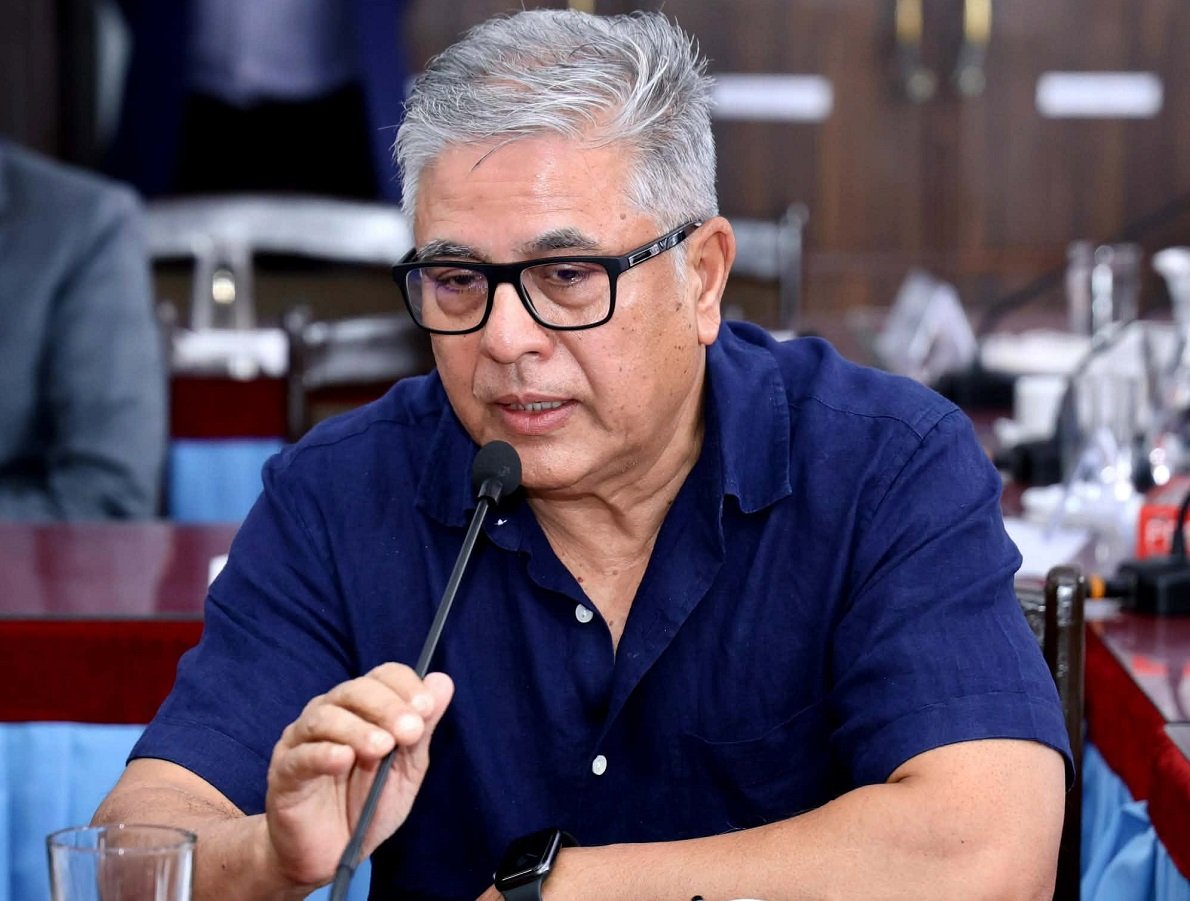
He said that the market demand has not been good on average in the last 10-15 years. 'In fiscal year 2082/083, there were major upheavals in the political sector as well. The series of government changes and the Gen Z youth movement directly affected the economy,' he said. 'Due to political transition and movements, economic agendas were overshadowed. The pressure of election expenses and the trend of reallocating development budgets to other sectors further negatively impacted capital expenditure.'
Dr. Nepal said that the average demand in the market is not good at present. He stated that the government needs to make policy and legal reforms to create an investment-friendly environment for the problems seen in the economy last fiscal year and for new changes.
Policy Reform Efforts
The then government had planned to make policy reforms through the budget. However, the government fell at the beginning of budget implementation. The subsequent government became election-focused. The government made every effort to make the country's economy dynamic. The interim government and the current government have also started that work.
On the day he took charge of the Ministry of Finance, Finance Minister Dr. Swarnim Wagle announced the abolition of various acts. The government has moved forward accordingly. The government has also allowed ministries to reallocate funds themselves to increase capital expenditure. It is preparing to change more than a dozen policies to bring about changes in the economy.
Although the country's external sector appeared strong, the overall economy showed pressure due to a decrease in demand as consumers' purchasing power in the domestic market was weak.
Economy's Size Increased to 66 Kharba
The size of the economy increased by approximately Rs 5 kharba in fiscal year 2082/083. In the last fiscal year, with an economic growth rate of 4.61 percent, the size of the economy reached Rs 61 kharba 7 arba. Nepal's economic growth rate was estimated to be 3.85 percent last year. According to the data released by the National Statistics Office, the size of the economy is estimated to reach Rs 66 kharba in this fiscal year. The government had set a target of 6 percent economic growth through the budget.
12 Kharba 41 Arba Revenue Income
The government had set a target of Rs 14 kharba 80 arba for total receipts (revenue, grants, and others) for the current fiscal year, and by the end of Ashar, it has collected Rs 12 kharba 41 arba 31 crore 85 lakh. This is 83.87 percent of the total target.
Out of the total revenue, Rs 11 kharba 21 arba (84.57 percent) was collected from tax revenue and Rs 1 kharba 20 arba (77.87 percent) from non-tax revenue.
Similarly, out of the Rs 53 arba 44 crore target for foreign grants, only 58.5 percent, i.e., Rs 32 arba 26 crore, has been received.
In the last fiscal year, Rs 11 kharba 78 arba 82 crore was collected as revenue. This is more than Rs 1 kharba compared to the fiscal year 2081/082.
Revenue Collection in Which Year?
The target for revenue collection in fiscal year 2082/083 is Rs 14 kharba 80 arba. Achieving this target is challenging given the low revenue collection in previous years.
In fiscal year 2081/082, the target for revenue collection was Rs 14 kharba 19 arba, and Rs 11 kharba 78 arba 82 crore was collected. In fiscal year 2080/081, Rs 10 kharba 58 arba was collected.
According to the Ministry of Finance, despite challenges due to the Gen Z movement, weak private sector morale, and international circumstances, revenue collection has been encouraging compared to the previous fiscal year.
In fiscal year 2071/072, Rs 4 kharba 5 arba was collected, Rs 4 kharba 81 arba in 2072/073, Rs 6 kharba 9 arba in 2073/074, Rs 7 kharba 26 arba in 2074/075, Rs 8 kharba 29 arba in 2075/076.
Similarly, Rs 7 kharba 93 arba was collected in 2076/077, Rs 9 kharba 35 arba in 2077/078, Rs 10 kharba 66 arba in 2078/079, Rs 9 kharba 57 arba in 2079/080, and Rs 10 kharba 58 arba in 2080/081.
A budget of Rs 21 kharba 24 arba 34 crore has already been allocated for the current fiscal year, of which Rs 12 kharba 70 arba 58 crore is allocated for current expenditure, and Rs 10 kharba for capital expenditure. Additionally, Rs 4 kharba 22 arba 24 crore is allocated for financial management.
Current expenditure is Rs 12 kharba 70 arba 58 crore, which is 59.8 percent, capital expenditure is Rs 4 kharba 31 arba 10 crore, and financial management is Rs 4 kharba 22 arba 24 crore.
This specific news has been automatically translated by AI. As a result, there may be some inaccuracies or language errors.


_OmeV4uvYg3.jpg)