MP Bidushi Rana Calls for Effective Coordination Mechanism Between Private Sector and Government

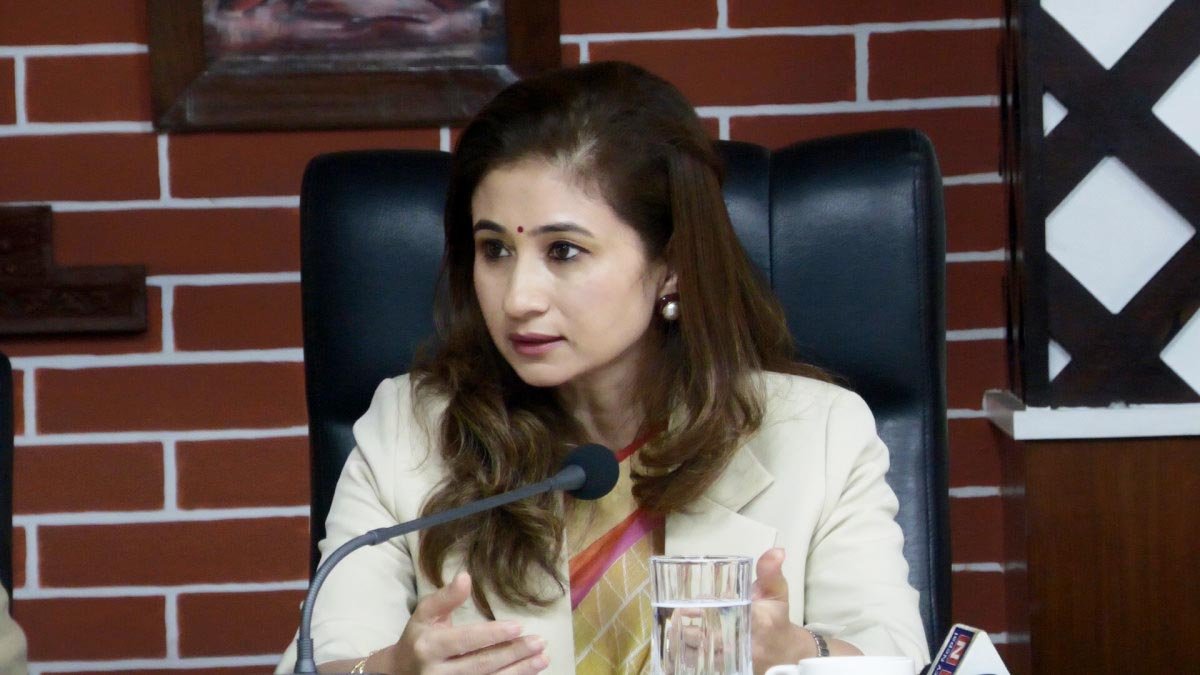
Kathmandu. Ruling party Rastriya Swatantra Party MP and entrepreneur Bidushi Rana has stated that there is a need for an effective coordination mechanism to bridge the existing gap between the private sector and the government.
Speaking at a discussion with industrialists and businessmen organized at the Ministry of Youth, Employment and Entrepreneurship in Singha Durbar on Thursday, MP Rana emphasized the need to form a task force or group to coordinate directly between the Prime Minister's Secretariat and the private sector.
She expressed concern that Nepal's private sector is currently transforming into a 'training center' rather than a 'production center'. She stated that industries train workers at their own expense, but after becoming skilled, they go for foreign employment.
This causes industries to always have to work with unskilled manpower and face problems of declining productivity. To solve this problem, she suggested that the government should arrange for training or there should be a legal commitment that trained workers must work in the concerned industry for a certain period.
'It seems that Nepal's private sector is more focused on the training sector than the production sector,' said MP Rana. 'Industries have to conduct training with their own resources. However, after three months of training at minimum wage, many trainees are waiting for visas for foreign employment within four to five months.'
She explained that they leave their jobs after getting a visa and then have to train a new group. She said that this has added double and triple costs to the industry, and added, 'If a commitment can be made for those trained by the government to work in the country for at least one or two years, industries will get quality manpower.'
MP Rana stated that there should be a clear analysis and study of which sector requires how much and what type of manpower in the country's labor market. She emphasized the need to conduct demand-based skill development programs by classifying skilled, semi-skilled, and unskilled workers. She also proposed to create a 'national database' to utilize the skills and experience of Nepalis returning from foreign employment.
'It is necessary to keep records of the experience, skills, and expertise of workers returning after learning skills abroad,' she added. 'If they can be connected with entrepreneurship, employment, and training systems in the country, it will greatly contribute to skill transfer within the country.'
She analyzed that the high cost of business in Nepal is an obstacle to industrial development. Pointing out the need to connect skill development programs through online and hybrid models in the current digital age, she mentioned that cooperation with the private sector is indispensable to achieve the economic goals set by the government. She stated that the government and the private sector should sit at the same table not just to list problems but to find solutions and focus on delivering results with concrete action plans.
This specific news has been automatically translated by AI. As a result, there may be some inaccuracies or language errors.