Federation of Commerce and Industry President demands active partnership for private sector in policy making

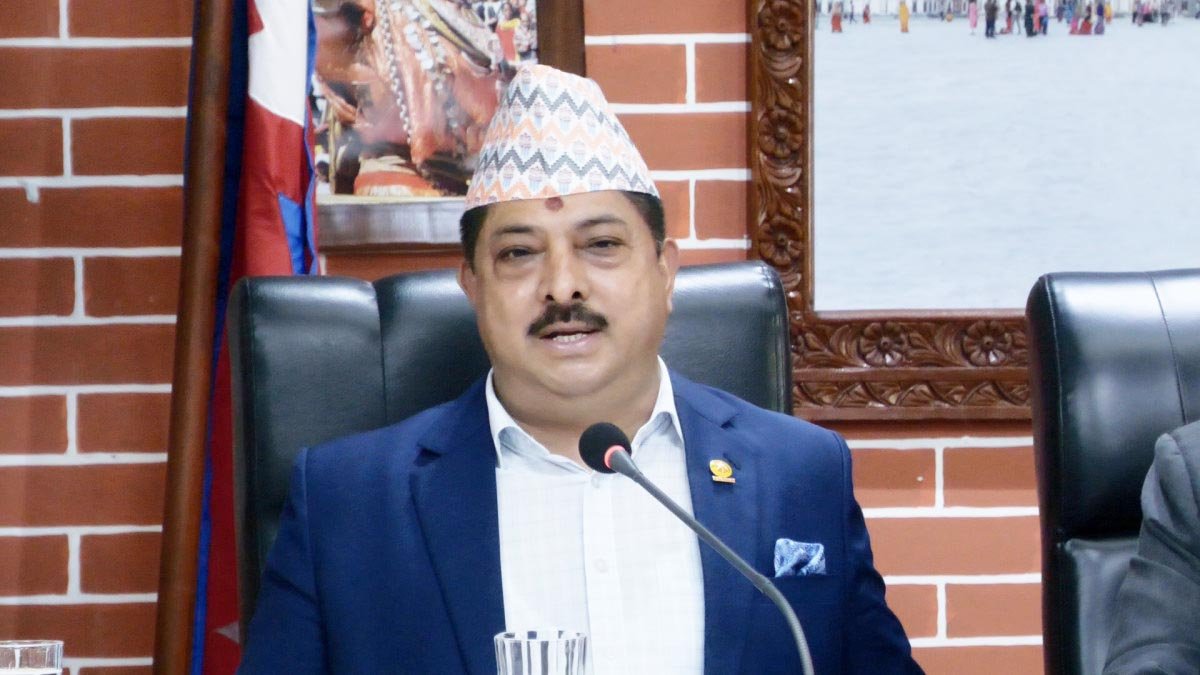
Kathmandu. The President of the Federation of Nepal Industries and Commerce, Anjan Shrestha, has demanded that the government should not only include the private sector as 'witnesses' but also as active partners when making laws and policy reforms.
President Shrestha expressed this view on Thursday during a discussion with industrialists and businessmen organized at the Ministry of Youth, Labor, and Employment.
Speaking at a meeting related to labor and employment organized on the eve of the new fiscal year, he complained that the government does not give the private sector enough time for homework when amending or revising any act or law. President Shrestha said that it is unfortunate that Nepal has to depend on foreign countries for both employment and consumption.
According to him, although 5 to 6 lakh manpower enters the labor market annually, the government and private sectors have been able to provide employment to only a limited number. Mentioning that it is a big challenge for about 2500 to 3000 youths to go for foreign employment daily, he gave the example of the Philippines. 'The country cannot become economically prosperous solely through foreign employment,' he said. He expressed concern that domestic industries have only become like training centers for producing skilled manpower.
Referring to the government seeking suggestions within seven days for the amendment of the Company Act, he said, 'Based on past experience, the private sector has always been kept only as a witness.' He stated that although the government shows that it works with the private sector at the forefront, in reality, it keeps them only as witnesses. 'We were present,' he added, 'but the role was only that of a witness.'
He demanded an end to this trend, stating that pressure comes to finish work when suggestions have to be given within two to three days. 'At least, if any law needs to be amended, one month's time should be given for it,' he said, 'One month's time should be given to get an opportunity to do sufficient homework.' He emphasized the need for a practice of preparing and discussing unclear matters by sitting together in the middle before finalizing the draft.
He also questioned the effectiveness of the training provided separately by various ministries and bodies. His suggestion is to integrate the training provided by the Ministry of Education, Industry, and Labor, as well as the Prime Minister's Employment Program and local levels. He emphasized the need to increase the activeness of institutions like CTEVT.
'When talking about training, it seems like we have given a lot of training,' he said, emphasizing the integration of training provided by various bodies, 'How much the training has been utilized needs to be seriously considered.'
He said that although union activities and strikes in the industrial sector have decreased recently, it is difficult to retain skilled manpower and increase productivity. Mentioning that job creation has become challenging due to the current economic slowdown and declining demand, he drew the ministry's attention to the timely amendment of the Labor Act. He stated that the private sector is ready to cooperate with the government for employment promotion and skill development, but a business-friendly environment and policy stability are essential for that.
This specific news has been automatically translated by AI. As a result, there may be some inaccuracies or language errors.