India-Australia Relations Transform from Sanctions to Strategic Partnership

Twenty-eight years ago, in May 1998, following the nuclear tests conducted in Pokhran, Australia suspended defense cooperation with India. Military exchanges were halted. Indian officers training in Australian defense colleges were sent back home.
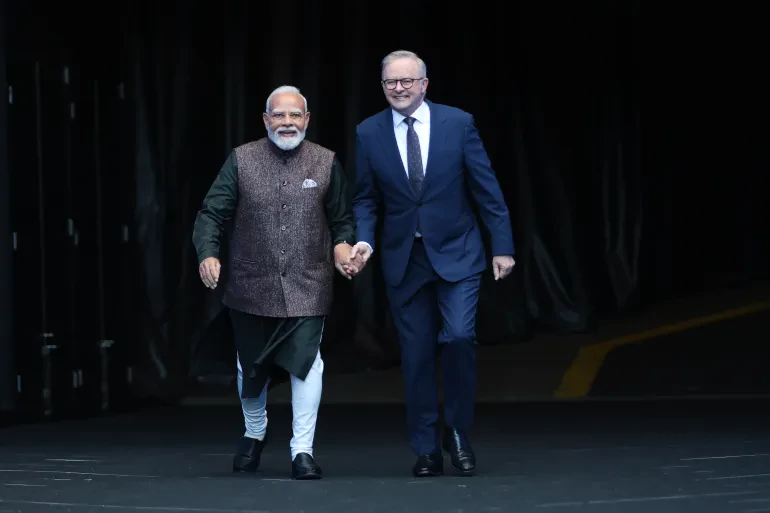
This week, during Prime Minister Narendra Modi's visit to Australia, both countries made an announcement. According to the announcement, Canberra will invite an Indian military instructor to serve in an Australian defense college. This journey from sanctions to strategic partnership is one of the most remarkable bilateral transformations in contemporary history.
However, viewing Modi's Australian visit merely as another success in India-Australia relations would be an understatement of its significance. Beyond the relationship with Canberra lies the Asia-Pacific region. It is here that Modi's visit reveals the larger story of the changing power balance.
Modi's three-country tour included Indonesia, Australia, and New Zealand. On the map, this itinerary reflects India's expanding strategic horizon in the Asia-Pacific region. Indonesia connects India's reach in Southeast Asia. It is located at the confluence of the Indian and Pacific Oceans.
In recent years, Australia has become one of India's most important strategic partners. Although New Zealand is much smaller, it further expands India's diplomatic reach in the Pacific. Overall, these three visits demonstrate how New Delhi perceives the emerging power balance and how it seeks to shape it.
Today, there are few countries in Asia with whom India shares as many common interests and values as with Australia.
The context for this is clear. China is rising. The United States under Donald Trump is unpredictable and is retreating. Economies, technology, energy, and supply chains are becoming tools of strategic competition. India, Japan, Indonesia, Australia, and New Zealand, among others, are all trying their best in their own ways to avoid falling victim to Chinese hegemony and a new Cold War.
The relationship between Canberra and New Delhi was long a story of missed opportunities. Due to the Cold War, India's self-reliant economy, the 'White Australia Policy,' and Canberra's refusal to sell uranium to India, the two countries remained distant for decades. But that is no longer the case.
Today, there are few countries in Asia with whom India shares as many common interests and values as with Australia. Both countries are English-speaking, federal, and multicultural democracies. They believe in and respect the rule of law. Furthermore, they share a common strategic interest in maintaining balance in the Asia-Pacific region and ensuring that no single power dominates this region. In addition, Indians are now the largest source of skilled migrants for Australia.
The agreements made during Modi's visit are certainly not just for show. These agreements include the implementation of uranium exports for civil nuclear energy and expanded defense cooperation. They also include greater collaboration in maritime security, cyber and critical technology, clean energy, skills, investment, and critical minerals.
Let's talk about uranium. Australia had once refused to sell uranium to India because New Delhi had not signed the Nuclear Non-Proliferation Treaty. Even after the signing of the civil nuclear cooperation agreement between India and Australia a decade ago, Australian uranium exports were stalled due to Canberra's own domestic politics.
This week, an 'Administrative Arrangement' has been finalized. This will open the way for Australia to actively facilitate India's civil nuclear energy program. Thus, a symbol of discord has now become a medium of partnership.
India is not just considering the encirclement of China as its ultimate goal. Nor has it handed over its China policy to Washington, Canberra, or Tokyo.
This transformation is easily explained in the context of the concerns created by China and Beijing, and that is partly true. China's rise has altered the calculations of every serious Asian power. India learned about the limitations of Chinese engagement from the border clash in the Galwan Valley in 2020. Australia has understood the cost of Chinese economic pressure. Japan has been struggling with China's pressure in the East China Sea for years.
Indonesia and New Zealand have their own reasons for understanding that interdependence without resilience can lead to risks. But China has only accelerated the relationship between these countries; it does not explain the deep trust that has been built between them.
For India, this is more than that. India is not just considering the encirclement of China as its ultimate goal. Nor has it handed over its China policy to Washington, Canberra, or Tokyo. It will compete with Beijing when necessary, cooperate where possible, and stabilize relations when it is wise to do so. This is not ambiguity. This is Indian statecraft guided by the thinking of thousands of years of Indian civilization.
Strategic autonomy makes sense. Western critics prefer to dismiss it as 'hedging.' They consider it opportunism hidden under the guise of principle. They misunderstand both India and the current times. Strategic autonomy does not mean refusing to choose; it means refusing to let others choose for them.
The emerging Asia-Pacific region will not be shaped solely by aircraft carriers and superpower summits. It will also be shaped by various networks. For example: maritime partnerships, technology alliances, resilient supply chains, educational exchanges, diaspora relations, and the habit of strategic consultation.
This is why middle powers like Japan, Indonesia, and Australia are important. None of these middle powers can impose their terms on the international system. But they can prevent it from falling into instability. They can push back against any hegemonic power that thinks it can monopolize power. Furthermore, they can bridge the gap between unconditional surrender and open confrontation.
This is India's rejection of China's claim to regional supremacy. This is India's rejection of leaving its national interests at the mercy of another power's unpredictability.
In the traditional sense, India is not a middle power. Its size, population, economy, and civilizational confidence place it in a category of its own. But it understands and values groups of middle powers. India has no interest in living in a bipolar world dictated by Washington and Beijing.
The Asia-Pacific region that India wants to help shape is neither an American lake nor a Chinese sphere of influence. Nor is it a battlefield for perpetual confrontation. Rather, it is an open, multipolar, and rules-based region, not one that is suppressed and coerced into submission.
Twenty-eight years ago, Australia saw India as a problem. Today, it sees India as a partner in the solution. And this is what places Modi's visits to Indonesia, Australia, and New Zealand far above the sum of these bilateral relationships. Overall, these visits represent New Delhi's Asia-Pacific moment. This is India's refusal to rush into anyone's camp.
This is India's rejection of China's claim to regional supremacy. This is India's rejection of leaving its national interests at the mercy of another power's unpredictability. A decade ago, talking about India as a balancing power was a trend. Today, India wants to be a decisive power.
This specific news has been automatically translated by AI. As a result, there may be some inaccuracies or language errors.