NAIMA Nepal Mobility Expo 2026 Coordinator Gaurav Sharda Discusses Preparations and Expectations

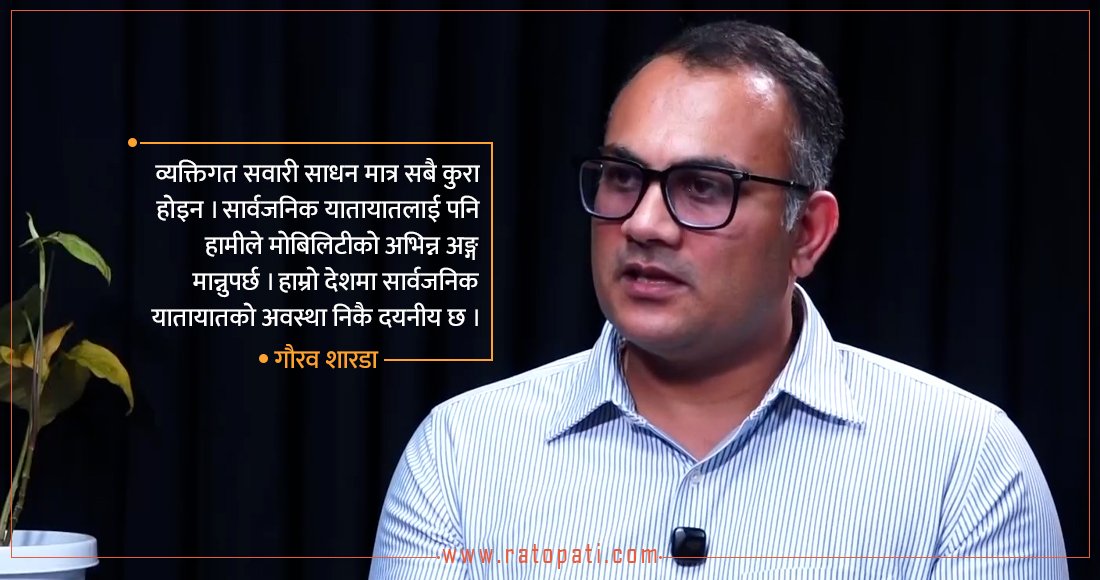
Kathmandu. Anish Mijar of Ratopati has interviewed Gaurav Sharda, coordinator of the NAIMA Nepal Mobility Expo 2026 organized by NAIMA (Nepal Automobiles Importers & Manufacturers Association).
- NAIMA is organizing the Nepal Mobility Expo from July 26 to 31. You are also the coordinator of this expo, how are the preparations?
– We are currently in the final stages of preparation for the expo. All our planning phase tasks have been completed. Technical aspects such as which exhibitors will participate, who the sponsors will be, and which company will be given what space have all been finalized.
Now, only the execution part remains. Preparations from our side are complete, and the expo is set to begin grandly on the scheduled date.
- How many companies are participating in this year's NAIMA Mobility Expo, and what new things will the audience be able to see?
– This year's expo is very special and grand. More than 55 brands are participating. More importantly, more than 40 new products will be unveiled during this expo.
In terms of categories, there will be two-wheelers, four-wheelers, and commercial vehicles. We have also provided diversity in terms of technology.
The expo will feature exhibitions of ICE (Internal Combustion Engine) petrol and diesel engines, hybrids, and EVs. Customers will be able to see and compare vehicles of every technology available in the market under one roof.
- NAIMA is organizing the second edition of this expo. What is the difference between last year's experience and this year's preparations? What new can visitors expect?
– Last year's first edition was very successful, but we also learned a lot from it. We have taken into consideration the suggestions given by visitors and our participating entrepreneurs this time.
Since it is the monsoon season in July, we have made arrangements so that visitors do not face problems with rain when moving from one hall to another.
We have made it disability-friendly. This facility was available last year as well, but we have made it more effective this time. The third major issue was parking.
As the parking at Bhrikutimandap alone is not sufficient, we have arranged to use the parking at Nepal Police Club and Blue Pavilion for six days. Also, for ease of transportation, we have partnered with Pathao as a ride-sharing partner.
This will provide some discounts and convenience to customers coming to and from the expo. Regarding banking and financing, our banking partners are coming with easy processes and attractive facilities. Entrepreneurs have also offered special schemes on their products.
- Nada Auto Show has also been held for a long time in the automobile sector. For the last two years, two auto shows have been happening. What is the justification for NAIMA holding a separate Mobility Expo?
– Many people ask this question. The main reason for NAIMA to hold a Mobility Expo is the desire and suggestions of our members. Entrepreneurs have been demanding a slightly different, more modern, and international-standard expo.
Our priority is to improve the stall sizes, quality, and the visitor experience. We are trying to understand and explain automobiles not just as a means of transport but in the broader sense of mobility. Therefore, NAIMA has created this separate platform to promote the business of its members and for customer satisfaction.
- You mentioned that the expo includes some learning sessions besides vehicle exhibitions. Could you tell us something about them?
– This is a very important aspect of our expo. We are organizing learning sessions for six days at the Blue Pavilion of Nepal Police Club. Discussions will be held on topics such as road safety, new technologies, EV battery reuse, and its management.
We will also talk about ethanol blending, which is currently a hot topic. For this, we have invited local experts as well as international experts. They will share their experiences and international practices, which will help in modernizing our automobile sector. This will be not just a place for business but also a place for teaching and learning.
- What is the current state of Nepal's automobile market? It seems like vehicle sales have been stagnant for the past few years?
– Nepal's automobile sector is currently in a state of stagnation. Talking about four-wheeled vehicles, only about 13,000 vehicles have been imported annually for the past four years. This is a very small number considering the number of companies in the market.
Similarly, sales of two-wheelers are around 300,000 annually. We are a young country where many people aspire to own a car or bike. However, the lack of market growth is a matter of concern. This also reflects the pace of the country's economy.
- What policy-related problems do you see as reasons for the market not growing? What are your expectations from the government and the central bank?
– The main issue is the Loan-to-Value (LTV) ratio. Currently, a 40 percent down payment is required for personal vehicles. We have been requesting that this be reduced to 20 percent.
A car is not just a luxury. It is also a necessity. If the down payment is reduced, vehicles will become accessible to many more people. The Governor of the central bank recently made some relaxations for large buses. However, we want this to be applied to the entire mobility sector.
There should be stability in the tax system. Especially in the case of EVs, frequent changes in tax rates create confusion for both businesses and customers. The government should bring a more practical and long-term tax policy.
In Nepal, entry-level bikes and cars are taxed as luxury items, which is not justified. Taxes need to be reduced to create an environment where even ordinary middle-class Nepalis can afford to own a car.
- We often hear about assembling or manufacturing cars in Nepal. What are the prospects and challenges for this?
– The idea of assembling cars in Nepal is very good and should happen. However, its economic aspect also needs to be considered. Only 13,000 cars are sold annually in Nepal, which is very low. If only 500-600 units of a single model of a brand are sold per year, it is not feasible to set up a large plant for it. The dies and other machinery required for an assembly plant are very expensive.
If we could sell 40,000 to 50,000 cars annually, and if a single model sold 4,000-5,000 units, then assembly would be economically viable.
The government has talked about 20 percent value addition, but the required components like batteries, tires, or plastic parts need to be produced in Nepal, which is not the case currently. Therefore, the cost of doing business is very high in the current situation.
- The use of EVs is increasing significantly in Nepal. However, what is the status of the necessary infrastructure, such as charging stations?
– Nepal has made great strides in EVs. About 75 percent of new vehicles sold are electric. Regarding charging stations, the private sector has invested heavily in this. Earlier, traveling on highways used to be a concern.
But now, charging stations have been established in many places. Hotel, restaurant, and coffee shop operators are also providing charging facilities to attract customers. Where there is demand, infrastructure tends to develop on its own.
However, during festival times, when thousands of vehicles leave Kathmandu, the infrastructure might be insufficient. Therefore, continuous work must be done on infrastructure development.
- How do you view the condition of road infrastructure?
– We are far behind in road infrastructure. Pokhara is 200 kilometers from Kathmandu. It should be a journey of 2 hours. But the current situation is not like that. The condition of the roads not only reduces the lifespan of vehicles but also increases business costs. If the roads are good, inflation will also decrease because transportation costs will be lower.
The government should invest not only in road construction but also in road safety and driver education. Good road infrastructure signifies the overall economic development of the country.
- What is NAIMA's stance on improving public transportation?
– Personal vehicles are not everything. We must consider public transportation as an integral part of mobility. The condition of public transportation in our country is quite dire. Public vehicles are not available after 8 PM. Routes are not organized.
If we can create quality and reliable public transportation, the pressure of private vehicles on the roads will also decrease. NAIMA is trying to include entrepreneurs working in the public transportation sector through this expo as well.
- How aware are Nepali customers? How much research do they do before buying a car?
– Nepali customers are very smart and knowledgeable. Most customers come to the showroom having already researched a lot about the car's battery, technology, and price. They are also well-informed about what is happening in the international market.
This makes it both easy and challenging for us as businesspeople. When customers are informed, we don't have to explain much, but we also need to be equally updated to answer their questions.
- What are your expectations from the current expo? Do you have any targets for sales or visitor numbers?
– We have not set any specific sales targets or visitor number goals. Our main objective is to establish a harmonious relationship between automobile entrepreneurs and customers.
We want customers to be able to see all options in one place and have a good experience. Also, through our learning sessions, people will gain information about new technologies.
This expo is not just a place to sell cars; it is also a mirror reflecting the future of Nepal's mobility sector.
This specific news has been automatically translated by AI. As a result, there may be some inaccuracies or language errors.
_Haqbgxersl.jpg)