Farmer Earns Lakhs from Chili Cultivation

Chitwan. While the younger generation is migrating abroad in search of employment due to a lack of prospects at home, an experienced farmer in Chitwan has presented an excellent example of economic prosperity by toiling in the soil.
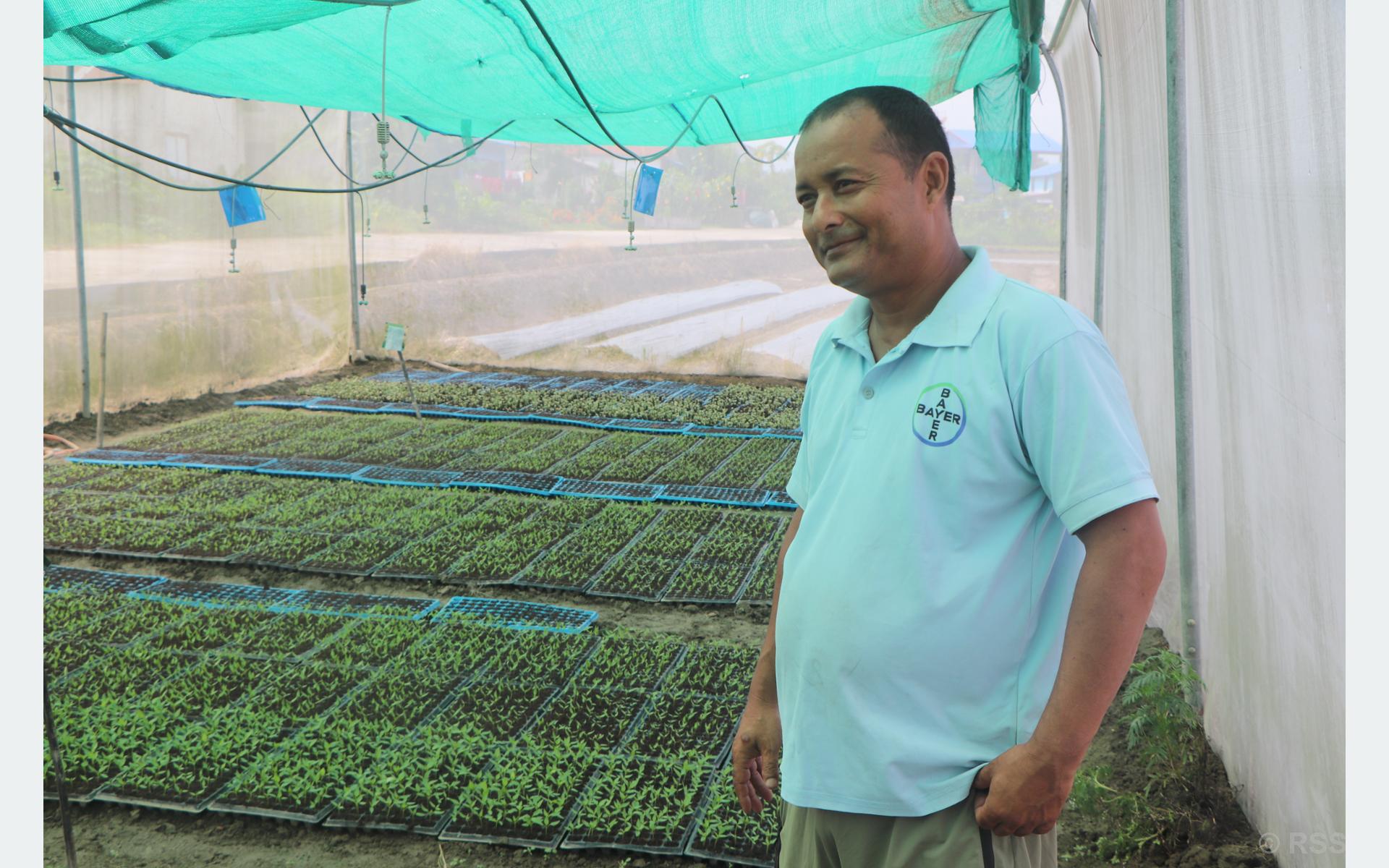
Farmer Naveenkumar Shrestha of Samanpur, Khairahani Municipality-10, has not only been earning lakhs of rupees annually from the commercial cultivation of hot chilies after quitting his teaching profession with a Bachelor of Education degree, but he has also provided employment to many local youths and locals.
Shrestha, who has become economically self-reliant by modernizing and commercializing his ancestral profession for over two decades, is now established as a successful and ideal farmer in the district. Shrestha, who was once a teacher, now has a very different daily routine. Feeling that the soil of his own farm gave him more satisfaction than the limited salary and confines of a job, he left the teaching profession and plunged fully into farming. After spending six years in the teaching profession, he is now busy in his hot chili garden with agricultural tools in his hands.
Although Shrestha has been involved in vegetable farming part-time since 2056 BS, he has given top priority to commercial hot chili cultivation since 2072 BS. He has currently cultivated bullet and long varieties of chilies on about 25 katthas of land. 'In the past, I had to cycle about 26 kilometers to sell vegetables,' Shrestha recalls, 'but nowadays, that is not the situation; traders come to the farm, and chilies and vegetables are sold directly from the field.'
Despite the strong dominance of Indian chilies in the Nepali market, Shrestha's produce has created a distinct identity in the market. Because the local produce is fresh and of higher quality compared to Indian chilies, his chilies fetch a higher price in the market than others.
The chilies produced by him reach Narayangadh, Tadi, Parsa in Chitwan, and even the capital Kathmandu. 'Other farmers here do not grow many hot chilies, so I have never had a problem with sales. I have never had to store chilies at home because they didn't sell on any given day,' he says. He mentioned that last year, he sold about one lakh rupees worth of dried chilies by drying the excess chilies that ripened on the plant. According to him, this is an evergreen crop that produces throughout the year and is the easiest to cultivate.
Shrestha is earning a commendable income from chili cultivation. Last year alone, he sold chilies worth 23 lakh rupees from 25 katthas of land. After deducting all expenses including fertilizer, seeds, and labor, he made a net profit of 12 lakh rupees.
Through agriculture, he has not only improved his economic condition but also created employment opportunities at the local level. His farm provides regular employment to 10 to 12 local people daily. Shrestha spends over 10 lakh rupees annually on wages for workers. 'My family and I work on the farm, and I have also given work to other brothers and sisters from the village. They have also found work, and I have benefited,' he says.
With the earnings from vegetable farming, Shrestha has expanded his ancestral property and broadened his business. He is currently operating Naveen Agro Center and Rice & Mustard Mill to provide fertilizer, seeds, and consultation to farmers. He also provides technical support and assistance to other farmers in the village facing problems. His family of six, including his parents, wife, and two daughters, is now happily sustained by this strong foundation of agriculture.
Shrestha has become a source of inspiration for the youth migrating abroad due to a lack of prospects at home. His success clearly demonstrates that if one loves their own soil and toils, they can earn more and gain more self-respect at home than abroad, and that the future of agriculture in Nepal is very bright if the right plans and efforts are made.
This specific news has been automatically translated by AI. As a result, there may be some inaccuracies or language errors.
_QrB2irqZF2.jpg)
_2MW2lv6Wod.jpg)