Nepali Film Production Decreases by 50% in 2083 BS

Kathmandu. The pace of Nepali film production has decreased significantly this year (2083 BS). The latest production permit data from the Film Development Board shows that film production has decreased this year compared to last year.
A production permit must be obtained from the Film Development Board before producing a film. According to the board's details, only 27 films have obtained production permits in the months of Baishakh and Jestha of the current year 2083 BS.
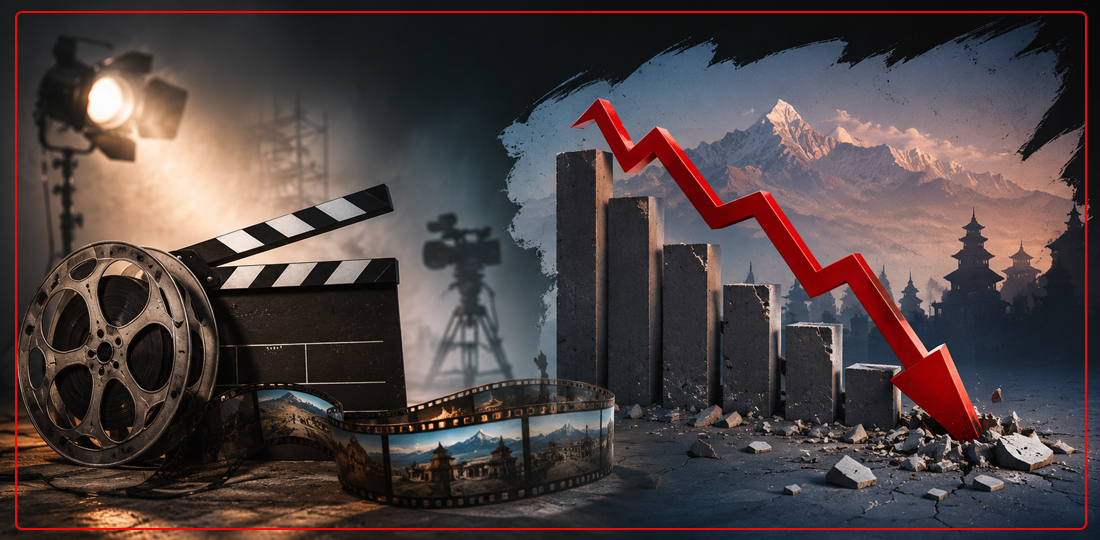
In the same period last year, 2082 BS, 54 films had obtained production permits. Looking at this data, the process of producing new films has decreased by about 50 percent this year compared to last year.
The number of films obtaining production permits from the board this year is 16 in Baishakh and 11 in Jestha. Films that obtained permits in Baishakh include 'Bichautiya', 'Malaya Kramu', 'Ek Muthi Badal', 'Teen Tighre Kya Bigre', 'Chyona, Hitko Maya', 'Timi mero ma timro', 'Whole Timers 2', 'Phalano Dhishkano', 'Asha', 'Ugram', 'Mero Prem Adhuro', 'Dhukdhuki', 'Ek Ekana Dui', 'Khandahar ra Devkali'.
Similarly, in Jestha, 'Yug', 'Pardesh', 'Panchami', 'Gajagu Sanskar', '4 GPA', 'Swami', 'Kanya Keto', 'Lyang Lyang', 'Tiri Miri Jhyai', 'Ghar Hinde ko Manchhe' and 'Sunko Bihani' have obtained permits.
Among the 27 films that obtained production permits in Baishakh and Jestha, 'Teen Tighre Kya Bigre' is in the preparation stage of filming. Popular singer Pashupati Sharma, teleserial artist Samiya Karki, and singer Anju Panta's daughter Paritoshika Panta will be seen in the lead roles in this film. The activity of other films is slow at the moment.
Why has film production decreased?
There are many reasons for the decrease in Nepali film production. The main reasons among them are the business of films, the expensive remuneration of artists, and the political instability of the country. However, filmmakers mostly blame the artists. They say that film production has decreased due to the expensive remuneration of artists.
Uday Subba, Chairman of the Film Producers Association, also says that film production is on the decline due to the unnatural remuneration of artists. He says that the audience's interest is the second reason. 'The remuneration of artists is exorbitant. Paying their remuneration makes the film expensive, but we are unable to capture the audience's interest,' he says, 'Why make films just to make artists rich when there is no business?' He argues that it will be difficult to save the industry if the investment modality is not changed.
'Either artists should reduce their remuneration and take a share in the profit, or the style of investment should be changed,' Subba adds, 'The gap where unsuccessful artists go hungry and successful ones take exorbitant money is weakening the industry from within.' Subba believes that the lack of film business is another reason for the decrease in production.
Writer and critic Samipya Raj Timalsina, however, says that this decline should not be viewed solely negatively. He says that production increases when film business increases and decreases when it decreases. 'Films like 'Purnabahadur's Sarangi' did very good business at the box office. Because of that, many people got the hope that there is good money in this sector, and production registration increased sharply,' Timalsina says, 'After that success, films could not do business of the same level, so producers are in a wait-and-see mode.'
Timalsina estimates that producers may be hesitant to invest now due to the global economic recession and its impact on our economy.
Actor, producer, and director Nawal Khadka sees the state's policy and audience psychology at its root. He understands that producers are discouraged due to the tendency of audiences to be liberal towards foreign films and turn up their noses at Nepali films.
'Doing business of 5-10 lakhs and artists demanding 50-60 lakhs remuneration? This is not practical from anywhere. How can producers survive in such a situation?' Khadka adds, 'The tendency to look for Bollywood or Hollywood quality in Nepali films has overshadowed originality.'
Khadka warns that if not heeded in time, this dire situation will completely collapse the Nepali film industry.
Who is making films?
This specific news has been automatically translated by AI. As a result, there may be some inaccuracies or language errors.