Farmers Enthusiastic as International Demand for Organic Coffee Rises in Bhojpur

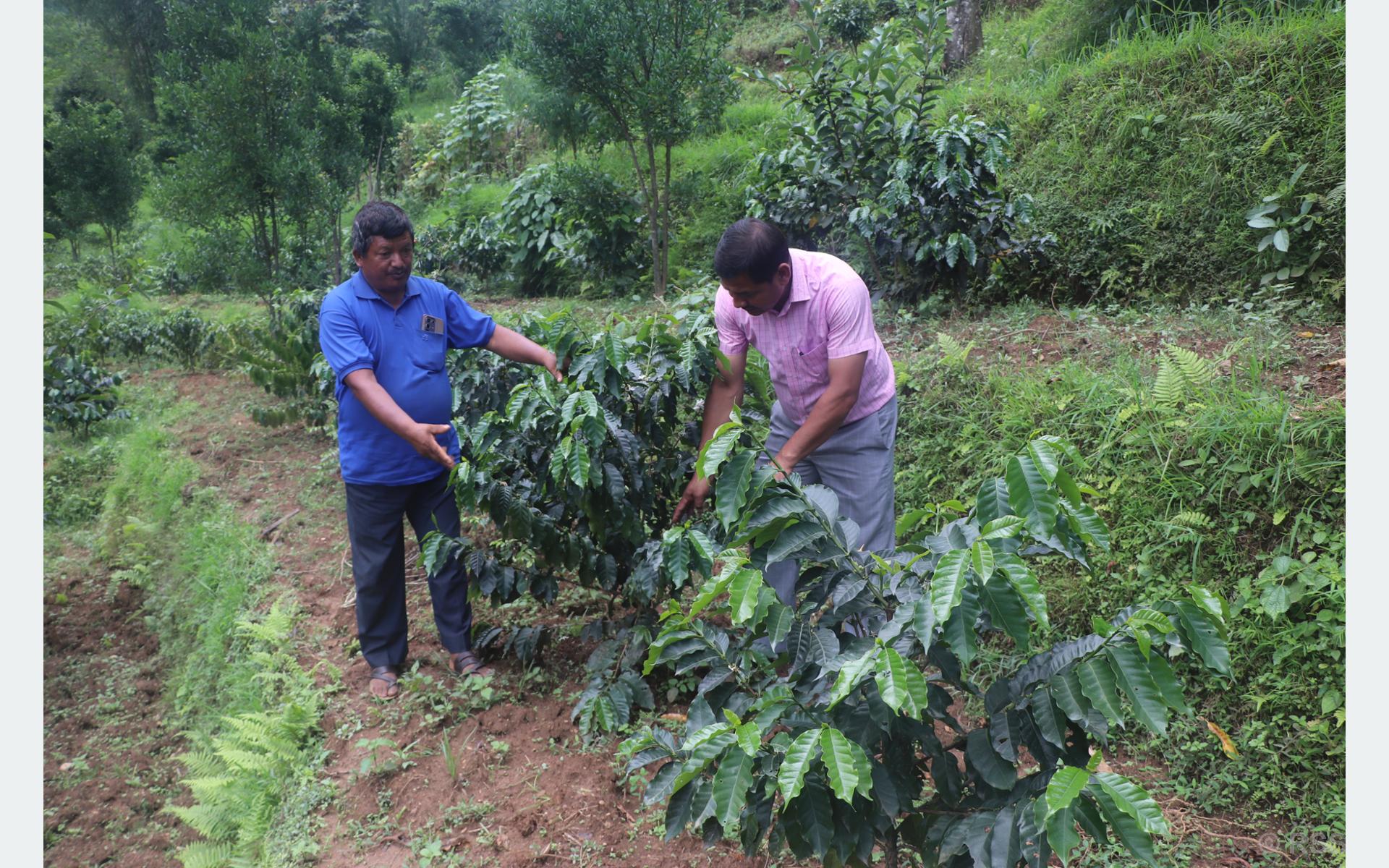
Bhojpur. Farmer Jeevan Thapa of Shadananda Municipality in Bhojpur is very excited as the demand for the organic coffee he produces continues to increase in the international market.
He has been engaged in its commercial cultivation for the past few years after leaving traditional farming and seeing good income from cash crop coffee farming.
Thapa has expanded coffee cultivation over an area of 65 ropanis. There is no problem with the market for the coffee he produces, and it has started to be exported abroad as well as sold in the domestic market. He says he has exported about one thousand kg of coffee abroad so far.
Currently, he is adding value to coffee through his own processing industry. 'Selling processed coffee yields double the price compared to selling raw beans,' he says. Like Thapa, other farmers are also attracted to coffee cultivation. Local farmer Pritamkumar Rai says that coffee cultivation should be considered a long-term source of income. 'Coffee that is planted once yields for many years, so it is a sustainable crop,' he says.
Another local, Sangita Rai, said that it has become very easy to work after receiving seedlings, fertilizer, and equipment from the municipality, and the active participation of women in this has also contributed to women's empowerment. Local farmer Mukti Rai, who returned from foreign employment, shares his experience that good income can be earned from coffee by working hard in the village rather than going abroad.
With the goal of poverty reduction and commercialization of agriculture, Shadananda Municipality has started the Organic Coffee Cultivation and Commercialization Project with an investment of approximately 30 million rupees in the fiscal year 2082/83. The program has been prioritized with the aim of making coffee a major source of income and employment, substituting imports, promoting exports, and branding local products.
The municipality has allocated a budget of 16.5 million rupees for the operation of the program, and with the inclusion of farmers' cost sharing, the total size of the project will reach 28.9 million rupees, informed Chief Administrative Officer of the Municipality Matrika Prasad Dahal. This public-private partnership practice will reduce the distance between production and market, and the municipality plans to develop Shadananda as a 'coffee hub' within the next five years. The hilly terrain, moderate temperature, and suitable rainfall provide a conducive environment for coffee.
Under the project, 157 farmers will directly benefit in the first phase, informed Agriculture Branch Chief Shila Pun Magar. They will be provided with 75,000 coffee seedlings, 113 mini tillers of 5 HP capacity and 50 mini tillers of 7 HP capacity for plowing the fields. In addition, 20 brush cutters, 257 sprayers, and 16 sickles will be distributed. To make the farming completely organic, 22,620 kg of cow dung, 21,360 kg of bone meal, 86 liters of mineral oil, 100 liters of Bordeaux paste, and 33 liters of EM (Effective Microorganism) will also be provided.
Shadananda's Mayor Surendra Kumar Udash says that this program has been implemented for the commercialization of the agricultural sector and the strengthening of the rural economy. 'We have launched a large-scale coffee cultivation expansion program. Studying the national and international markets, the potential for coffee appears very good, so we have increased investment while encouraging farmers,' he said.
According to the Deputy Mayor of the Municipality, Pramila Rai, this program will create a basis for retaining youth who have returned from foreign employment in the village. The municipality will not only distribute materials but also conduct capacity-building training on topics such as seedling planting methods, pest control, and post-harvest management.
The area between 800 meters to 1,800 meters above sea level is considered suitable for coffee cultivation, and this cultivation is being expanded in 13 out of the 14 wards of Shadananda. There is also potential to develop coffee as 'agro-tourism' by linking it with tourism. If problems such as technical services, market price fluctuations, and climate change can be resolved, Shadananda Municipality appears set to be established as a major coffee production center in the country.
This specific news has been automatically translated by AI. As a result, there may be some inaccuracies or language errors.