Seven Provincial Governments Prioritize Agricultural Transformation in FY 2083/84 Budgets

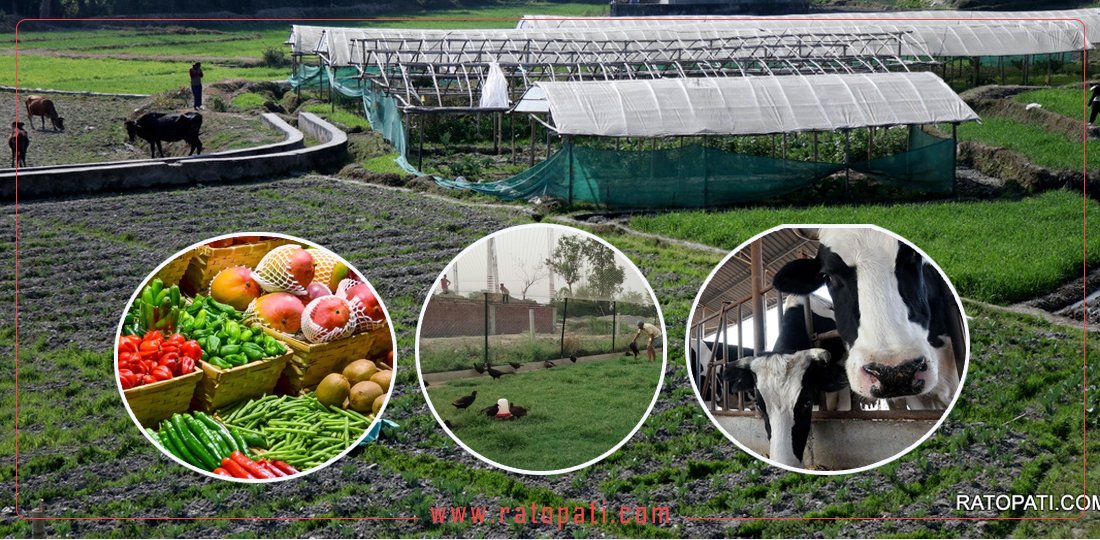
Kathmandu. All seven provincial governments of Nepal have placed the structural transformation of the agricultural sector at the center of their policies and programs through their budget statements for the fiscal year 2083/84.
A common resolution seen in the budgets of all seven provinces is to modernize, mechanize, commercialize, and make the agricultural system, which is a traditional means of livelihood, technology-friendly, thereby laying the foundation for a self-reliant economy.
To make the provincial economy dynamic, stop youth migration, and substitute imports, all seven provinces have adopted new strategies this time, such as programs directly benefiting farmers, concessions on commercial agricultural loans, development of production clusters based on geographical specialization, and conservation of soil fertility.
These budgets appear to have made an effort to formulate farmer-centric budgets by correcting past policy weaknesses for the transformation of the agricultural sector.
Koshi Focuses on Agriculture from Daily Kitchen to Market
The Koshi Province government has allocated a total budget of 2.92 billion rupees for the integrated development of agriculture, industry, and cooperative sectors, with a special focus on import substitution and production increase. Koshi Province has put forward special promotion programs to reduce the import of agricultural products used in daily kitchens such as onions, garlic, potatoes, and tomatoes.
In addition, 83.8 million rupees have been allocated for interest subsidies to provide concessions on agricultural loans to small and commercial farmers, and 73 million rupees for the promotion of commercial fruits, cash crops, and spice crops. By allocating special budgets for animal health and epidemic control (180 million rupees), animal breed improvement, fish farming, and integrated agriculture, Koshi Province has adopted a strategy to strengthen the chain from production to marketing.
Focus on Organic Agriculture in Madhesh
The Madhesh Province government has allocated 2.9235 billion rupees for agriculture and food management with the main slogans 'Productive Madhesh, Self-reliant Nation' and 'Madhesh Can Feed the Nation'. Madhesh has implemented a direct subsidy system to identify genuine farmers through digital farmer identity cards and send subsidies directly to farmers' accounts based on production, discouraging middlemen. A policy has been adopted to establish the Madhesh Agricultural Commodity Exchange to ensure market access, and mobile soil testing laboratories will be operated to reduce the use of chemical fertilizers in Madhesh Province.
There is a special plan in Madhesh Province to establish a fertilizer factory in a public-private partnership model to promote the production of organic fertilizers and provide up to 50 percent incentive grants for small and commercial agricultural machinery.
Bagmati: No New Programs
The Bagmati Province government has allocated a massive budget of 6.7177 billion rupees, covering agriculture, livestock, forest, and environment sectors, prioritizing provincial food security and productivity increase. Bagmati Province has adopted a policy to continue the effective 'One Ward, One Agricultural Product Program' implemented in the past and expand it to 60 more wards in the province.
To achieve self-sufficiency in milk production, a provision has been made to provide a 50 percent subsidy on electricity tariffs consumed by dairy cooperatives and cold storage facilities. By launching the 'Krishi Gyan Ratna Promotion Program' to connect youth with agriculture, Bagmati Province has adopted a policy to promote sustainable agricultural development, land management, and agricultural innovation.
Most of the agricultural budget brought by Bagmati Province continues programs from the current fiscal year.
Gandaki: From Himalayan Water to Agriculture App
The Gandaki Province government has allocated a budget of 2 billion rupees for the improvement of agriculture, land management, and cooperatives sector with the strategic goal of 'Himalayan Water, Hilly Soil: Development and Prosperity on Gandaki's Path'. Gandaki Province has arranged a provision of 40 million rupees as interest subsidy to attract youth returning from foreign employment into commercial agriculture and create self-employment through the 'Return to Village' campaign.
A special budget of 300 million rupees has been allocated to expand commercial orchards of high-value fruits such as walnuts, macadamia nuts, oranges, kiwis, and avocados on 2500 hectares of land in hilly areas based on geographical specificity. To facilitate marketing, an 'Agriculture Ambulance' and an agriculture app for digital marketing will be launched, and a program has been set to declare 10 local levels as fully vaccinated local levels for livestock.
Lumbini: Services at Farmers' Doorsteps, Priority to Indigenous Rice Varieties
The Lumbini Province government has made efforts to strengthen the rural economy by allocating a budget of 1.7807 billion rupees targeting commercial agriculture, land management, and cooperatives. Lumbini Province has allocated 27.8 million rupees for the 'Technical Services at Farmers' Fields and Sheds, Support for Commercial Agricultural Production' campaign to provide technical services and medical treatment at the doorstep of 20,000 farmers.
To conserve biodiversity and promote the cultivation of indigenous local rice varieties (Tilki, Kalanmak, Jhinua, etc.), a provision has been made to provide an incentive grant of 1,000 rupees per Katha. 60 million rupees have been allocated to make hilly districts free from Foot-and-Mouth Disease under the animal health service and vaccination campaign, with Lumbini Province giving special emphasis on increasing productivity and market expansion.
Karnali: One Village, One Orchard
The Karnali Province government has adopted a policy to make agriculture the backbone of Karnali's prosperity by allocating 2.9287 billion rupees for the Ministry of Agriculture, Land Management, and Cooperatives, considering the geographical remoteness and climatic suitability.
Karnali Province has given high priority and continuity to the 'One Village, One Commercial Fruit Orchard' program for the promotion of apple, walnut, and orange production. 71.5 million rupees have been allocated for the promotion of cotton cultivation in Surkhet and Mugu districts, and 96 million rupees have been set aside for improving the livelihoods and developing entrepreneurship of youth and targeted groups. A special budget of 121.7 million rupees has been arranged for the commercial farming and value chain development of sheep, goats, and yaks in the hilly regions of Karnali.
Far-Western Budget: 'One Local Level, Two Products'
The Far-Western Province government has allocated a total of 2.92 billion rupees for the commercialization of agriculture and sustainable productivity increase, increasing investment in targeted communities and youth-oriented entrepreneurship.
Far-Western Province has arranged a budget of 55.44 million rupees for the 'One Local Level: Two Products' program to increase production based on the potential of each local level. 20.5 million rupees have been allocated for the 'Let's Sweat and Smile in Our Country' campaign to create an environment for youth returning from foreign employment to stay in the country, and 36 million rupees have been allocated to improve the livelihoods of the poor, landless, and freed Haliya and Kamlari.
A budget of 30 million rupees has been allocated to conduct a complete vaccination campaign to control epidemics affecting livestock and poultry.
Madhesh and Koshi provinces are trying to establish a system of providing direct subsidies to farmers using technology, which is believed to reduce the opacity in subsidy distribution. Bagmati, Lumbini, and Madhesh provinces have adopted policies to establish biological and organic fertilizer factories and distribute soil health cards to reduce reliance on chemical fertilizers.
To prevent the migration of youth and connect returnees with agriculture, Gandaki, Karnali, and Far-Western provinces have introduced special interest subsidies and entrepreneurship programs. Gandaki's 'Return to Village' and Far-Western's 'Let's Sweat and Smile in Our Country' programs are expected to help attract youth to the field of commercial agriculture.
Karnali has focused on developing commercial clusters of apples, walnuts, and sheep-goats by identifying the suitability of its hilly geography.
This specific news has been automatically translated by AI. As a result, there may be some inaccuracies or language errors.