Nepal's Tea Industry Faces Export Hurdles Amidst Systemic Weaknesses

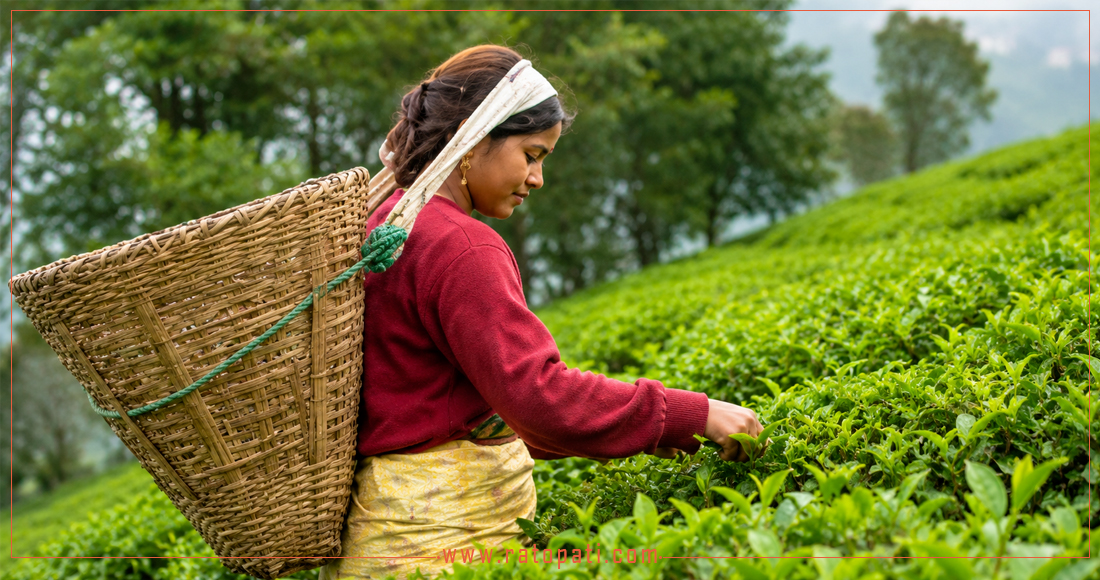
Tea produced in the green hills of Nepal's eastern mountains is a product connected to our identity, potential, and the lives of thousands of farmers. When tea cultivation began in Ilam, Nepal, in 1863, Sri Lanka was cultivating coffee. When the fungal blight disease severely increased in coffee cultivation, tea cultivation began in Sri Lanka from 1867.
Sri Lanka's tea industry, which started after ours, has reached billions. But in our country, the recent obstruction in exports to India has raised a serious question again. Even if we produce good tea, how strong have we made the structure for reliable testing, certification, branding, and connecting with international markets?
In Nepal, structures have been built with government investment for tea laboratories, testing centers, and trade platforms. But sadly, it is disheartening to hear that these structures are being rented out as hotels instead of being used for their original purpose. This is not just a misuse of a building; it is a serious issue connected to the future of the Nepali tea industry. Is the government unable to build reliable laboratories? Why are such things not our priority?
It may be natural for India to tighten the quality testing and standards for tea entering its market. But we must respond not with emotional reactions, but with a strong system. We need to provide a system with our own capable laboratories, reliable test reports such as residue analysis, origin certification, traceability, and documentation according to international standards.
In recent years, India has seen a policy of tightening quality testing of imported tea, FSSAI standards, labeling, and source declaration. This move is related to teas coming from countries including Nepal, Kenya, Vietnam, China, and Sri Lanka.
We can learn a lot from Sri Lanka in this regard. Despite being a small island nation, Sri Lanka has made 'Ceylon Tea' a strong brand in the global market. They have made tea not just an agricultural product, but a matter of national identity, quality, and export diplomacy. The Tea Board, laboratories, certification, logos, trading systems, and market diversification have made their tea reach the world. Sri Lanka is still one of the world's major tea exporting countries.
In 2024, Sri Lanka exported about 245.7 million kg of tea, earning about 212 billion Nepali rupees. Sri Lankan tea is generally known as 'Ceylon Tea'. And not only its bulk, but also its packets, tea-bags, green tea, instant tea, and specialty teas reach the world market.
Orthodox tea from Ilam, Kanyam, Fikkal, Panchthar, Dhankuta, and the eastern hills has the quality to establish a distinct identity in the world market. But for that, tea gardens alone are not enough.
Sri Lanka's tea trade is not dependent on India. Their main market is outside India. Looking at recent statistics, it goes to Iraq, Turkey, Russia, UAE, China, Azerbaijan, America, Germany, and Japan. In the period of January-April 2024, Iraq, Turkey, and Russia have appeared as top markets in the list of countries exporting.
Nepal's tea also has that potential. Orthodox tea from Ilam, Kanyam, Fikkal, Panchthar, Dhankuta, and the eastern hills has the quality to establish a distinct identity in the world market. But for that, tea gardens alone are not enough. Laboratories are needed, testing centers are needed, certification is needed, a trading platform is needed, market diplomacy is needed, and most importantly, we need reliable laboratories to test and certify our products. Do we have all this infrastructure?
Sri Lanka's strongest aspect is quality governance. They have managed tea not just as a normal agricultural commodity, but as a 'national brand'. They have done the following for it:
First, there is the Sri Lanka Tea Board for the development of tea, which plays a role in regulation, promotion, certification, and quality assurance of the industry. The Tea Board's Analytical Laboratory performs quality assurance, testing, and certification of Ceylon tea.
Second, they have made their Lion Logo a powerful certification mark. According to the Sri Lanka Tea Board, packets bearing the Lion Logo guarantee 100 percent. This logo is a global trademark owned by the Tea Board.
Third, the Tea Export Association mentions that Sri Lanka has implemented ISO 3720 as the minimum standard for tea. This helps regulate basic quality.
With the formation of the new government and its commencement of work, it is time to raise questions about Nepali tea. Our tea is good, but how good is our system?
Fourth, they are also conscious about residue/food safety. Efforts are made to meet various standards for export. One study showed that tested samples of export-quality Ceylon black tea were within the Codex, EU, and Japanese MRL limits.
Are we failing in this very aspect? How serious are we about taking our products to the global market? In our country, structures built with government investment have become hotels. Such things should have become the backbone for industries and exporters, providing reliability, shouldn't they? But the government has not been able to pay attention to this.
Trade with India should be facilitated, but we should not be solely dependent on India. It is not impossible to expand the market for Nepali tea to Japan, Europe, America, and the Middle East, similar to Sri Lanka. Some of our companies have also made Europe their main market. Can't we learn from them?
With the formation of the new government and its commencement of work, it is time to raise questions about Nepali tea. Our tea is good, but how good is our system? We produce, but can we certify? We want to export, but have we built a structure that speaks the language of the global market?
To save and strengthen the future of the Nepali tea industry, now not just concern, but clear policy, capable laboratories, quality certification, market diversification, and responsible institutional leadership are needed.
If structures are being built, let's use them reliably. Let's make an honest effort to build the foundation of the industry, not misuse government investment. Only then will it be connected to the prosperity of Nepali tea farmers, industries, and the country.
This specific news has been automatically translated by AI. As a result, there may be some inaccuracies or language errors.