Nepal's Path to Prosperity: Beyond Physical Development
"Prosperous Nepal" is mentioned in the state's policy to the manifestos of political parties. That is, prosperity is a common goal of all Nepalis. However, the debate on the concept of prosperity is not based on sufficient ideological clarity. Although prosperity is accepted as a goal, there has been no serious discussion about its meaning, basis, and stages.
There is a tendency to consider the expansion of physical infrastructure and economic activities as the basis for prosperity. This concept considers the expansion of roads, buildings, industries, or other physical structures as indicators of prosperity. That is, physical development is considered prosperity. However, the question of prosperity is not so simple.
Production, trade, and physical infrastructure expansion are the basic stages of development. An economy without production does not create employment. An economy without trade does not expand markets. An economy without infrastructure does not gain momentum in socio-economic activities. Therefore, production, trade, and infrastructure expansion are the bases for economic progress. However, these are not sufficient bases for prosperity.
Industries can be built. Trade can increase. Roads and physical structures can be constructed. The country's income can also increase. However, a situation where citizens do not receive quality education, health services, reliable employment, social security, and just opportunities cannot be called prosperous. Therefore, the achievement gained through the expansion of physical structures is not prosperity but a means to the journey of prosperity.
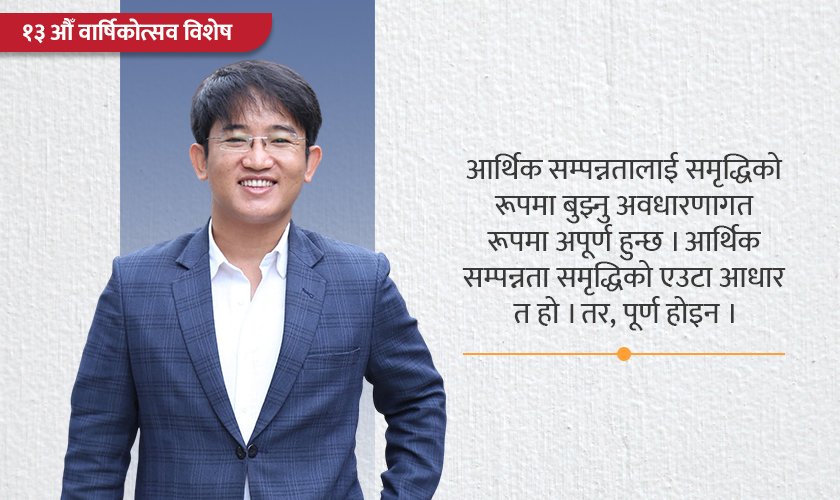
Understanding economic affluence as prosperity is conceptually incomplete. Economic affluence is one basis of prosperity. But not complete. Even if the country is economically affluent, if the human development aspect is weak, such a society cannot be called prosperous.
Prosperity is not measured solely by the expansion of physical infrastructure or economic growth rate. Building a school and educating society are not the same thing. Building a hospital and citizens being healthy are also not the same thing. Building roads and expanding citizens' opportunities are also not the same. Society cannot be prosperous until citizens receive quality education and health services, have equal access to opportunities, social security is ensured, justice is easily accessible, discrimination ends, and people can live with dignity.
In this context, it is necessary to look at Nepal's journey towards prosperity objectively. In recent decades, achievements have been made in the construction and expansion of physical infrastructure. However, from a multidimensional perspective of development and prosperity, Nepali society still appears to be in its initial stages. This is because the foundations of human development, institutional capacity building, a productive economy, and social justice have not yet been strengthened. The lack of quality education, weak health services, lack of employment, labor migration, limited social security, lack of good governance, and weak 'human capital development' confirm that Nepal's journey towards prosperity is still in its initial stages.
Prosperity is not just the result of physical structures built by the state or policies implemented. The state can create the foundations for development.
The journey of prosperity is also related to a production-oriented economy. Economic prosperity is not possible without production. However, Nepal's economy is still heavily dependent on imports and remittances. There has been no balanced development between agriculture, industry, and the service sector. Although the production sector is weak, consumption is high. Domestic products cannot compete. A large number of labor forces have gone abroad. In such a situation, even if economic activities increase, the foundation of a productive economy remains weak. Therefore, a sustainable foundation for economic prosperity cannot be built without expanding production, productivity, industrialization, and entrepreneurship.
Good governance is also an important aspect along with physical development in the journey of prosperity. Without good governance, physical development is not effective. Corruption, impunity, administrative inefficiency, policy instability, and institutional weaknesses render the achievements gained from physical development unsuccessful. Therefore, good governance is a fundamental condition for prosperity.
Social, economic, political, and cultural contradictions are important aspects in the context of Nepal. Historically, Nepali society has been affected by multifaceted contradictions such as class inequality, ethnic and regional discrimination, gender inequality, unbalanced access to resources, unemployment, imbalance between production and consumption, and political instability. Similarly, in a society diverse in culture, language, and ethnicity, issues of identity, representation, participation, and coexistence are also complex. Without resolving such contradictions, the journey of good governance and prosperity cannot move forward.
Until the contradictions in society are resolved, the fruits of physical or other development cannot be distributed justly. Even with economic growth, its benefits accrue only to a limited class, sector, and group. Weak social justice does not establish equal access to opportunities. Human capacity development is limited by economic inequality. Political instability affects long-term development strategies. Institutional weaknesses weaken good governance and public accountability.
A prosperous society can be called a high social state built after ending inequality, discrimination, exclusion, and deprivation in society. Where the fruits of development are distributed justly to all citizens. Equal access to opportunities is ensured. Respectful coexistence is established among all existences.
Prosperity is not just the result of physical structures built by the state or policies implemented. The state can create the foundations for development.
Therefore, Nepal's journey towards prosperity is essentially a journey of social transformation. The goal of prosperity cannot be achieved without building the foundations of social justice, equal economic participation, political stability, cultural coexistence, and institutional good governance. However, these foundations are not established solely through state policies, plans, and announcements. Active cooperation between citizens and the state is also necessary for their successful implementation.
Prosperity is not just the result of physical structures built by the state or policies implemented. The state can create the foundations for development. It can create opportunities. It can make necessary structural arrangements. However, society must transform those opportunities into production, entrepreneurship, innovation, and social progress. This means that the basis of prosperity is not only policy, planning, budget, and infrastructure, but also active citizen participation, productivity, accountability, and social consciousness.
If citizens feel ownership, the achievements of physical development can be sustainable. Citizen consciousness that protects public resources, obeys laws, engages in productive activities, fulfills social responsibilities, and holds public institutions accountable can transform development into prosperity. If citizens remain inactive, relying solely on the state, the achievements of development become limited, unbalanced, and temporary.
Prosperity is not something the state alone can build. It is a 'social condition' built through the joint efforts of the state and society. The state must create the environment. Citizens transform it into results through creativity, entrepreneurship, and accountability. Therefore, prosperity lies in the balanced relationship between the state's capacity and citizens' active participation.
Therefore, prosperity cannot be understood merely as building an affluent economy. Prosperity must move towards prosperity through human development, social justice, good governance, a productive economy, citizen participation, sustainability, and the just resolution of structural contradictions.
It is necessary to free Nepal's journey towards prosperity from the limited definition of physical development and connect it with human development, social justice, good governance, a productive economy, institutional strengthening, citizen participation, sustainability, and the resolution of structural contradictions.
The dream of prosperity remains incomplete without centering human development, building a productive economy, establishing good governance, and resolving the social, economic, political, and cultural contradictions existing within Nepali society. The real journey of prosperity begins where the focus of development is not on structures, but on people.
This is also the direction of the heavy mandate given by the people to the Rastriya Swatantra Party (RSP) in the elections after the Janji movement. The party and the government are making every effort to fulfill the aspirations of the people and deliver what the people expect. However, the full participation of the people in this will further inspire them to move in that direction.
(Limbu is a leader of the Rastriya Swatantra Party.)
This specific news has been automatically translated by AI. As a result, there may be some inaccuracies or language errors.