India's PM Modi Asks Nepal to Prepare List of Issues for Discussion

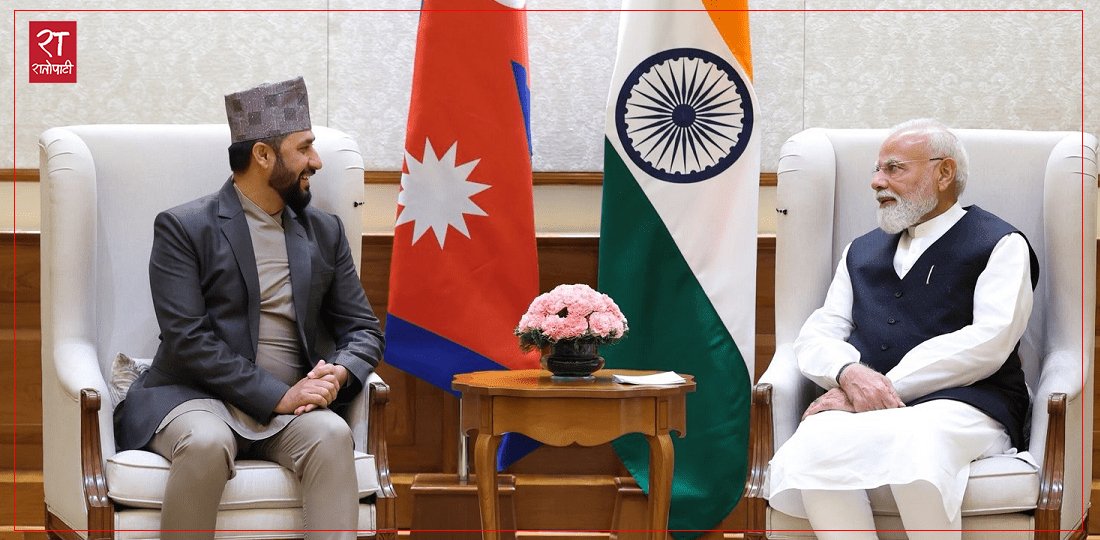
Kathmandu. Indian Prime Minister Narendra Modi has urged Nepal to prepare a list of issues on which there are problems between Nepal-India.
During a meeting with Rabi Lamichhane, chairman of Nepal's ruling party Rastriya Swatantra Party, on Wednesday, Indian Prime Minister Modi mentioned that he was willing to work with the Nepali government. However, an official participating in the delegation said that he urged Chairman Lamichhane to prepare a list of what work to do and what issues to discuss.
'India has stated that it is ready to discuss all issues between Nepal-India including hydropower, airport, and border crossings,' the official said, 'He has asked for a list with a deadline and said that he will work on it with priority.'
Indian Prime Minister Modi had made a similar proposal 12 years ago. Although he made a similar request during his visit to Nepal in 2014, it has not been provided by the Nepali side so far.
That point is mentioned in point 11 of the joint communiqué issued by both sides at that time. The point states, 'The leaders of both countries agreed to review, amend, and update the 1950 Peace and Friendship Treaty and other bilateral agreements. They welcomed the decision of the joint commission to instruct the foreign secretaries of both countries to discuss specific proposals to amend the 1950 Peace and Friendship Treaty, which the Government of Nepal has agreed to provide as soon as possible.'
Indian Prime Minister Modi had urged to provide proposals on how to amend the 1950 Peace and Friendship Treaty as soon as possible. However, such a proposal has not been provided by the Nepali side to India so far. A former secretary of the Ministry of Foreign Affairs said, 'Although secretary-level meetings were held from time to time, that issue was never seriously discussed.'
He said that although there was talk of amending the treaty, there was never any discussion on the basis or method of doing so. 'The documents and other evidence related to it are not only with the Ministry of Foreign Affairs. Other related ministries were supposed to provide them, but they were not provided, so time was passed by doing this and that,' he said.
Now Modi has repeated the same thing. The 1950 treaty is related to the East India Company. That is why Prime Minister Balendra Shah had said that discussions were also being held with England (Britain).
After Prime Minister Balen expressed his intention to seek Britain's help to resolve border disputes, the Indian Ministry of External Affairs clarified that any problem between Nepal-India would be resolved jointly by both sides and there was no need for a third party.
When Prime Minister Modi visited Nepal in 2014, Sushil Koirala was the Prime Minister. Both prime ministers had agreed to resolve the remaining Nepal-India border issues permanently.
They welcomed the formation of the Nepal-India Border Working Group to clear the no-man's land area, construct, restore, and maintain border pillars, and carry out other technical tasks.
It was agreed to instruct the foreign secretaries to work on the remaining border issues, including Kalapani and Susta, by taking necessary technical input from the working group. At that time too, the Indian side had stated that agreement had been reached on about 98 percent of the border and insisted on signing the strip map, but the Nepali side did not agree.
The joint communiqué states that the Nepali side had also replied at that time that it would sign only after all the remaining border issues were resolved.
This specific news has been automatically translated by AI. As a result, there may be some inaccuracies or language errors.