Parliamentary Stalemate Over Prime Minister's Controversial Statement

Kathmandu. Concerns are growing that the parliament, the supreme representative body of the people, might turn into a battleground of confrontation and force. This concern is fueled by the tendency of the ruling party to push through its agenda and the opposition to stand firm on its demands since the formation of the new parliament.
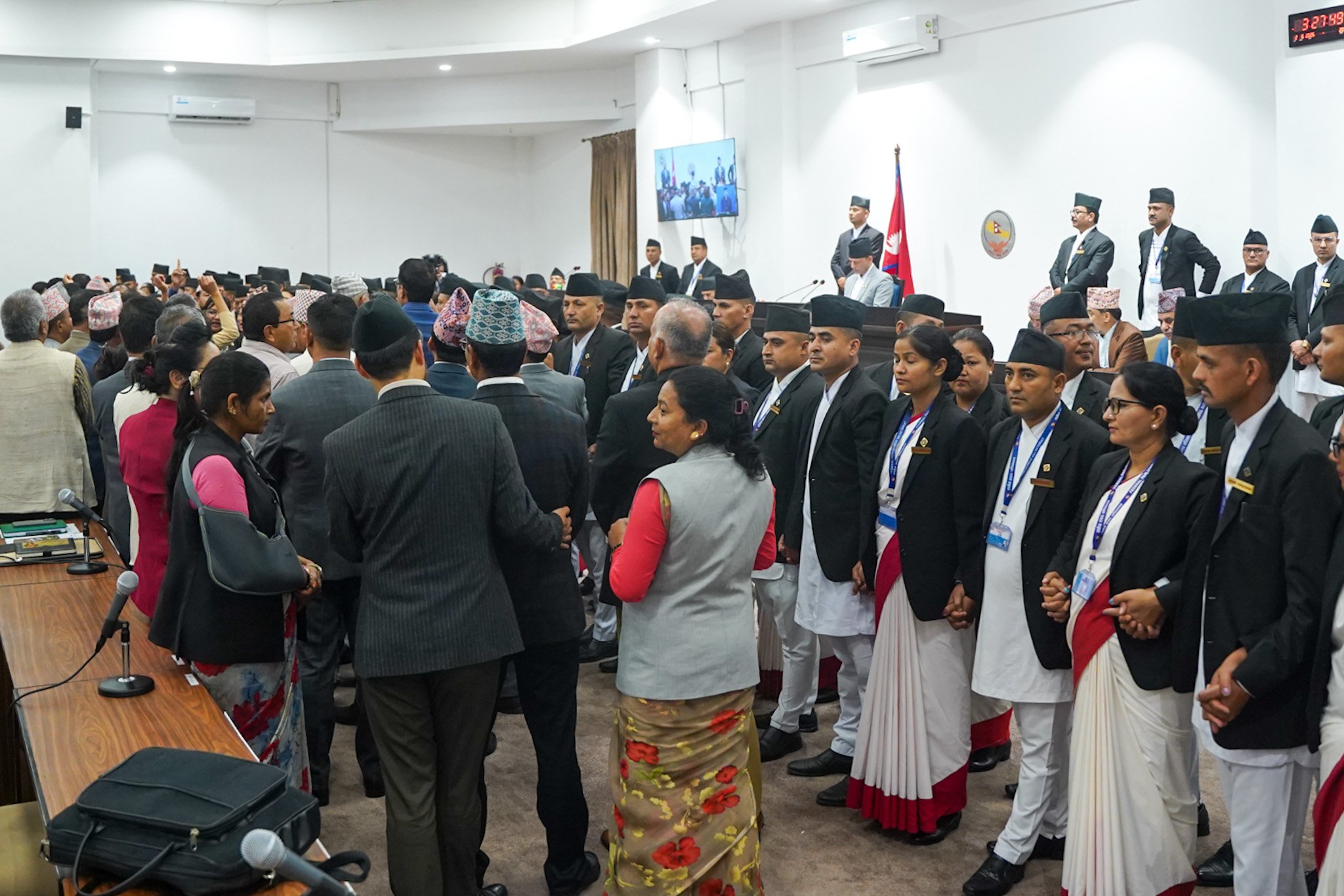
Speaker DP Aryal appears to be trying to push through the agenda by overpowering the opposition, which is significantly outnumbered and still struggling to come to terms with its recent unexpected defeat. Speaker Aryal is accused of forcibly passing his own rules of procedure for running the house for five years on the strength of the majority on Sunday night, May 17, amidst the opposition's obstruction, sloganeering, and encirclement of the well. Speaker Aryal could have brought the opposition parties on board and amended the process to gain consensus on running the house for five years. However, he did not choose that path.
Aryal did not seem to realize that the parliament becomes unsightly and weak when the speaker and the ruling party are inflexible.
Moreover, in parliaments worldwide, the ruling party has a majority, and it is the ruling party precisely because it has the advantage of the majority. Even in such a situation, the independent role of the speaker is seen and understood in conjunction with impartiality by making the parliament a common forum for debate, discussion, argument, and open dialogue. On the contrary, the speaker's role becomes more dependent on making the parliament a center of physical force, uncivil behavior, and chaos. If the recent scenes in the parliament continue, it cannot be said that ordinary citizens will not be ashamed and question, 'What kind of representatives have we elected?' in the coming days.
During the government's policy and program and parliamentary question-and-answer session, MPs demanded the Prime Minister in the parliament. However, an impromptu statement by the Prime Minister on May 17 landed him in controversy. The reverberations of the statement made by Prime Minister Balendra (Balen) Shah, also a senior leader of Rastriya Swatantra Party (RSP), in the House of Representatives meeting that day, claiming that 'Nepal has encroached upon Indian territory,' have not subsided.
It is not unreasonable to interpret and analyze the Prime Minister's statement, made from the rostrum of the parliament, against his own country as an act of treason. Following the public release of the Prime Minister's baseless statement, not only has there been opposition from the streets to the parliament, but the opposition has also demanded his resignation and burned effigies.
Prime Minister Balen himself has remained silent on such a sensitive issue that also involves national security. Instead, the Ministry of Foreign Affairs and the government spokesperson are giving evasive answers in defense of the Prime Minister's statement. As a result, discussions on the budget for the fiscal year 2083/84 and the making of important laws in the parliament are being affected.
The opposition parties in the parliament have been obstructing the parliamentary proceedings over Prime Minister Shah's statement regarding the border. They have clearly stated that they will not allow parliamentary activities to proceed until this issue is resolved.
For this reason, parliamentary proceedings could not move forward on Tuesday either. Consequently, Speaker DP Aryal was forced to adjourn the House of Representatives meeting for six days.
The opposition has demanded that Prime Minister Balen either come to the parliament and substantiate his irresponsible statement or withdraw it.
'We have asked the Prime Minister to correct or confirm his statement regarding the Nepal-India border,' said UML leader Guru Baral. 'We are clear on this. The parliament will not function without this.'
Due to the same demand, Tuesday's House of Representatives meeting was delayed by 2 hours. 'Because of that, today, Tuesday, we waited for the Prime Minister in the parliament for 2 hours, but he did not come,' said Baral. 'And the Speaker tried to conduct the meeting forcefully. Even then, we maintained our stance that the parliament cannot proceed until a clear response from the Prime Minister is received.'
The opposition parties claim that the Prime Minister's statement has raised questions not only within the country but also abroad.
They warn that if the speaker continues to run the house by exercising power on such a sensitive issue, it will lead to disaster.
'In a democracy, it is not power but discussion and dialogue that matter. The Prime Minister's treasonous statement must be corrected. Investigate it,' said UML MP Baral. 'Even the Speaker is providing incorrect information from his chair.' Baral claims that the Speaker has misinterpreted rule 56 of the parliamentary rules of procedure, falsely stating that there is no provision for 15 people to ask questions. 'If the Speaker continues to move away from discussion and dialogue like this, nothing but disaster will occur,' Baral warned.
Kavindra BurlaKoti, the general secretary of the ruling RSP, says that the opposition's demands will be addressed at the appropriate time. His statement suggests that RSP itself is not satisfied with the Prime Minister's statement on the border. 'The issues raised by the opposition will be addressed appropriately. Therefore, the parliament meeting has been adjourned until the 25th, with a period for discussion in between,' said BurlaKoti.
BurlaKoti also stated that the party has a clear stance on the Prime Minister's statement and the border. 'There is no question of the party not having a stance on this issue. Land has been used by both sides in the no-man's land,' said BurlaKoti. 'The choice of words to describe it is a separate matter. This is also reverse diplomacy.'
He clarified that the party had previously stated that Nepali land must be returned and efforts should be made for it.
'There is no more serious issue than the budget': Speaker Aryal
On Tuesday, Speaker Aryal sounded somewhat softer in the House of Representatives meeting. While the opposition was obstructing the parliament demanding clarification on the Prime Minister's statement, he stated that it had drawn his attention.

'I have taken note of the issues raised by the honorable members,' said Aryal. 'Certainly, the government has also taken the issues raised by them seriously.'
He also expressed confidence that the government would provide its response to resolve the issues raised in the house. However, he did not show the courage to rule for the Prime Minister to clarify. Instead, he assured that he, as the Speaker, would communicate with the government regarding the issues raised by the MPs and with the leaders of the opposition parties. After saying this, the Speaker also made it clear that the budget is not a more serious issue than the matters raised by the opposition in the House of Representatives.
'This is why I am not saying this issue is serious. I am not saying that the budget is a more serious issue than this,' said Speaker Aryal.
This specific news has been automatically translated by AI. As a result, there may be some inaccuracies or language errors.