Finance Minister Dr. Swarnim Wagle Claims Budget Will Lay Foundation for Economic Reform and Inspire Youth


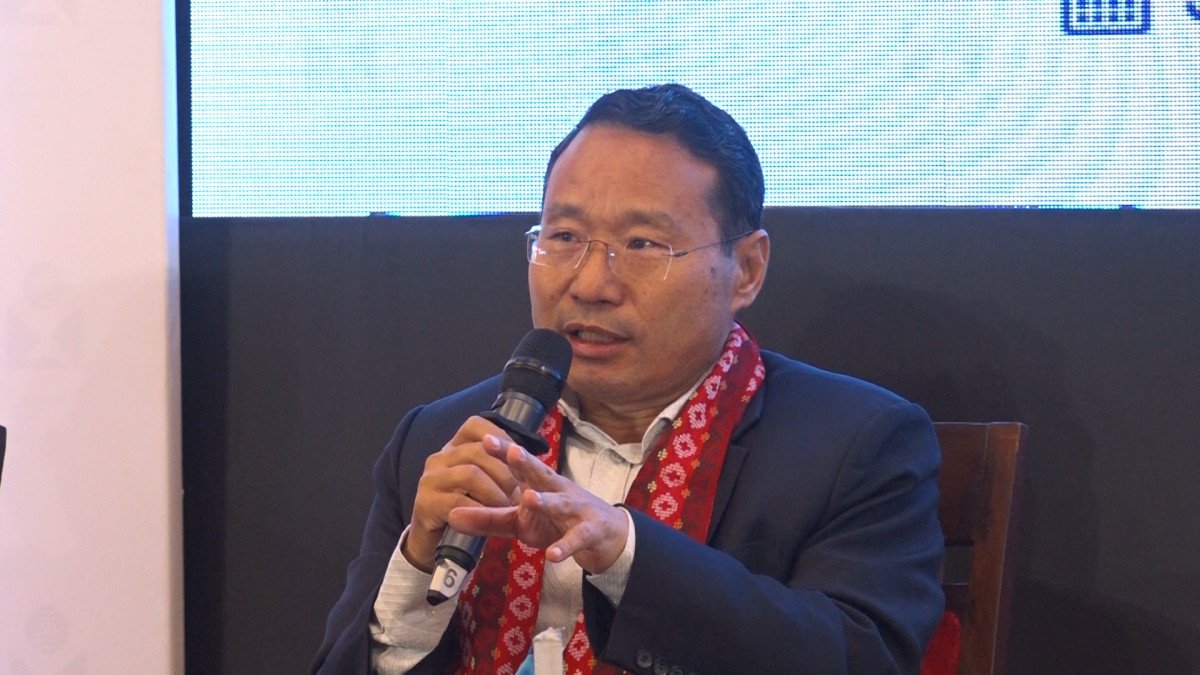
Kathmandu. Finance Minister Dr. Swarnim Wagle has claimed that the budget brought by the government will lay the foundation for policy reform in the country's economy and inspire the younger generation. Speaking at a 'Post-Budget' discussion organized by the Nepal Economic Journalists Association (NEJA), he stated that the budget is focused on creating an environment where young people who have just completed their studies can earn up to one lakh rupees per month with self-respect in their own country. He expressed confidence that the tax exemption of up to ten lakh rupees, which he termed a revolutionary step, will increase market liquidity and stimulate the economy. The Finance Minister said, 'We have created an environment where even a youth who has just finished college can think, 'Oh, by staying in Nepal and earning around one lakh per month, I can still have tax-free income and remain in Nepal with dignity.' He also clarified that a policy has been adopted to transform savings into investment by reducing the 39 percent tax applicable to the high-income group by 10 percentage points. He informed that the budget has made a provision for tens of thousands of Nepali businessmen facing old tax arrears to start anew by paying a 1 percent administrative fee. He pledged that the budget includes action plans to hand over a portion of Nepal Telecom shares to the general public, strengthen Rastriya Banijya Bank, and fully restructure Nepal Airlines Corporation and Nepal Electricity Authority, and these tasks will be completed this year. He stated that instead of relying solely on traditional sources of debt, offshore bonds, diaspora bonds, and thematic bonds will be issued for large infrastructure projects through the 'Alternative Development Finance Bill'. Finance Minister Wagle clarified that the government will not back down from the decision to impose VAT on electricity but will explore alternatives to ensure the burden does not fall on consumers. He argued that either the price will be adjusted through the Electricity Regulatory Commission from July 1, or consumers will be provided relief by increasing the limit of free units for the poor. He commented that there is misleading propaganda as if the sky is falling, when consumers using 150 units of electricity, whose bills are around 800-900, will only have to pay an additional 24 rupees. Regarding electric vehicles (EVs), he informed that the price of vehicles below 5 million rupees will decrease and the road construction fee will be halved. He clarified that driving luxury cars above 10 million rupees is a luxury item, and it is not possible to provide much subsidy to such luxury cars by exchanging scarce foreign exchange earned through hard work in the Gulf. He stated that taxes on luxury EVs have been determined to balance foreign exchange reserves and according to the principle of progressive taxation. The budget has made a provision of a monthly nutrition allowance of one thousand rupees for children in 25 remote districts and approximately 317,000 Dalit children across the country for social justice. Regarding the capital market, Dr. Wagle mentioned that the uncertainty has now ended as clarity has been brought to the tax rates as per the investors' demand, and this budget is not just a collection of numbers but a policy direction set for the next five years.
This specific news has been automatically translated by AI. As a result, there may be some inaccuracies or language errors.
_jxKX1kXOlf.jpg)

_htFaNqpIDJ.jpg)