Series of Brutal Murders Reported Across Nepal in Nine Days
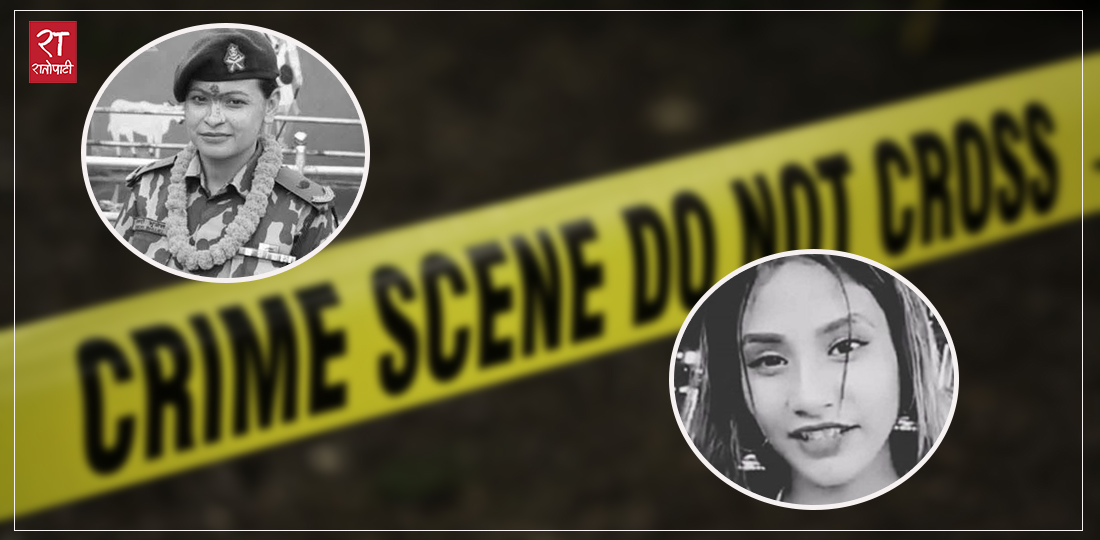
Kathmandu. In the last nine days, a series of brutal and horrific murders have been witnessed in various parts of the country. In these incidents, it has been found that husbands have murdered wives, fathers have murdered sons, and acquaintances have murdered women. Such incidents have clearly exposed the rampant crime, lack of impunity, and the character of our society.
- Incident Number 1: Wife Ishwari Bhujel murdered by Kumar Thapa, known as 'Nepali Bro', in Tarkeshwor Painyutar. (Jeth 22, 2083 BS)
- Incident Number 2: Wife Salina Tolangge Bishwakarma murdered by Khukuri strike by Bidur Bishwakarma near Army Barracks, Chhaling Road, Ward No. 10, Bhaktapur Municipality. (Jeth 20, Wednesday)
- Incident Number 3: Son Yadav Thapa (46) murdered by father Kambiraj Thapa (approx. 71) with a Khurpa in Dailekh. (Jeth 19, 2083 BS)
- Incident Number 4: Rima Tiwari (21) of Damak, Jhapa, murdered by Rakeshkumar Pandit (34) from India, residing in Damak. (Murder on the evening of Jeth 13, body found on Jeth 16)
The four brutal murder incidents mentioned above occurred in Kathmandu, Bhaktapur, Dailekh, and Jhapa within a span of just nine days. While these representative incidents are outcomes of momentary anger and impulse, anthropologists and sociologists believe they could also be a sample of the frightening psychosocial problems, impunity, and anarchy that have been growing within society.
According to senior advocate and professor Dr. Ranjan Bhakta Pradhananga, recent criminal incidents have not only exposed the character of our society but also depicted how it is contributing to social fragmentation.
According to him, there isn't just one reason for the increase in such perversions in society; many factors are at play. 'Some of these brutal incidents appear to be influenced by foreign employment, which has greatly disrupted our social fabric and given rise to crime,' he said, 'Another factor is that tolerance among individuals and society has become very low, leading to an increase in criminal incidents.'
Pradhananga states that crimes are occurring due to the frustration, stress, and mental illnesses that people harbor internally, even if they appear happy externally. 'People have no tolerance nowadays,' he said, 'Lack of study on moral and social values also seems to be a contributing factor.'
Professor Pradhananga suggests that moral education subjects should be included from schools to universities.
'In some recent incidents, it's not just family quarrels, but there might be some kind of relationship issues behind them,' he said, 'Family property could also be another reason.'
According to him, the lack of moral education and the rapid development of technology have led to people becoming isolated, and the feeling that society is necessary is dying out. He believes that some laws are also causing problems. 'With just a laptop and a mobile, it feels like society is not needed. This is a dangerous aspect,' Pradhananga said, 'Therefore, we see the need to educate our entire society.'
Furthermore, some are citing the growing notion of impunity, the belief that one can get away with committing crimes, as a reason for the increase in incidents. Some believe that the security agencies not taking victims' complaints and petitions seriously, and the weakening of fear of the state and law, could be other reasons.
According to psychologist and Tribhuvan University Gender Studies (MPhil PhD researcher) Savitri Gautam, incidents may be repeating due to a lack of accountability and the arrogance of power among people.
'The ratio of men murdering women or husbands murdering wives appears to be 159, while women murdering men or wives murdering husbands is 28,' said psychologist Gautam, 'Criminal mentality of people cannot be justified by anything.'
Gautam states that the occurrence of such criminal incidents should be understood as society moving towards a dangerous state. 'We can understand that our society is heading towards a dangerous situation, and on the other hand, the increasing graph of husbands murdering wives can be understood as a game of power or ego.'
She suggested that people might be getting involved in one crime after another due to a lack of accountability.
According to anthropologist Dr. Dambar Chemjong, such incidents used to happen before as well, but they were not widely reported. He stated that with the increased accessibility of communication in recent days, incidents have started to become public. 'Now, communication facilities have increased, and it's one aspect that many people are becoming aware of,' said Dr. Chemjong, 'But from a sociological and anthropological perspective, today's family is not like the family of yesterday.'
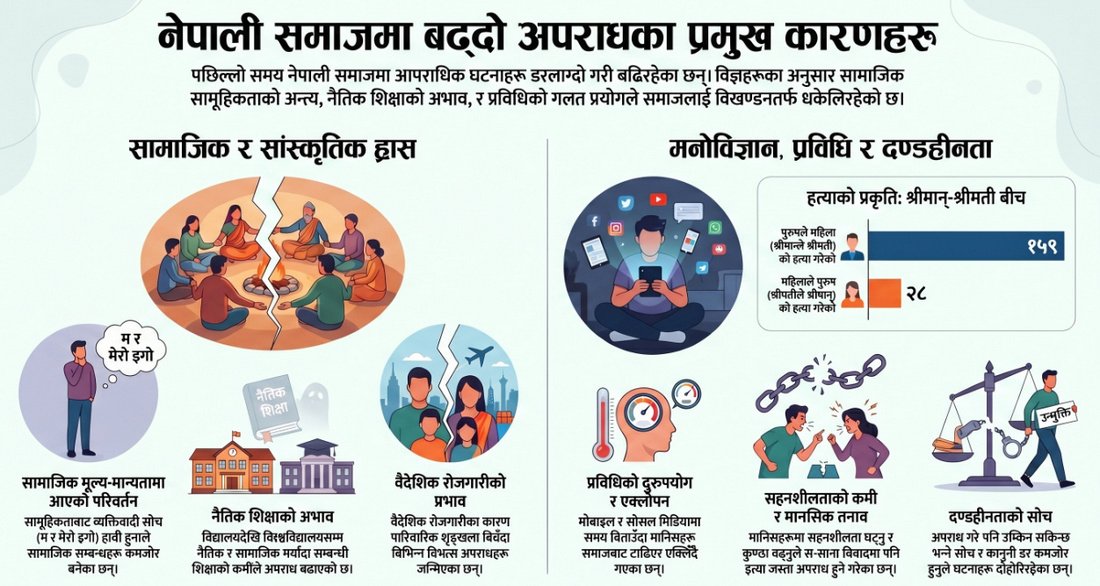
He explained that in the past, society was built on collectivism, family ties, community, and kinship, which was called social संस्कार (sanskar - culture/values). 'There used to be a feeling that if that संस्कार and institutional values and beliefs were not there, then I don't exist, my society made me,' he told Ratopati, 'But now, individualistic thinking has become dominant.'
Chemjong believes that due to this, the role of family or society, kinship, and relatives has been weakening. 'The ego of 'I am' has increased in society more than 'my parents, my family'.' He stated that instead of looking at where society is going, one should understand how and in what form society is changing.
According to Dr. Chemjong, looking at the form of this change, people are gradually becoming individualistic from social. 'People became individualistic from social. When the government, society, and the state did not understand how and at what pace and character this individualistic and personal development was happening, the incidents of Bhadra 23 and 24 occurred,' he said.
He gave an example that today's individuals, families, and society alone do not shape things, saying, 'The government and those in the state must consider the issues of generational change, transformation, and change in thinking in the context of a changing environment.'

Crime investigation expert and former AIG of Nepal Police, Tek Prasad Rai, states that criminal incidents have increased in Nepali society due to the use of social media, lack of moral education among people, and misuse of technology. 'Social media has not been used correctly. That is, its misuse has started,' he said, 'Regulation of this seems necessary.'
Former AIG Rai believes that for society to move in the right direction, individuals must first be conscious. 'We say the state is responsible for my security, but we must understand that it is only a theoretical matter, and we need to understand that I am responsible for my own security,' he said, giving the example of Bhadra 23 and 24, 'Where was the state in the incidents of 23 and 24? The country was burning. The state could not even protect the property of individuals, let alone the property of the state.'
Rai said that the biggest issue is that due to the lack of moral education, people are getting involved in criminal activities because of issues like sex, wealth, anger, and impulse.
'Overall, the development of technology is being misused,' Rai told Ratopati, 'It looks like development, but interaction between members of the same household has stopped. There is a growing concern that this will lead society towards further accidents.'
This specific news has been automatically translated by AI. As a result, there may be some inaccuracies or language errors.