Finance Minister Claims Upcoming Budget Smallest in a Decade


Kathmandu. Finance Minister Dr. Swarnim Wagle has claimed that the upcoming fiscal year's budget is the smallest and most balanced in the last 10 years in proportion to the Gross Domestic Product (GDP).
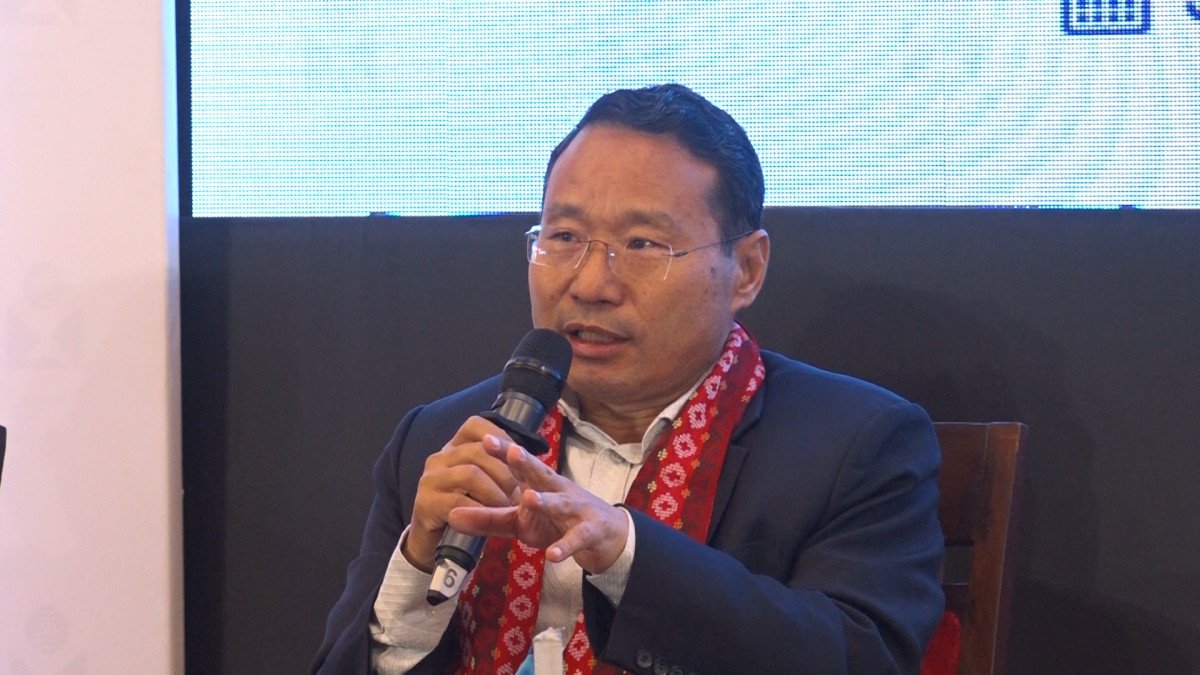
Speaking at a 'Post Budget' discussion organized by the Nepal Economic Journalists Association (NEFEJ), Finance Minister Wagle emphasized the need to clear the confusion surrounding the budget size.
He clarified that the budget was prepared amidst extreme pressure of time and resources. He stated that this year's budget has been brought to lay the foundation with a five-year action plan, and more refined plans will come next year. Finance Minister Wagle completely rejected the criticism that the budget is ambitious.
Although there is a lot of discussion about a 650 billion loan in the market, he analyzed that the burden of net debt will be low as more than half of it will go towards paying the principal and interest of old loans. Informing that the government has set a target of collecting 1580 billion in revenue next year, he said that the government is firm on mobilizing internal resources. He stated that the debt-to-GDP ratio will be kept balanced by improving the utilization capacity of foreign loans.
Mentioning that the concept of 'Growth Quadrilateral' has been put forward in all seven provinces to connect the infrastructure built in the last 20 years with economic growth, he informed that economic activities will be increased by expanding important road sections like Muglin-Pokhara, Siddhartha Highway, and Hulasi Highway.
Speaking at the program, he lamented the significant lack of time, having to present the budget in mid-May after coming into the government in mid-March. He said, 'The first challenge this time was a severe constraint, a time constraint and a resource constraint.'
He clarified that with the intention of not taking steps without in-depth study on serious and complex policy proposals, this time only easily implementable and less controversial issues have been included, and it will come in a more refined form next year.
The Finance Minister pointed out that even though a budget of 1964 billion was presented earlier, the actual expenditure was confined to only between 1600 to 1700 billion due to the efficiency of the state mechanism. He argues that although many consider the current budget of 2124 billion to be ambitious, it is very small in proportion to the GDP.
Based on the estimate that the country's GDP will reach 74 kharba 58 arba next year, this budget amounts to only 28.5 percent of the GDP. He recalled that in the past, during the times of Kovid and post-earthquake, budgets ranging from 35 to 37 percent of GDP used to come, but that had lost the credibility of the budget process.
He urged to move beyond the confusion about the size, stating that although public expectations were high due to the two-thirds government, a very balanced budget had to be presented due to resource limitations. He said that tax exemptions and tax incentive facilities have been introduced to address the market's sluggishness and low demand, and small but effective steps have been taken to attract the private sector for investment. He clarified that the government's main priority is to complete old incomplete projects and lay the foundation for a new technology-friendly economy.
This specific news has been automatically translated by AI. As a result, there may be some inaccuracies or language errors.
_jxKX1kXOlf.jpg)

_htFaNqpIDJ.jpg)