QUAD to Jointly Develop Port Infrastructure in Fiji

India, the United States, Australia, and Japan have jointly announced plans to develop port infrastructure in the strategically very important island nation of Fiji in the Pacific Ocean after a meeting in New Delhi this week.
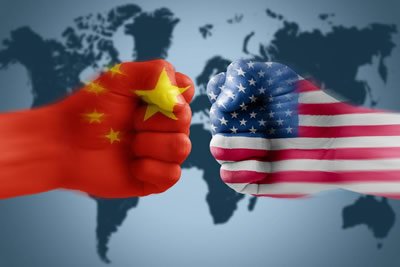
This group of four countries is called the 'Quadrilateral Security Dialogue Alliance' (Quad). For the past two decades, this group has been acting as a balancing power to China's economic and political influence in the Asia-Pacific region.
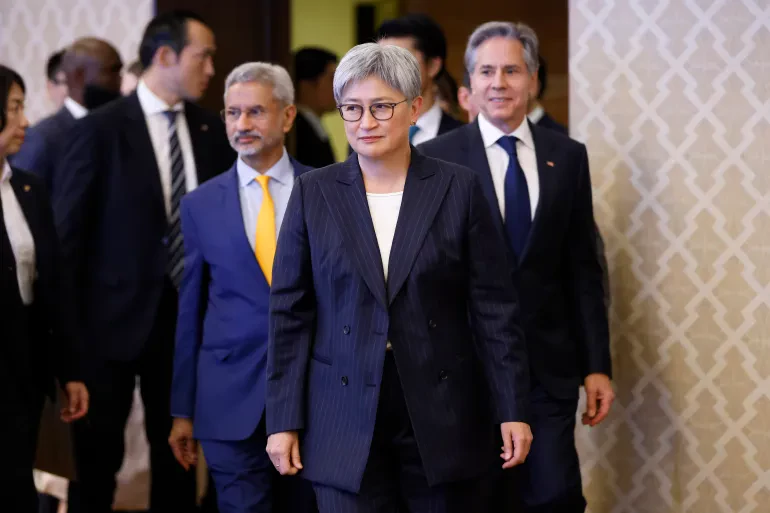
Australian Foreign Minister Penny Wong said that this initiative launched in Fiji is the Quad's strongest commitment to providing high-quality infrastructure in the Pacific region. According to her, this pilot project of port infrastructure in Fiji demonstrates the Quad's ability to provide quality infrastructure according to the priorities of the Pacific region.
At a time when questions are being raised about the relevance of the Quad in today's world order, and when US President Donald Trump is trying to improve relations with China, Washington has shifted its focus from the Asia-Pacific region to the Western Hemisphere and the Middle East.
So the question now arises: what is the significance of port development in Fiji? And can it become another major flashpoint in US-China relations?
- What are the plans for port development in Fiji?
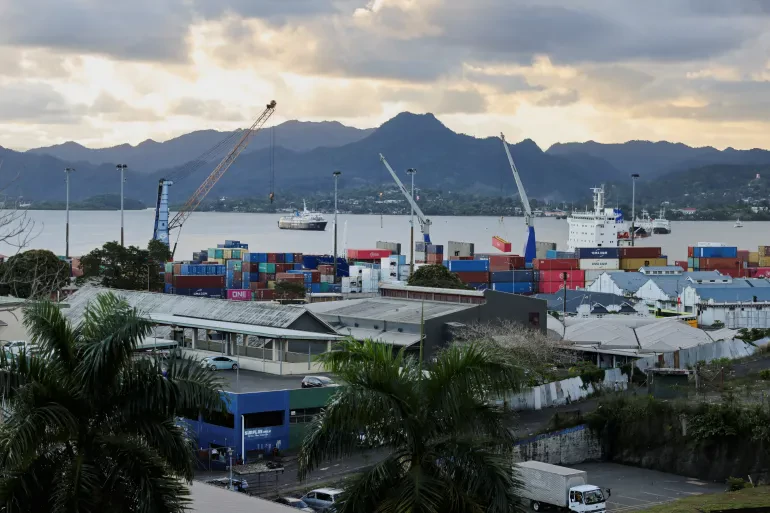
According to Fiji's Foreign Minister, under the newly announced 'Quad Ports for Future Cooperation', the first ports will be in Suva and the islands of Lautoka. These will be developed under a pilot project. This is the first joint port initiative by the Quad.
The capital Suva is already the country's largest and busiest port. Lautoka, located in the northwest of Fiji, historically developed during sugar exports, is the second largest city.
Fiji's Foreign Minister Sakiasi Dito said to the Fijian media, 'Mainly these two (cities) should be... then we can expand northwards towards Vanua Levu, and if the project reaches there, then Levuka too.'
However, no further concrete details about the port plan have been made public yet.
Fiji's media reported this week that the Suva Port Agency, in which the Fijian government has a 41 percent stake, has discussed port improvement plans worth US$181 million and potential US$1.82 billion plans for Suva port relocation with US officials.
Suresh Prasad, acting CEO of Fiji Ports, called the announcement 'very surprising'. He told reporters: 'If this is a Quad project, it will be a big (mega) project, possibly Suva port itself.'
In 2023, Fiji's Prime Minister Sitiveni Rabuka had discussed the redevelopment of Suva port with China, but those plans did not move forward.
Rabuka told the Fijian parliament last Monday that an agreement has been reached to study potential US-backed infrastructure with the US Millennium Challenge Corporation (MCC). He also stated that the cost of any project would be met through grants, not loans.
- What does the Quad do in the Asia-Pacific region?
The four Quad countries are the most influential powers in the region, apart from Russia and China.
The Quad's cooperation has expanded from an initial security-centric approach to various areas in the Asia-Pacific, including maritime security, infrastructure, technology, health, and supply chains.
This group operates 'Indo-Pacific for Maritime Domain Awareness (IPMDA)', which helps Pacific countries monitor illegal fishing, smuggling, and other maritime activities using satellite data. It aims to reduce dependence on China by facilitating the supply chain of lithium, rare earth elements, and other strategic minerals. Cooperation also takes place in quantum computing and cybersecurity.
Fiji has traditionally been close to Australia, and the Quad countries have pledged to cooperate with small Pacific island nations on disaster relief, combating the effects of climate change, and humanitarian assistance.
The Quad countries also conduct joint military exercises in the region under the 'Annual Malabar (maritime military exercise of Quad countries)'. This includes activities such as anti-submarine warfare, aircraft carrier operations, and maritime interoperability.
- Why is China dissatisfied with the Quad?
'China views the Quad as an anti-China alliance, and this new project in Fiji is seen as the Quad expanding its activities from sensitive areas of the Indo-Pacific towards Pacific island countries,' says Sana Hashemi, a postdoctoral fellow at the Taiwan-Asia Exchange Foundation, who has a special interest in China.
In recent years, Beijing has invested billions of dollars in the region, and with it, its influence has also grown.
Responding to journalists' questions about the Quad's initiative in Fiji this week, Chinese Foreign Ministry spokesperson Mao Ning warned that any cooperation in the region 'should not be targeted at any third party.'
'China has made its stance on the Quad clear many times. Cooperation between countries should be for regional peace, stability, and prosperity, and should not be targeted at any third party,' she told reporters, 'We oppose forming exclusive groups or engaging in bloc confrontation.'
In a joint statement issued after the meeting in New Delhi this week, the foreign ministers of the Quad countries expressed concern over the growing tensions in the East China Sea and the South China Sea, reiterating 'strong opposition to any destabilizing unilateral actions, by the use of force or coercion, that threaten regional peace and stability.'
The statement did not explicitly name China, but it is seen as related to China's claims over Taiwan and the military exercises conducted around the island. The next day, Chinese spokesperson Ning told reporters: 'The situation in the East China Sea and the South China Sea is generally stable.'
'Some countries should stop interfering in maritime affairs in China's neighborhood and sincerely respect the efforts made by regional countries to maintain peace and stability,' she said, clearly signaling the Quad, 'Those who form small groups, exaggerate tensions, and incite confrontation will not receive any support.'
- How powerful is China regionally?
Beijing has transformed into a continental Asian power in the decades since the end of World War II. And now it is presenting itself as a central economic and increasingly strategic power in the region.
According to the Lowy Institute's 2025 'Asia Power Index', China ranks second in overall power in the region after the US, but it dominates in many key areas such as trade relations and economic influence.
China is also the main regional trading partner for 22 out of the 27 countries covered in the index, showing how dependent Asian and Pacific economies are on the Chinese market, supply chains, and imports.
Beijing recognizes eight countries in the region as 'Comprehensive Strategic Partners'. This is the highest priority in China's diplomatic relations. Top Chinese officials have been visiting the region frequently, and President Xi Jinping has participated in various summits in recent decades.
'China's growing influence in the Pacific island countries has been a major concern for Australia and other regional players,' Hashemi told Al Jazeera, 'Therefore, Beijing views the Quad's desire to work more actively in the region as a strategic encirclement and the rise of opposing alliances that could limit China's regional ambitions.'
Meanwhile, Fiji still owes more than US$100 million to Chinese state banks for road construction and other infrastructure projects from a decade ago.
- What have Western powers done to counter China in the region?
The US and Australia have increased their strategic engagement in the Pacific islands in recent years due to growing concerns about China's expanding diplomatic and maritime influence in the region.
The 'AUKUS' agreement between Australia, the US, and the UK was announced in 2021. Under this, Canberra and London are working with Washington to design nuclear-powered submarines to be provided to Australia in the 2040s.
The US and Australia have also advanced various initiatives in the Pacific region in recent years, including strengthening defense agreements with Papua New Guinea. Australia has also increased aid, police cooperation, and climate financing to Pacific island nations.
In 2022, China signed a landmark agreement with the Solomon Islands, allowing Beijing to send police, military, and armed forces to the Pacific nation. This has given China a strong presence in maritime areas less than 2,000 kilometers (1,240 miles) from Australia.
Washington then immediately sought to reopen its embassy in the region and expand diplomatic access. The US reopened its embassy in the Solomon Islands in 2023 after a 30-year hiatus. In the same year, it opened a new embassy in Tonga and announced plans to open more diplomatic missions in countries including Vanuatu and Kiribati.
Under Joe Biden's administration, the White House renewed strategic agreements called 'Compact of Free Association' with three Pacific countries—the Marshall Islands, Micronesia, and Palau.
However, according to Hashemi, China is still ahead of these joint efforts.
'For many countries, especially for the US, engagement with this region has been temporary and sporadic. There has been no continuous focus on local fundamental concerns such as climate change, infrastructure, and economic resilience,' the analyst said.
'Therefore, continuous commitment and continuity are necessary to counter China's influence. This is where the Quad's recent announcement becomes important, although its impact will depend on whether these announcements translate into implementation.'
- Where does Fiji stand on this issue?
Bilateral relations between China and Fiji have also progressed significantly over time. In 1975, Suva was one of the first Pacific island nations to establish diplomatic relations with the People's Republic of China, recognizing Beijing instead of Taiwan.
Relations took a major turn after the military 'coup' in 2006 overthrew the Fijian government, and traditional allies like Australia and New Zealand imposed sanctions. Fiji then moved closer to China. This trend continued even after the democratically elected Prime Minister Sitiveni Rabuka came to power.
'Fiji is considered the most influential country in the region and serves as a gateway and regional hub for the wider region,' Hashemi said.
'The Pacific islands are spread across vast ocean areas and are located amidst important sea routes connecting Asia, Australia, and the Americas,' she added, 'Influence there provides strategic depth and enables China to expand its maritime presence beyond the first and second island chains respectively. This plays an important role in developing a powerful global maritime power.' But this means Fiji has to practice a difficult balancing act.
Its traditional alliance with Australia, and through it its relationship with the US and other Western allies, has maintained its development momentum, and Suva is seen as a partner in the Pacific region where the Quad is looking for a strong base.
The US market is the largest export destination for Fijian goods, worth US$383 million in 2025, followed by Australia at US$168 million. China is Fiji's largest importer, billing US$531 million last year, second only to Singapore's US$751 million in exports. However, Fiji's exports to Beijing are only US$49.2 million, showing its largest trade deficit with China.
Pacific island nations like Fiji are expanding cooperation with Australia, the US, Japan, and India while maintaining strong economic ties with China, Hashemi said.
'They primarily adopt a multi-directional foreign policy and hedging strategy, which involves engaging with all major powers but not formally aligning with any single side,' she told Al Jazeera.
'No country wants to get caught in the competition between major powers.'
Yashraj Sharma, based in New Delhi, writes news, special reports, and analysis for Al Jazeera's South Asia and Explainers desk.
This specific news has been automatically translated by AI. As a result, there may be some inaccuracies or language errors.