Congress Spokesperson Questions Cooperative Fraud Case Decision


Kathmandu. Nepali Congress spokesperson Devraj Chalise has raised questions about the recent decision and government steps in the cooperative fraud case involving Rastriya Swatantra Party (RSP) chairman Ravi Lamichhane. Chalise mentioned that the court has made a 'selective justice' by giving acquittal to Rastriya Swatantra Party chairman Ravi Lamichhane and GB Rai.
He stated that the state has given special concessions to RSP chairman Lamichhane and GB Rai in the cooperative fraud and money laundering case.
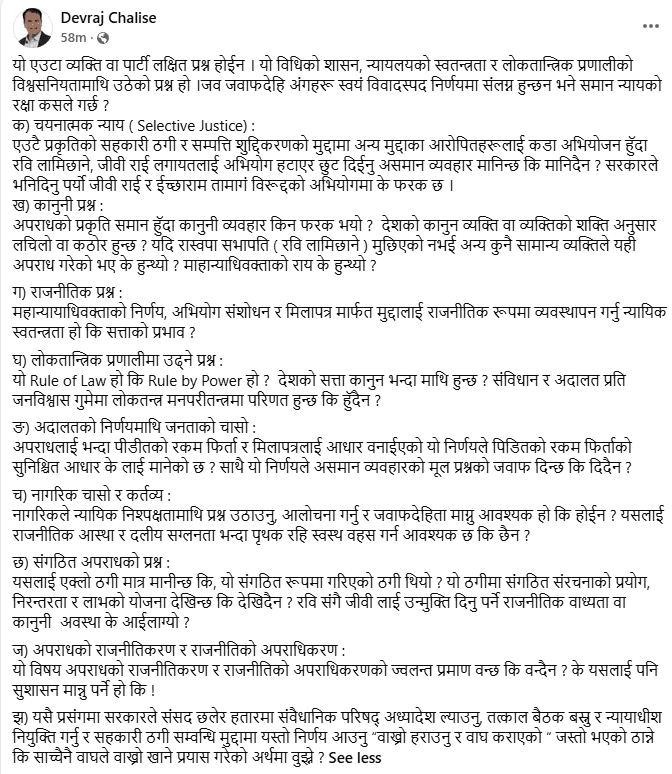
Writing a status on social media on Saturday, spokesperson Chalise said that it is unequal treatment to acquit Lamichhane and Rai from the charges while other accused in the same nature of crime are facing strict legal action. He questioned, 'What is the difference in the charge against Ichharam Tamang and GB Rai? Does the country's law become flexible or strict according to a person's power?'
Questions on the Influence of Power and the Role of the Attorney General
Spokesperson Chalise has interpreted the decision from the Attorney General's office, amendment of charges, and attempts at settlement as 'influence of power'. Chalise said, 'Is this rule of law or rule by power?' He asked, 'When the accountable bodies themselves are involved in controversial decisions, who will protect equal justice?' He also questioned what the Attorney General's opinion would have been if an ordinary person, instead of Lamichhane, had been involved in the case.
Concerns about Organized Crime and Politicization
Defining cooperative fraud as 'organized crime', Chalise claimed that the use of organized structure and the plan for profit are clearly visible in it. He questioned what the government's 'political compulsion' is to acquit GB Rai along with Ravi Lamichhane, calling it a clear example of the politicization of crime and criminalization of politics.
Linkage with Ordinance and Judge Appointment
Chalise commented that the government hastily bringing the ordinance related to the Constitutional Council by bypassing parliament, immediately holding a meeting and appointing judges, and this decision in the cooperative fraud case immediately thereafter is like 'a goat getting lost and a tiger roaring'. He hinted that this should be understood in the sense of a 'planned attempt by the tiger to eat the goat'.
Chalise also expressed dissatisfaction that the court based its decision on the return of victims' money and settlement rather than the crime. Questioning the assurance of the return of victims' money, he mentioned that it is the duty of citizens to question judicial impartiality and demand accountability. Spokesperson Chalise concluded that it is necessary to have a healthy debate on this issue rising above political beliefs.
This specific news has been automatically translated by AI. As a result, there may be some inaccuracies or language errors.
_BSX4jxIBxx.jpg)


_CuZWldRsJU.jpg)