Government Prioritizes Energy Sector Development in Upcoming Budget


Kathmandu. The government has given special priority in its policies, programs, and budget for the development and expansion of the energy sector, which is considered a major pillar of the country's economic prosperity.
After receiving priority in the policies and programs, it is believed that it will receive further important place in the upcoming budget. Considering the progress in this sector through the cooperation of the government and the private sector, stakeholders say that the budget will have a new 'departure'.
The Independent Power Producers' Association Nepal (IPPAN) also expects that the upcoming budget will address the guidance they have been seeking.
While responding to the questions raised during the discussion on the priorities and principles of the Appropriation Bill on Tuesday, Finance Minister Dr. Swarnim Wagle has already indicated that the energy and physical infrastructure sectors will receive special importance in the upcoming budget.
The government's policy and program for the upcoming fiscal year 2083-84 has adopted a policy to promote the energy, water resources, and irrigation sector not just as a subject of infrastructure development, but as a strategic sector directly linked to civilization, culture, biodiversity, and human existence.
The government's policy and program, which has been made public, presents a vision of conserving rivers not just as water resource assets, but as bases for human civilization, religious faith, cultural continuity, and environmental balance. This appears to be an effort to expand the development concept focused on hydropower production and infrastructure construction in the past and connect the river system with the overall life system.
According to the policy, scientific studies of rivers that are important from religious, cultural, environmental, and social perspectives will be conducted. The government's commitment in the policy to conserve the traditional knowledge, lifestyle, and spiritual connection of indigenous and local communities living on riverbanks as national heritage signals a balance between development and identity.
Especially in recent years, with rapid hydropower construction, river exploitation, excavation, and climate change affecting the natural flow of rivers, biodiversity, and coastal lifestyles, the government's announcement to ensure a 'clean and continuously flowing river system' is considered meaningful. According to experts, this concept accepts rivers not just as a means of energy production, but as living ecological systems. Since the upcoming budget will also be determined based on the policy, the private sector also expects positive results. IPPAN Chairman Ganesh Karki says that they are waiting for the 'Sunset Law' for the development of the energy sector.
According to Karki, the problem will be solved if a 'Sunset Law' is introduced where all services can be obtained at a single point, as more than 40 files are stuck in the Ministry of Forests, and the upcoming budget will address this issue, according to the private sector's belief.
Similarly, the government has also put forward a policy to implement an integrated water resource management system based on river basins. Under this, multipurpose projects will be developed by integrating hydropower, irrigation, drinking water, tourism, and downstream benefits. This is seen as a long-term and coordinated model for water resource utilization.
In the energy sector, the government has reiterated its ambitious target of producing 30,000 megawatts of electricity within the next decade. To achieve this target, a policy has been adopted to amend laws related to energy, forests, land, and environment and implement a one-door system. The objective is to make the project approval process faster and investment-friendly.
The government has also put forward a policy to provide share investment opportunities as an alternative to cash compensation to local citizens affected by projects. This is seen as an effort to make local communities direct financial partners in the project.
While the government's policy of expanding private sector participation in electricity generation, transmission, distribution, and energy trade remains, a target has also been set to increase domestic electricity consumption by promoting energy-based industries. Along with this, it is mentioned that cross-border energy trade agreements will be used as a basis for attracting long-term investment.
Energy, Water Resources, and Irrigation Minister Biraj Bhakta Shrestha expresses his belief that the government has focused its activities on the energy and water resources sector, which is a major pillar of prosperity, and that the upcoming budget will become a new pillar for it. He has directed the ministry and subordinate bodies to prepare accordingly.
The government has also put forward a plan to expand 'off-grid solar', wind, and micro-hydropower systems in rural and remote areas where national transmission lines do not reach. This program aims to reduce energy access and regional inequality.
Towards a green economy, the government has strategically prioritized green hydrogen and chemical fertilizer industries. Such industries will be provided with tax and customs exemptions, concessional electricity rates, capital incentives, and investment-friendly policies. It has also been announced that the development of necessary infrastructure will be started to expand the commercial use of green hydrogen in the transportation sector.
In the irrigation sector, the government has put forward a policy to utilize underground water resources in areas of Terai-Madhesh without irrigation facilities and to expand irrigation through lift technology in arable lands in hilly and mountainous regions.
Priority will be given to consumer participation in the modernization, maintenance, and restoration of large irrigation projects. The government has also prioritized the management of risks arising from climate change.
The policy is to expand automatic water and weather centers, strengthen the forecasting system, and make the multi-hazard early warning system more reliable. This time, the government appears to have made an effort to connect energy and water resource policies not only with economic growth but also with environmental sustainability, cultural preservation, biodiversity, and community existence.
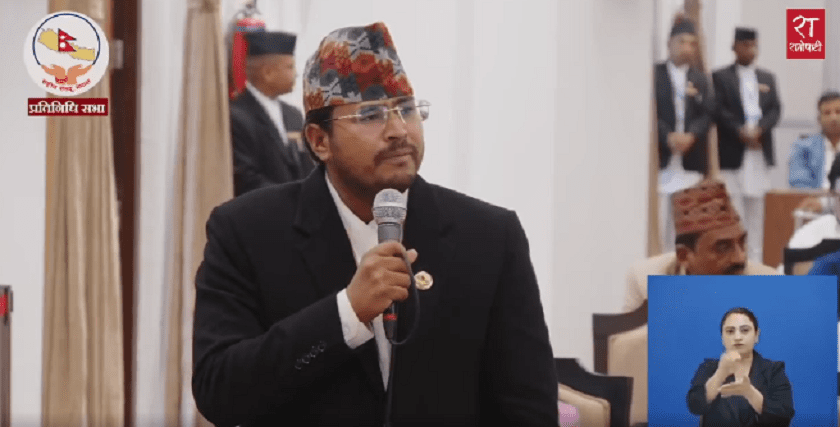
Participating in the discussion on the principles and priorities of the Appropriation Bill for the upcoming fiscal year, Rastriya Swatantra Party MP Shriram Neupane expressed the view that if Nepal is to be truly prosperous, we must recognize, understand, and utilize the immense water resources we possess.
He stated that it is urgent to bring the 'Sunset Act' immediately to implement rapid investment, quick decisions, and long-term vision in this sector. "Along with good governance, the first priority is and must be the balanced production and consumption of energy. The country must increase exports to become rich. Imports must be reduced. Today, we are consuming more than we are producing. This is increasing the trade deficit and burdening the economy," he said.
The demand to end the situation where those seeking to invest in the energy sector have to visit seven ministries and 21 departments has been raised for a long time but has not been addressed. The government's policy and program have already provided guidance to address this issue. Many believe that if the upcoming budget can make more concrete arrangements in this regard, this sector will take a qualitative leap.
Currently, with the total installed capacity reaching four thousand three hundred megawatts, electricity exports to India and Bangladesh have begun, and large-capacity transmission lines are under construction, the private sector believes that the government should no longer delay in resolving practical, policy, and technical difficulties. Stakeholders emphasize that the government's commitment to move forward by taking the private sector, which contributes about 80 percent to the country's system, into confidence must now be put into practice.
This specific news has been automatically translated by AI. As a result, there may be some inaccuracies or language errors.