Office of the Auditor General's Report Highlights Financial Irregularities


Kathmandu. The report of the Office of the Auditor General has exposed financial indiscipline and irregularities in Nepal's public administration and government machinery.
Every year, the Auditor General's reports point out such irregularities. However, efforts to eliminate the many irregularities highlighted by the Auditor General are rarely made. Similarly, the Auditor General has shown a frightening picture of the trend of illegal expenditure. On Friday, the 63rd annual report of the Auditor General was submitted to President Ram Chandra Paudel and made public.
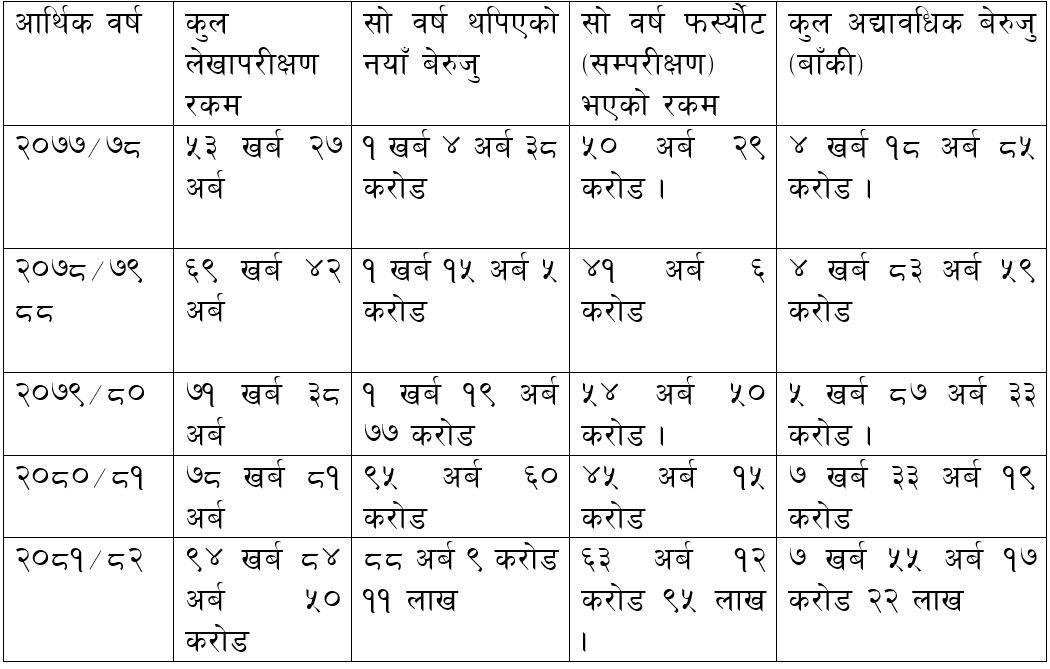
The public report shows that the country's financial system is at risk due to arbitrary exploitation of the state treasury, blatant violation of laws, and haphazard reallocation of funds. According to the report, an additional Rs 88.09 billion 11 million was added to the arrears in the fiscal year 2081/82 alone. With this, the total updated arrears of the state have exceeded 7.5 trillion, reaching Rs 7.55 trillion 17 billion 22 million.
The arrears for the fiscal year 2081/82 alone amounted to Rs 88.09 billion 11 million. He stated that out of the Rs 94.84 trillion 50 billion audited in 5,526 offices in 081/82, nearly Rs 1 trillion in arrears was found.
Last year, there were approximately Rs 7.33 trillion in arrears, of which Rs 63.12 billion 95 million was settled, and Auditor General Toyam Raya informed that Rs 7.55 trillion 17 billion 22 million in arrears remains. The Auditor General's Office audited a total of 5,526 entities, including federal, provincial, local levels, organized institutions, and committees, amounting to Rs 94.84 trillion 50 billion, of which Rs 32.64 billion 75 million is to be recovered by the government, and Rs 50.26 billion 88 million needs to be regularized, the Auditor General's Office showed.
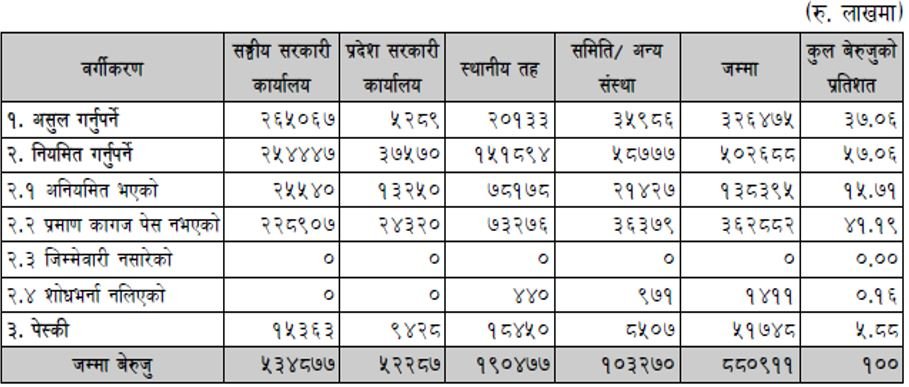
Similarly, irregularities amounted to Rs 13.83 billion 95 million, and Rs 36.28 billion 82 million for which supporting documents were not submitted, the Auditor General's Office mentioned in the report. Federal government government offices alone have arrears of Rs 53.48 billion 77 million (1.83 percent of total audit), provincial government offices Rs 5.22 billion 87 million (1.63 percent), local levels Rs 19.04 billion 77 million (1.72 percent), and committees and other institutions Rs 10.32 billion 70 million (2.31 percent) in arrears.
57 Percent of Arrears Need Regularization
Out of the total arrears of Rs 88.09 billion, the largest portion is the arrears that need to be regularized, as mentioned in the report. Of this, Rs 32.64 billion 75 million (37.06 percent) needs to be recovered, Rs 50.26 billion 88 million (57.06 percent) needs to be regularized, and Rs 5.17 billion 48 million (5.88 percent) is outstanding advances.
With the addition of this year's arrears, the government's total updated arrears have reached Rs 87.55 trillion 17 billion 22 million. Last year, such arrears were Rs 7.33 trillion 19 billion.
Auditor General Raya stated that the amount of arrears and the audited amount have decreased compared to the past. He mentioned that the arrears decreased because the records of 179 offices could not be submitted due to the destruction of documents during the Gen Z movement, and audits of Rs 147.90 billion could not be conducted.
He stated that in his first report after becoming the Auditor General, arrears of Rs 31 billion were found in local levels.
He claimed that the arrears in local levels are improving, as it was Rs 25 billion last year and is now Rs 19 billion. He also stated that the Office of the Auditor General is continuously improving the issues of arrears it has identified.
Status and Trends of Arrears in the Last 5 Years
Although the Office of the Auditor General publishes alarming statistics of arrears every year, their settlement is extremely slow. This is why the total updated arrears are increasing. Looking at the data of the last five years, the rate at which arrears are added is higher than the amount settled, which means the updated arrears are continuously rising.
The Office of the Auditor General submits thousands of pages of reports to the President every year, showing the dire state of the state treasury. The report reaches the Public Accounts Committee of Parliament. Discussions are held for months. The committee gives strict instructions to the government and the concerned ministries. However, the result is always zero.
Out of the total arrears of Rs 88.09 billion this year, Rs 32.64 billion (37.06%) needs to be recovered, Rs 50.26 billion (57.06%) needs to be regularized, and Rs 5.17 billion (5.88%) is in expired advances.
Arrears, Settlements, and Updated Status in the Last 5 Years (in Rs Billion)
Heap of Irregularities in Local Levels: Rs 19 Billion in Arrears in a Single Year
The state of financial discipline in the local levels of the country appears to be even weaker and more worrying.
Out of the Rs 11.09 trillion 52 billion audited in 721 local levels, 1.72 percent, or Rs 19.04 billion, of new arrears has been added. With this, the total updated arrears of local levels have exceeded Rs 22.04 billion.
The Auditor General has pointed out many instances where local levels have blatantly violated the budget and laws. In violation of the Local Government Operation Act, 219 local levels have kept Rs 7.56 billion 74 million in unallocated funds without a plan and spent it at their discretion.
268 local levels have not conducted the internal audit mandated by law. The bank accounts of 90 local levels show a deficit of Rs 544.9 million compared to their records, indicating extreme financial mismanagement in local levels.
Why are the Auditor General's Suggestions Not Implemented?
The Office of the Auditor General submits thousands of pages of reports to the President every year, showing the dire state of the state treasury. The report reaches the Public Accounts Committee of Parliament. Discussions are held for months. The committee gives strict instructions to the government and the concerned ministries. However, the result is always zero.
However, Auditor General Raya claimed continuous improvement compared to the past. He claimed that arrears are decreasing because federal, provincial governments, and local levels have made improvements based on the suggestions given by the Auditor General. He said, 'We mention in the report to make every entity and positional responsibility accountable. Many policy reforms have also been made based on the Auditor General's report. That should be considered an improvement.'
He stated that the Auditor General also submits suggestions for the country's economy and policy reforms. He said that some improvements are being made based on those suggestions.
The legal and ethical culture of treating arrears as a serious economic crime has not yet developed in our administration. Under the guise of arrears to be regularized, high-ranking officials have the leeway to later settle arrears by submitting fake bills or obtaining policy decisions from the Council of Ministers. As a result, those who make mistakes are often pardoned instead of being punished.
The Economic Procedure and Financial Accountability Act, 2076 clearly stipulates that the primary responsibility for settling arrears lies with the head of the concerned office and the accounting responsible officer (secretary).
However, employees who are transferred or retire with billions in arrears are never brought under legal scrutiny. Impunity has created a wrong narrative of treating arrears as a normal process. Discussions on the Auditor General's reports by the Public Accounts Committee are often just political maneuvering and ritualistic. Ministries do not comply with the directives given by the committee.
This specific news has been automatically translated by AI. As a result, there may be some inaccuracies or language errors.