Confusion Persists as Schools Defy Government Directives on Academic Session and Fees

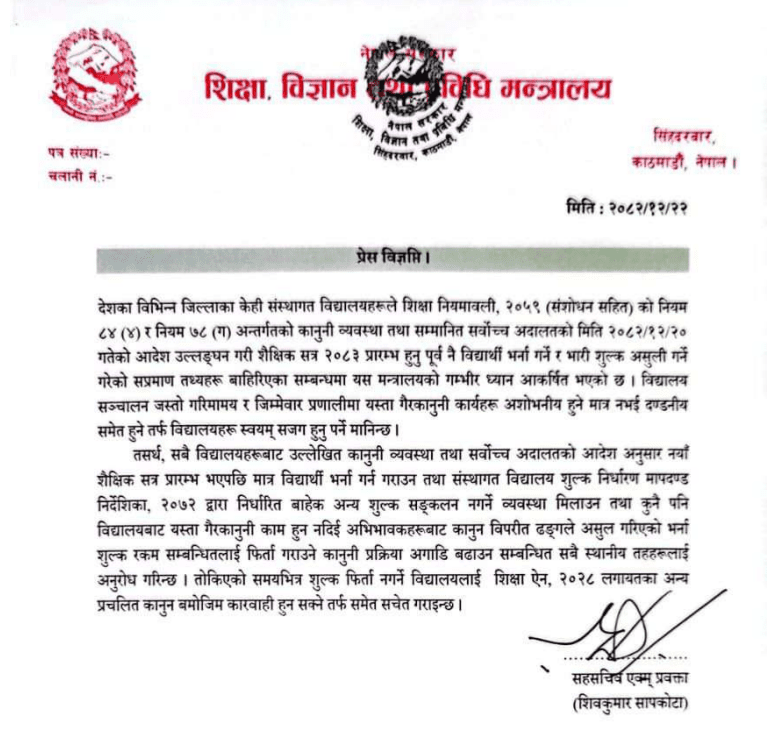
Kathmandu. Many private schools had already begun student admissions before the start of the new academic session. However, the Ministry of Education issued a notice on Chaitra 22, warning of strict action against schools found conducting admissions and charging exorbitant fees.
The Ministry also directed that student admissions should only commence after the start of the new academic session and instructed schools not to collect fees other than those permitted by the Institutional School Fee Determination Guidelines, 2072.
Previously, on Chaitra 16, the Ministry had directed that programs conducted by various institutions under the guise of entrance preparation classes and bridge courses for school-level admissions be completely shut down from Baisakh 1.
Many parents and stakeholders initially viewed the steps taken by Education Minister Sasmita Pokharel, following the formation of the government led by Balen Shah, as a positive move to curb the exploitation by private schools in the name of fees.
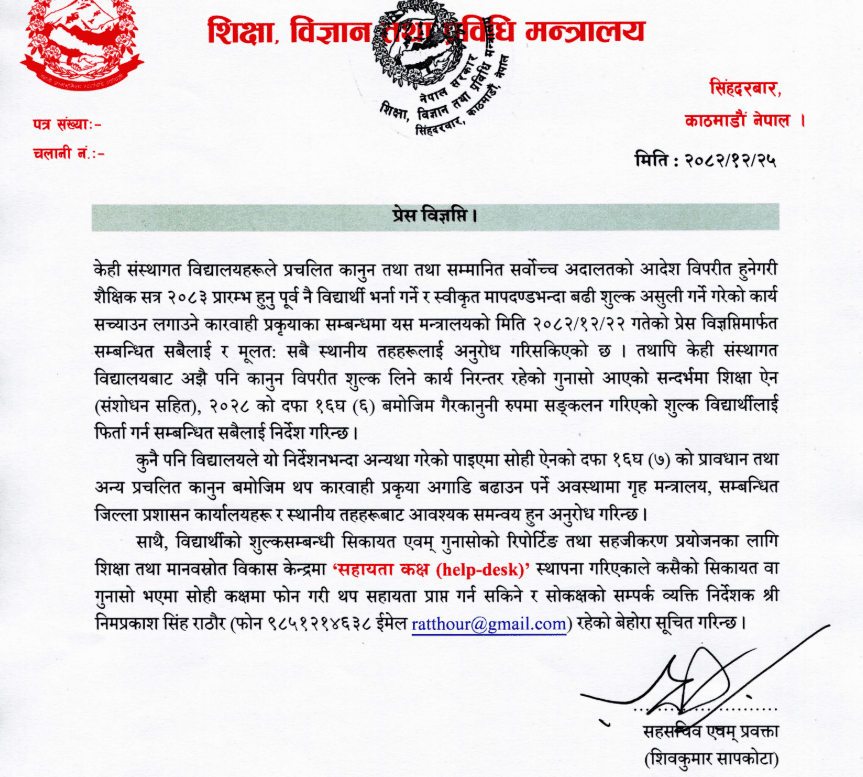
Amidst this positive reception, the Ministry issued a directive on Chaitra 25 for private schools to refund illegally collected fees. Furthermore, a phone number was publicized for reporting such illegal collections. Although the Cabinet meeting explicitly stated that the admission campaign should begin on Baisakh 15 and classes on Baisakh 21, violations have been observed.
Such violations have been found to occur at the level of some local governments and the schools themselves.
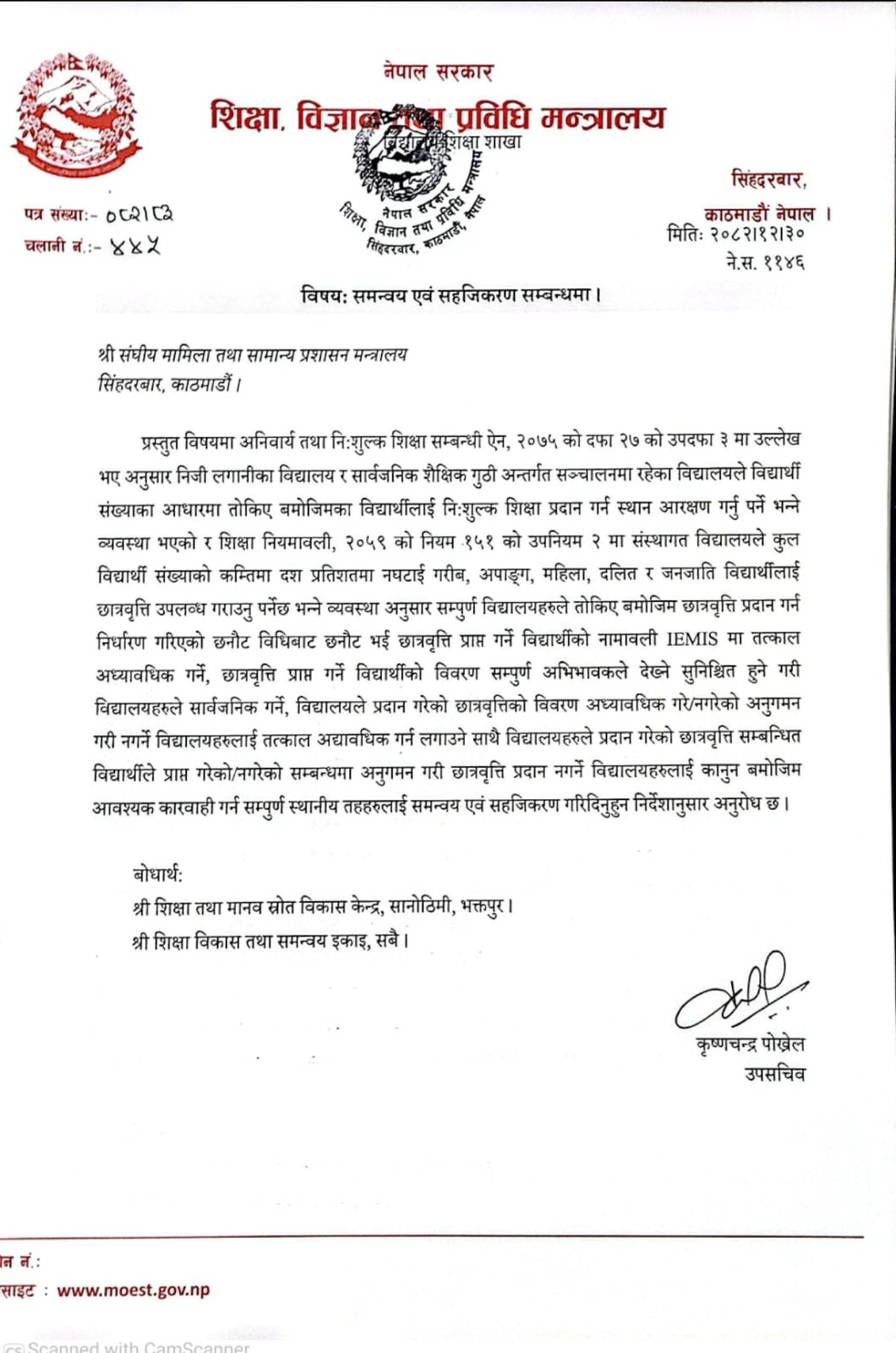
Stakeholders argue that while the government has made successive decisions regarding the new academic session, admissions, and fees, there are weaknesses in implementation and follow-up. Towards the end of Chaitra, the Ministry also directed private schools to publish details of scholarship recipients. Despite instructions through the Ministry of Federal Affairs and General Administration to provide scholarships to at least 10 percent of total students and publish their details, implementation remains unseen.
According to government directives, the admission campaign should start from Baisakh 15. However, most schools in the capital have reached the final stages of their admission campaigns and are preparing to open. Moreover, they have not provided any fee concessions as requested by the Ministry; instead, they are collecting fees under various headings.
Although schools were told not to burden students with unnecessary books, no one seems interested in implementing this. 'It seems the government just issues notices without implementation,' said one parent. 'I don't see any difference between the previous government and the current one.'
In the past, the Ministry of Education had issued various directives, from prohibiting exorbitant admission fees to other matters, citing the law. The parent remarked that just as in the past, the government remains indifferent while school operators act arbitrarily.
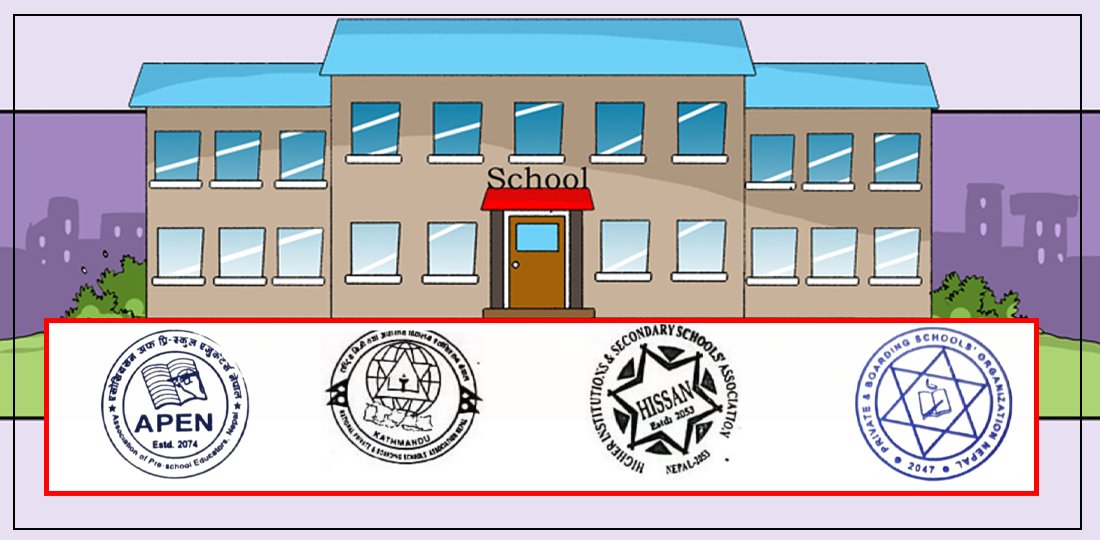
With a near two-thirds majority and a government led by Balen Shah, private school operators appear to be adopting a 'wait and see' policy. However, they do not seem honest about implementing government decisions. Instead, private school operators have issued a statement challenging the government's directives. After the government asked them not to charge fees for the month of Baisakh and admission fees, four umbrella organizations of private school operators issued a statement on Baisakh 4, stating that school fees for Baisakh must be paid. PABSON, N-PABSON, HISAN, and APEN issued a joint statement mentioning that school fees would be determined according to prevailing laws.
'Admission fees (equivalent to one month's tuition), monthly tuition fees (12 months), and annual fees (equivalent to double the monthly tuition) along with other fees prescribed by law will be applicable.' Additionally, separate fees must be paid for extra services like meals, transportation, and special training. While school operators make such claims, the government side remains speechless. Instead, preparations for classes in the capital's schools are increasing, and parents have not received any relief as per the government's directives. Some argue that the government's directives seem focused only on the capital, ignoring the thousands of schools outside, giving the impression that the government cannot think for the entire country. Furthermore, confusion has increased as local levels ignore government directives and make their own decisions.
Directive to Refund Illegal Fees
On Chaitra 25, the Ministry of Education, Science and Technology directed private schools to refund illegally collected fees. Fifteen days have passed since the Ministry issued this directive, but the Ministry itself has no official data on how much of it has been implemented. However, students and parents complain that the government's directive has not been implemented by schools and local levels.
'After the government's directive, schools should have informed us to come and collect the refund, but no such information has been received,' says a parent who enrolled their child in a popular school in Lalitpur. 'The government issued a directive. That's it; there is no mechanism for monitoring.'
Change in Academic Session Date
The Cabinet meeting held on Chaitra 22 changed the date of the academic session, which was previously scheduled to start from Baisakh 2. The government decided to start the next academic session from Baisakh 15 instead of Baisakh 1. However, some local levels have challenged this decision, stating that it cannot be implemented and they are not bound by it, having already started student admissions and classes as previously planned.
Eleven local levels in Gorkha held a meeting with the DDC chief on Baisakh 4 and have been operating schools since Baisakh 7. They also expressed serious concern regarding the circulars issued by the Ministry of Education of the Government of Nepal about school operations and admissions, stating that it contradicts the provision that an academic session must have 220 working days.
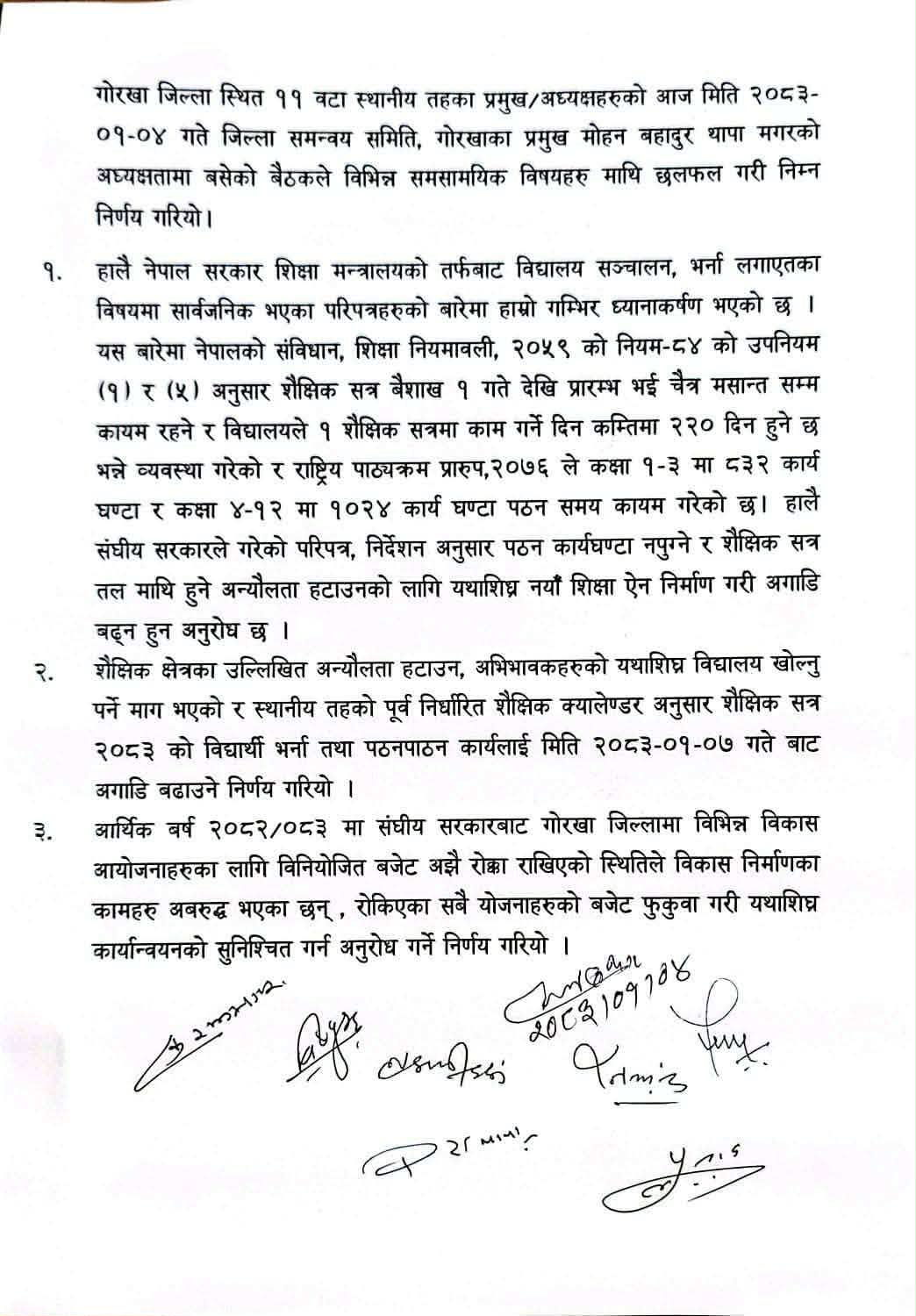
'Regarding this, according to the Constitution of Nepal, Rule 84, Sub-rules (1) and (5) of the Education Regulations, 2059, the academic session starts from Baisakh 1 and continues until the end of Chaitra, and the school must work for at least 220 days in one academic session. The National Curriculum Framework 2076 has set 832 working hours for grades 1-3 and 1024 working hours for grades 4-12,' the statement issued after the meeting said. 'To remove the confusion caused by the recent circular and directive of the federal government regarding insufficient working hours and the shifting of the academic session, we request the immediate drafting and advancement of a new Education Act.'
The heads of local levels in Gorkha stated that they decided to proceed with student admissions and classes for the 2083 academic session from Baisakh 7, in accordance with the pre-determined academic calendar of the local level, to remove confusion in the education sector and address the demands of parents to open schools as soon as possible.
What does the Ministry say about the implementation of the directive?
When we asked Shivkumar Sapkota, Joint Secretary and Spokesperson of the Ministry of Education, Science and Technology, about the situation where the government issues a flood of directives but they are not effectively implemented, he gave a one-sided view that everyone must follow the government's directives and decisions.

'The government's role is to call for, direct, facilitate, and coordinate the implementation of any decisions made,' said Spokesperson Sapkota. 'And the current government has done the same.'
Sapkota stated that if there are any legal difficulties in implementing decisions like changing the academic session date, the government will also work to clear the path.
'It is better for everyone to implement the government's decision. Rather than talking about taking action if the directive is not followed, there should be a collective feeling that a decision made by a national government is for the whole country and must be implemented,' Sapkota said. 'This is not just for any particular municipality or local level.'
He also mentioned that some decisions made by the Government of Nepal are equivalent to law. 'There might be differences where existing laws and acts conflict,' Sapkota said.
He said the same applies to the issue of fee refunds. Stating that the jurisdiction for school operations and fee determination lies with the local government, he said the Ministry has also requested the local municipalities. 'The authority to control and determine fees or operate schools is vested in the municipality. But when complaints are coming from the public, the government has to listen, and that is why it was brought to public notice,' Sapkota said. 'Therefore, the respective municipalities and schools should think about this.' He also said that the implementation of the Ministry's directives will be reviewed over time.
Did not come to take the refund: PABSON
RB Katuwal, General Secretary of the Private and Boarding Schools Organization Nepal (PABSON), says that the different decisions of the central government and local governments have naturally created confusion.
'There is confusion due to different decisions and directives,' says PABSON General Secretary Katuwal. 'It has become difficult to coordinate.' 'If a child in Kathmandu or Bhaktapur has already started going to school and studying, while one in Kathmandu has not, this is likely to affect the psychology of the students.'
He said that if the government had asked to start schools from the 15th without stopping the admission process, it could have been easier to implement, but they did not go for that option.
Regarding the directive to refund fees, Katuwal said it only applied to those who enrolled before the Supreme Court's stay order. However, he claimed that even after the government's directive, many parents did not come to collect the refund. 'Most did not take it back. Because they have to enroll by Baisakh 15 anyway. Their understanding is that they might not get a seat then,' Katuwal says. 'Many did not want to take it, some did not even come into contact. Some have taken it back.'
Former PABSON President DK Dhungana says that schools should be operated within the Education Act, Regulations, and Guidelines. 'If it is outside that, there should be monitoring and action,' Dhungana said. He mentioned that in some matters, a negative narrative is created, and no one should do anything that affects the psychology of the 2.5 to 2.6 million children studying in private schools.
Separate statement from the Association of Rural Municipalities and Municipalities
With the country moving into a federal structure, all three levels of government have their own acts, rules, and laws. Accordingly, local levels are granted the authority to operate schools. The Association of Rural Municipalities and the Municipal Association have stated that they have already informed the Education Minister and ministry officials that the central government's decision and circular to start the academic session from Baisakh 15 is causing confusion in implementation and affecting educational activities. They also complained that such a decision was made without any consultation with them.
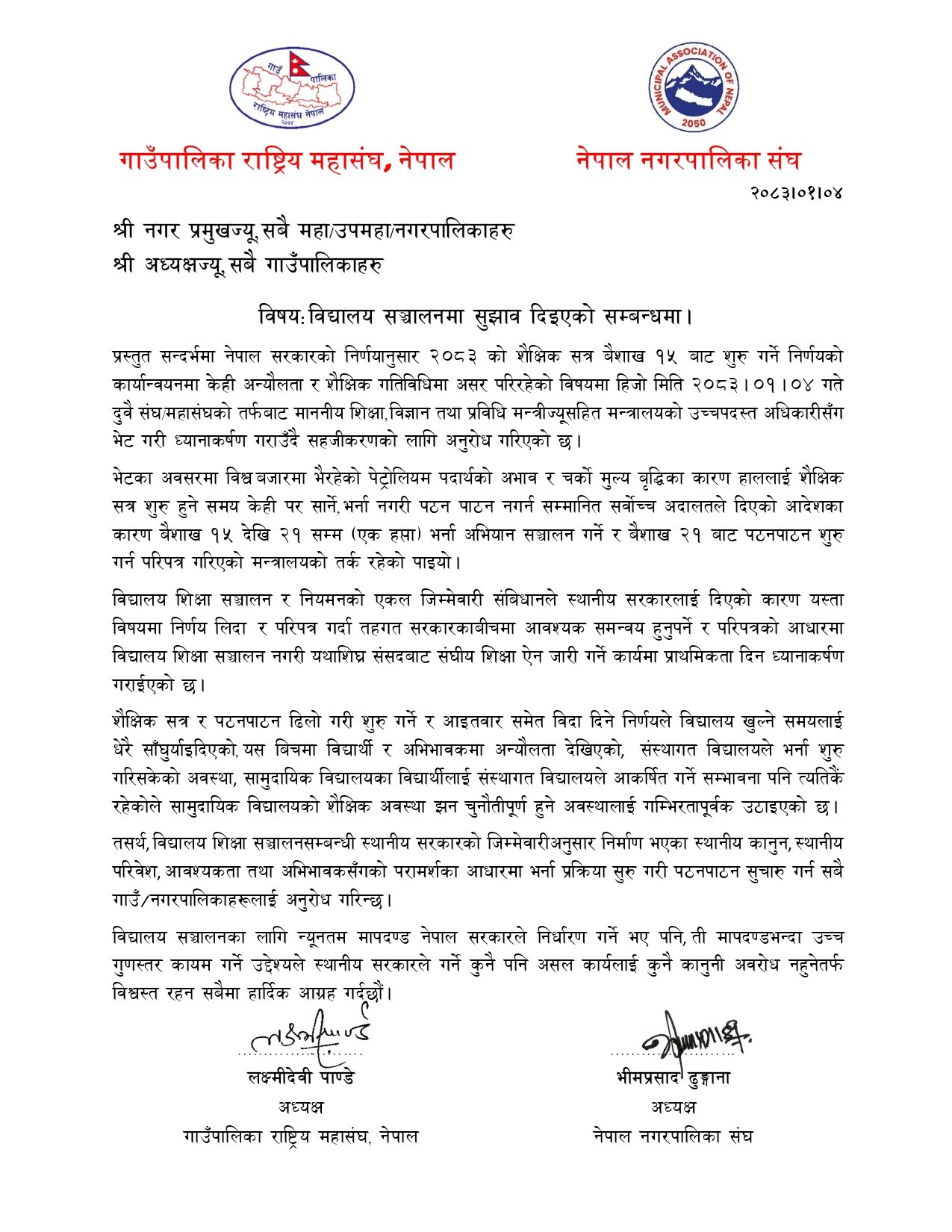
'Because the constitution has given the sole responsibility of operating and regulating school education to the local government, there should be necessary coordination between the levels of government when making decisions and issuing circulars on such matters, and we have drawn attention to prioritize the issuance of the Federal Education Act from the parliament as soon as possible instead of operating school education based on circulars,' both associations and federations said.
Both the Association of Rural Municipalities and the Municipal Association say that the decision to start the academic session and classes late and to give holidays on Sundays has narrowed the time for schools to open significantly.
'In the meantime, confusion has been seen among students and parents, private schools have already started admissions, and the possibility of private schools attracting students from community schools is equally high, so the situation where the educational status of community schools will become more challenging has been raised seriously,' the joint statement said. 'Therefore, all rural/municipalities are requested to start the admission process and resume classes based on local laws, local context, needs, and consultation with parents, in accordance with the local government's responsibility regarding the operation of school education.'
This specific news has been automatically translated by AI. As a result, there may be some inaccuracies or language errors.
_BSX4jxIBxx.jpg)
_CuZWldRsJU.jpg)