Home Minister Gurung's Decision to Forgo 'Pirke' Salutes Sparks Debate


Kathmandu. Home Minister Sudan Gurung has announced that he will no longer accept the 'Pirke' salute (a ceremonial salute given while standing on a raised platform) from security forces during his visits to Nawalparasi (Bardaghat Susta East). According to his secretariat, the announcement was made on Sunday during his visit to the Armed Police Force battalion in Gaindakot.
In the past, the practice of taking and giving 'Pirke' salutes has been a source of controversy and stunts. Around 2076 BS, incidents of officials receiving salutes while standing on platforms covered in red cloth frequently went viral on social media. One such incident involved Ambar Bahadur Gurung, a provincial assembly member from Okhaldhunga, who faced criticism after students gave him a salute while he stood on a platform during a school event.
Similarly, in Ashar 2076 BS, Maoist Center politburo member Mohan Kumar Khadka also faced backlash for receiving a 'Pirke' salute from students during a school sports event.
Even Ram Kumari Jhakri, a CPN-UML leader who had previously criticized the practice on social media, faced controversy when she received a 'Pirke' salute from police while serving as the Minister for Urban Development during a visit to her home district of Gulmi in Poush 2078 BS. Following the criticism, Jhakri offered an explanation.
The tendency to stand on platforms to receive salutes, effectively positioning oneself above the citizens, has existed for a long time. Following local, provincial, and federal elections, social media was often flooded with images of such salutes. Due to intense public criticism, this trend has been declining recently.
Now, with Home Minister Gurung's announcement, the debate has been reignited. Former DIG Hemant Malla noted that while the tradition of giving salutes to VIPs from a slightly elevated position exists in military organizations, it is a tradition that should be handled with care. He stated, 'The culture is to salute the flag, not the individual; that is what should be upheld.'
_nfCSq2VJaZ.jpg)
However, Malla emphasizes that salutes should not be given or taken indiscriminately. 'It should not be taken randomly; there are specific places for receiving salutes,' he said.
He explained that the tradition involves security personnel wearing official uniforms and the recipient wearing formal attire. Regarding the origin of the practice, he added, 'This is a military tradition that began even before the Panchayat era.'
Controversy has grown as some security officers, in an attempt to please those in power, began offering salutes at hotels and on roadsides. Former DIG Malla remarked, 'The culture is to provide salutes to VIPs at offices, not on the road.'
The practice became so distorted that the former mayor of Mahalaxmi Municipality in Dhankuta, Parshu Nepal, even stood on a table to receive a salute.
The protocols for providing salutes to VIPs are outlined in the operational guidelines of the Nepal Police and the Armed Police Force. Former IGP Sarbendra Khanal described Home Minister Gurung's decision to stop the 'Pirke' salute as 'appropriate.'
Khanal stated, 'There is a culture of receiving them during formal ceremonies and inspection programs.' He noted that during informal visits, police posts often lack the manpower to provide such salutes.
'A salute requires a team of 1-8, consisting of one commander and eight personnel,' said former IGP Khanal. 'In my experience, it is difficult to manage when there is a shortage of personnel in places where salutes are expected.'
Mandatory 'Guard of Honour'
While the 'Pirke' salute is not mandatory, security officers note that the 'Guard of Honour' provided during formal ceremonies is essential. It is customary for the army to provide a 'Guard of Honour' when foreign heads of state or military chiefs visit.
Similarly, when Nepali VIPs go on official visits abroad, they are also provided with a 'Guard of Honour.'
There is a culture of providing formal salutes when Home Ministers and Home Secretaries visit the headquarters of security organizations, which former DIG Malla considers mandatory.
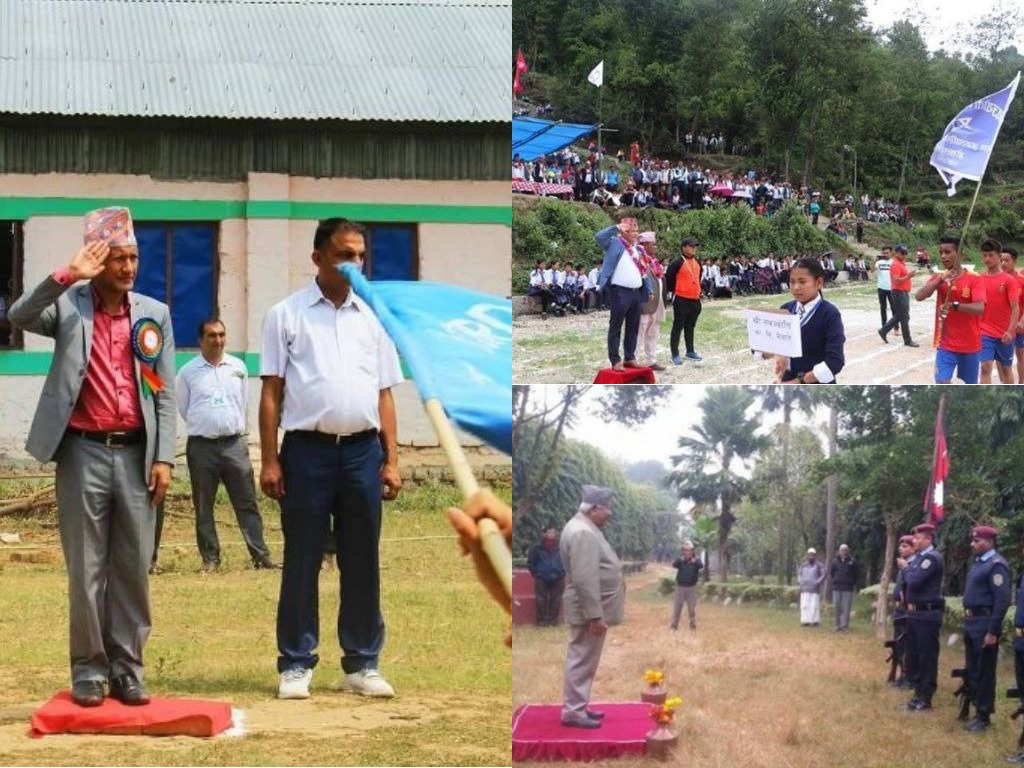
During the Panchayat era, Zonal Commissioners used to receive 'Pirke' salutes. Recently, elected local representatives have been criticized for showing an obsession with this practice. Some local heads received salutes while standing on platforms, chairs, or even tables during local events. While the practice continued for some time due to a mindset that viewed representatives as hereditary rulers, it has decreased following increased criticism.
However, security officers analyze that receiving salutes from security forces at their offices is a standard military culture. Former Prime Minister Baburam Bhattarai also faced criticism for receiving a 'Pirke' salute at a sports event.

This specific news has been automatically translated by AI. As a result, there may be some inaccuracies or language errors.

_KGLQG1Q14l.jpg)