Legendary Singer Asha Bhosle Passes Away

Kathmandu. How do you remember the legendary singer Asha Bhosle? Is it through the melodious song 'Chura Liya Hai Tumne' from the 1973 film 'Yaadon Ki Baaraat', or perhaps the fast-paced 'Dum Maro Dum'? Or maybe through Nepali songs like 'Gairi Khetko Shirai Hanyo' from the film 'Prem Pinda' or the signature Tihar Laxmi Puja song 'Diyo Bali Sanjhko'? We remember Asha through every genre of music. From Sunday, she will only exist in such memories, as this trinity of melody, sweetness, and exceptional vocal artistry is no longer with us in person.
Asha lived a life longer than the average person. Even at the age of 92, she remained active in music, showing no signs of fatigue in her voice or spirit. She found her musical rhythm under the shadow of her elder sister, Lata Mangeshkar. Her sister Usha Mangeshkar is also a famous singer. Her entire family was immersed in music.
Asha began her musical journey by singing Marathi songs. After stepping into Bollywood playback singing with the song 'Sawan Aaya' from the film 'Chunariya' in 1948, she never looked back. Songs like 'Chura Liya Hai Tumne Jo Dil Ko', 'Dil Cheez Kya Hai', 'Dum Maro Dum', 'Ae Mera Dil', 'Jawani Janeman', 'Rangeela Re', and 'Tanha Tanha' became immensely popular. She could sing every style; whether it was melodic, pop, or fast-paced, her voice fit perfectly.

Her magical voice, sweet tone, and excellent singing style captivated everyone. When one is perfect in every aspect, one reaches the highest peak of success, the number one spot. But in Asha's case, the number one spot remained 'impossible'. The reason was that her elder sister, Lata Mangeshkar, had already occupied that position. Therefore, it is the understanding of Indian musicians that she had to be content with being 'number two' in her musical career.
Asha was connected to music from childhood. Her father, Deenanath Mangeshkar, was a master of classical music and held a respected position in Marathi theater. Deenanath had five children: Lata, Meena, Asha, Usha, and Hridaynath. Coming from a musical family, the influence was natural. Eldest daughter Lata began showing an interest in music from a young age, and following in her sister's footsteps, Asha also moved forward. However, when Asha was nine, her family faced a deep financial crisis. After that, the Mangeshkar family left their village in Maharashtra and moved to Mumbai. At the age of 14, Lata took on the responsibility of the entire family and struggled in the film world. In all this, Asha supported her sister Lata. After that, both sisters began their Bollywood journey and managed to reach great heights. Lata passed away on February 6, 2022. Six years later, her sister Asha has also left the world.
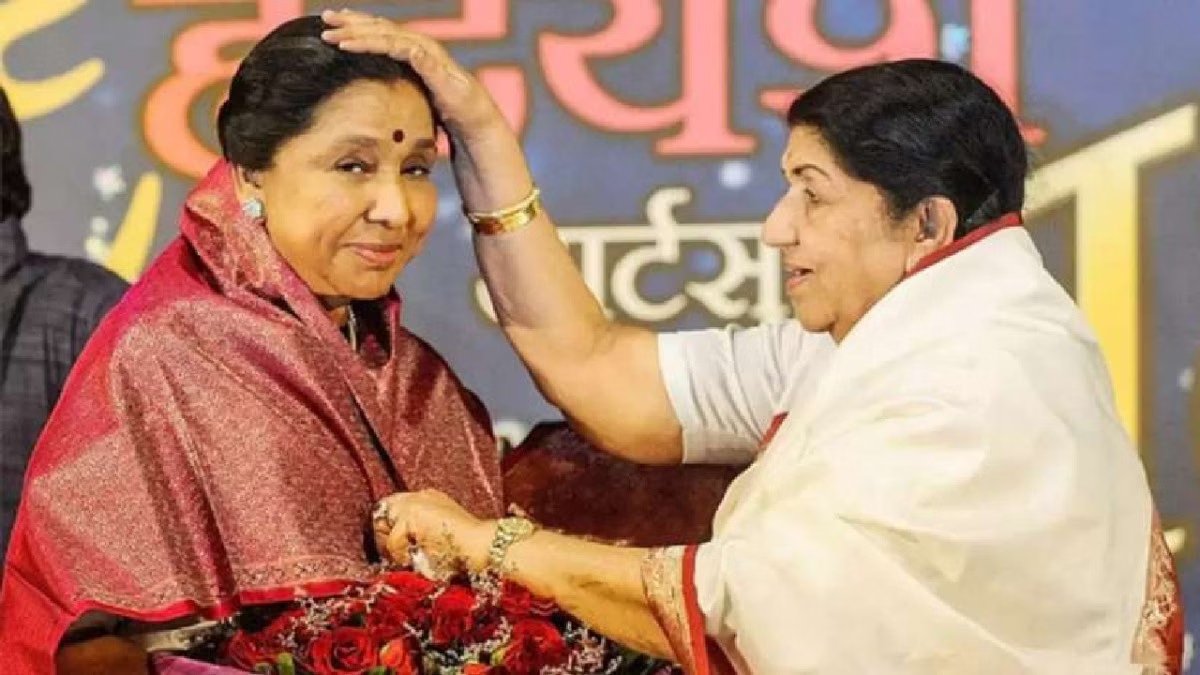
Asha has sung over 12,000 songs in 20 languages, including Hindi, Marathi, Bengali, Punjabi, Bhojpuri, and Nepali. Just like in India, Nepali music lovers also hold her in high regard and will continue to do so.
For generations before Gen Y, it can be said that Asha's songs were companions in their upbringing. Who among us hasn't heard them? Songs like 'Mohani Lagla Hai', 'Maya Ta Maya Ho', and 'Pahadko Mathi Mathi' sung with Narayan Gopal. Her pairing with Narayan Gopal in singing was particularly special. Asha used to call the Nepali Swar Samrat her 'favorite singer'.
We have heard the song 'Gairi Khetko Shirai Hanyo' many times. This is a song sung by Asha Bhosle herself. Included in the film 'Prem Pinda', released around 2046 BS, the music for this song was composed by Shambhujeet Baskota. He had gone to Mumbai and had Asha sing this song. Before that, composer Baskota had collaborated with Asha on the song 'Timro Aankhako Sagar Ma' for the film 'Chelibeti'.
'I collaborated with her on four songs, two solos and two duets. The collaboration with her was very cordial,' Baskota told Ratopati, 'Nepal will always remember the contribution she made to Nepali music.' Baskota collaborated with Asha on the song 'Chhunchhan Timilai Chanchal Hawa' from the film 'Karodpati', released in 2054 BS.
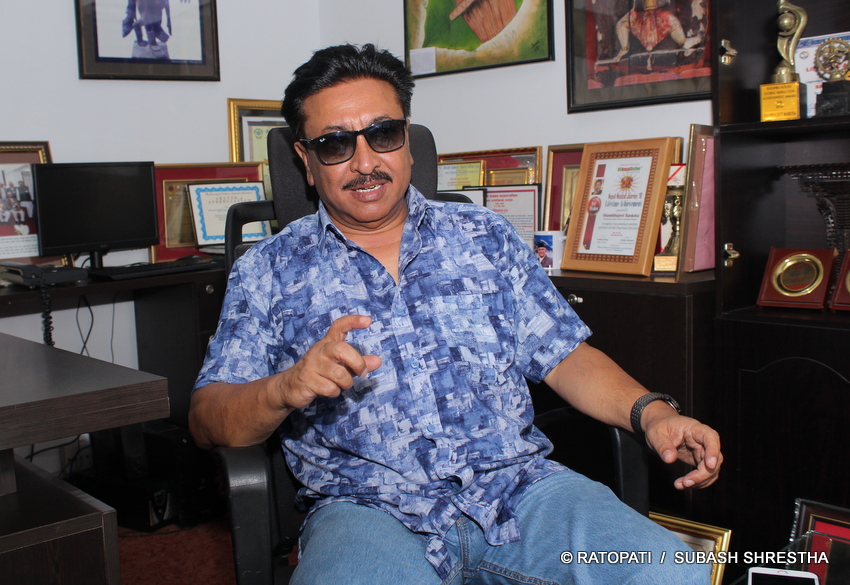
Baskota recalled the moment he reached Bhosle's residence 'Prabhu Kunj' in Mumbai around 2045 BS to play the song. 'I played the song from the film 'Chelibeti' for her while having tea in the morning. She liked my composition very much and said let's record it in a big studio in Mumbai,' he shared.
Recalling the effort Asha used to put into understanding and pronouncing the language, Baskota says, 'Since some Nepali words were similar to Bengali and Marathi, it was easy to understand. She used to ask about the words she didn't understand. I would explain the feeling, story, and emotion of the song to her in English or Hindi. She had to work a little on the pronunciation, but she would sing with great effort.'
Baskota says that his relationship with Asha Bhosle was not just musical but also familial and intimate. 'Although I haven't met her in person recently, we had spoken on the telephone,' he shared, 'When I spoke to her on the phone once, she said she wouldn't be going out much anymore. While we kept saying let's meet, now it will never be possible to meet again.'
Composer Baskota considers Asha Bhosle to be the abode of Saraswati in her voice. 'She is a form of Saraswati. She was a very versatile singer, she could sing any kind of songs,' he says, 'She had the ability to sing any color of song, whether it was classical, modern, pop, or folk. She had an amazing ability to sing with true feeling.'
The songs Baskota collaborated on with Asha all set a standard and became timeless. Even today, these songs are listened to just as much.
Songs, creators, and artists will keep being born, but another Asha will never be born.
This specific news has been automatically translated by AI. As a result, there may be some inaccuracies or language errors.